Medical wait times cost Canadian patients almost $5.2 billion in lost wages last year
The Private Cost of Public Queues for Medically Necessary Care, 2025

Fraser Institute , Bio and Archives--May 5, 2025
Canadian News, Opinion | Comments | Reader Friendly | Subscribe | Email Us
VANCOUVER— Long waits for surgery and medical treatment cost Canadians almost $5.2 billion in lost wages and productivity last year, finds a new study released by the Fraser Institute, an independent, non-partisan Canadian public policy think-tank.
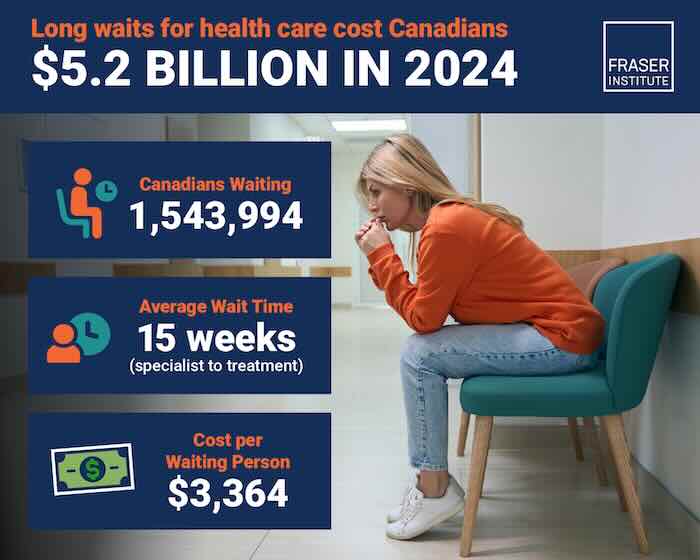
An estimated 1.5 million patients waited for medically necessary treatment last year, and each lost an estimated $3,364 (on average) due to lost wages and reduced productivity during working hours.
“Waiting for medically necessary treatment remains a hallmark of the Canadian health-care system, and in addition to increased pain and suffering—and potentially worse medical outcomes—these long waits also cost Canadians time at work and with family and friends,” said Nadeem Esmail, a senior fellow with the Fraser Institute.
The study, The Private Cost of Public Queues for Medically Necessary Care, 2025, draws upon data from the Fraser Institute’s annual Waiting Your Turn survey of Canadian physicians who, in 2024, reported the national median waiting time from specialist appointment to treatment was 15 weeks.
Crucially, the $5.2 billion in lost wages is likely a conservative estimate because it doesn’t account for the additional 15 week wait to see a specialist after receiving a referral from a general practitioner.
Taken together, the total median wait time in Canada for medical treatment was 30 weeks in 2024.
“As long as lengthy wait times define Canada’s health-care system, patients will continue to pay a price in lost wages and reduced quality of life,” said Esmail.
Because wait times and incomes vary by province, so does the cost of waiting for health care. Residents of Prince Edward Island in 2024 faced the highest per-patient cost of waiting ($6,592), followed by New Brunswick ($6,210) and Quebec ($4,261).
Average value of time lost during the work week in 2024 for patients waiting for medically necessary treatment
| Province | Average value of time lost | |
|---|---|---|
| British Columbia | $3,101 | |
| Alberta | $3,732 | |
| Saskatchewan | $3,398 | |
| Manitoba | $2,784 | |
| Ontario | $2,511 | |
| Quebec | $4,261 | |
| New Brunswick | $6,210 | |
| Nova Scotia | $2,387 | |
| Prince Edward Island | $6,592 | |
| Newfoundland and Labrador | $3,674 |
Media Contact:
Nadeem Esmail, Senior Fellow, Fraser Institute
To arrange media interviews or for more information, please contact:
Drue MacPherson, Fraser Institute
604-688-0221 ext. 721
drue.macpherson@fraserinstitute.org
View Comments
The Fraser Institute is an independent Canadian public policy research and educational organization with offices in Vancouver, Calgary, Toronto, and Montreal and ties to a global network of 86 think-tanks. Its mission is to measure, study, and communicate the impact of competitive markets and government intervention on the welfare of individuals. To protect the Institute’s independence, it does not accept grants from governments or contracts for research. Visit fraserinstitute.org.
Follow the Fraser Institute on Twitter | Like us on Facebook