Olfactory Memories
Survival in Tough Times: I breathe deeply, and then I’m with my brothers and our grandfather, back in the north side of the corn crib at the farm on the corner of 103 and Riley Road, New Castle, Indiana, summer of 1961
Dr. Bruce Smith , Bio and Archives--July 5, 2024
HeartlandLifestyles | Comments | Reader Friendly | Subscribe | Email Us
We all have olfactory memories. My dad recalled the smells of hardwood and varnish at the Jesse French piano factory in his hometown of New Castle, Indiana in the 1930s. There was the comforting scent of refrigerator yeast rolls in the oven and black raspberry jelly cooking at my grandmother’s house at the farm. Who hasn’t inhaled above the top of a frosty mug of draft root beer just before taking the first sip? There is the warm smell of new life among the curls of a newborn lamb’s head.
For farm folk, there are many scents
Some of these memories stand out, brought to mind just now and then when we re-experience a familiar scent. It comes flowing back as it puts me right there on the very day, years and years ago.
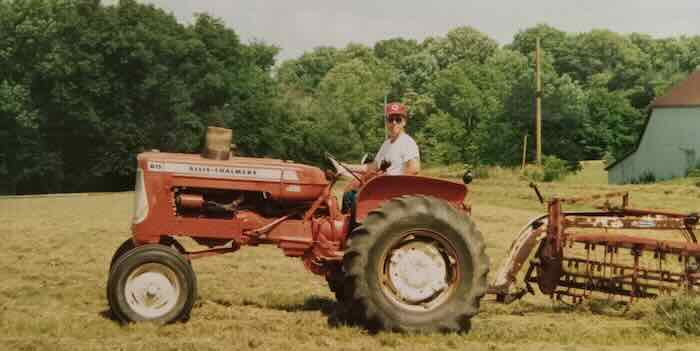
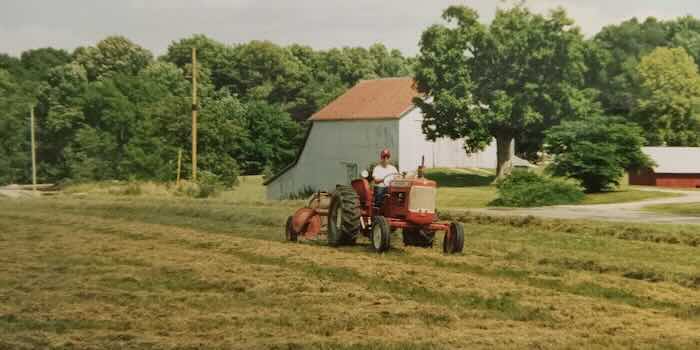
For farm folk, there are many scents, but there is something of the divine about hay in the field on the second day, and later in the haymow. It’s a rich scent, what some would call complex. Because we associate hay with warm summer days, it always seems a warm smell, comforting at near body temperature when we sail into it.
It is mellow, spicy, floral, soothing, inducing sighs of contentment. When the fragrance hits me, I do what every farmer does, looking up to consider the weather, guessing whether the time needed to cure will end and the baling will be finished before a thundershower arrives. If the hay is raked already, it will likely be baled that same afternoon, or no later than next midday. Prayers ascend imploring a bit more sun so the hay may go under shelter just in time.
Hay in the barn is like cured firewood in the woodshed
Hay is animal feed, so the scent speaks of nutrition, especially when there is some alfalfa or sweet clover in it. Hay made in May or June is higher in protein. Cattle love it on a snowy day when the outside world is overcast and the ground white and pale blue and you can see their breath in the air. In the blizzard of 1961 my brother climbed up into the haymow to throw down bales of alfalfa hay for the sleek black cattle in the south side of the barn. I can close my eyes and see them there now. They turn and pull mouthfuls out of the manger and almost close their eyes they enjoy it so much. They must think to themselves, Now this is how a wintry day is supposed to be in a snug barn when a farmer knows how to make good hay. They’ll still be enjoying it later when they lie down and peacefully chew their cuds. Goats and sheep nod approval when they rush to the hay rack, looking at me with mouths full, then turning their heads sideways to lick the fines out of the tray below. Rabbits stand silently in front of their feeders, pulling one stem at a time, as if eating spaghetti.
Hay in the barn is like cured firewood in the woodshed. It demands a pause to enjoy and appreciate its potential. It’s overwhelming, it surrounds me, I can almost feel it in the air and in my nose as I climb up to throw down bales, cut the strings and hang them on a nail, then drop the flakes through the hole in the floor to the livestock below. The scent of dairy animals rises through the opening in the floor above them. That good smell combines with fragrant hay for a mix most intoxicating.
Even today it comes back to me. Not far from me there is a farm family with a hay and straw concession. They have a self-serve trailer parked beside the lane with one side stacked with hay and the other with straw. A coffee can hangs near the top of the door for payment. When it threatens rain, the trailer door will be closed and latched. That means that when I open the door, the concentrated scent of both hay and straw has been held in wait just for me. When I open the door, I step in immediately and pause, eyes half closed, to breathe deeply. I’m instantly back on the farm in Henry County in those days of the 1950s, when the old ways were still the norm, and a big tractor might boast 60 horsepower.
Another olfactory memory happened just once for me that I can recall, but its glow has lasted a lifetime. I think we had moved away from the house adjacent to my grandparents’ farm in Henry County a year or two before, but all three of us brothers were still at home. Jim would have been around 17 and Stewart perhaps 13. I would have been about 8. My grandfather was a real farmer with livestock, practicing a crop rotation with corn, wheat, soybeans, oats, and hay. We were back in New Castle late in the summer for a visit, probably about the end of July. Our grandfather said he had something to show us. My memory begins at the corncrib south of the farmhouse, in the barnyard next to the barn. Maybe we went down to the field to see them auger the oats into the Studebaker truck, but I’m not sure about that. I remember the truck or a wagon backed up to the north door of the corncrib because that side was empty. The south side still had ear corn in it. In the center section were feed barrels and the faded carmine corn sheller with its cast iron flywheel. There was always an aluminum grain scoop with a blue handle nearby, and it held quite a bit. There may have been a smaller scoop, too.
Oats are old school. They were traditionally raised in cooler climates like Scotland, Canada, and the northern Midwest primarily for horses, but also for cattle. They also feed people. My grandfather raised them because they helped with weed control and because he would use them as feed for his livestock. They are spring-sown, ripening in summer not long after the wheat has been cut. They are more golden, a little more yellowish than wheat. The grain hangs from individual threads in a loose cluster atop the stems that become oat straw. That day the oats came straight from the field, so they were dry enough to store, but with many grasshoppers, spittle bugs, and tiny bits of straw mixed into every scoop. But oh, the aroma; there’s nothing quite like it. Corn and wheat are quite different, not as rich or sweet smelling.
We raised scoopfuls and threw them into the bin, putting some fine dust that carried the scent into the air. In the bin we had to scoop it to the back with the labor of our backs. Our grandfather showed us how, then asked if we wanted to try it. The oats were dry and slippery, so a full scoop would begin to empty itself as we raised it from the pile. We tossed it hurriedly, and learned that the higher we raised it the more work it took and the less result we had. When placed at the top of the pile it would begin to spill back toward us. Our jeans had turned up cuffs which immediately filled, oats got into our shoes and clung to our socks, grasshoppers would kick themselves into the air and land on a shoulder or an arm, or on a face. With each step we sank to our shins. The grain shooshed with every scoopful.
We farm boys didn’t notice sweating in our noble labor, but the entire time we were surrounded with and our noses were filled with a scent I shall never forget. Our grandfather looked on approvingly, offering this slice of farm life to us, but not requiring that we do it. He had saved this farm work for us so we would have the experience, not knowing whether it would remain in our minds or not. But it stuck in mine, and all these years I have been the richer for it.
Once in a while I will get a bag of cleaned oats to sow for winter cover in the garden. I open the bag and stick my face in to just above the golden oats below, there are no grasshoppers trying to dig out, but I breathe deeply, and then I’m with my brothers and our grandfather, back in the north side of the corn crib at the farm on the corner of 103 and Riley Road, New Castle, Indiana, summer of 1961. Grandma is in the kitchen in the farmhouse, and soon we will all be with her at the happiest place of my childhood when everything was still right with the world. Even now I am there right now in those golden days.
Recall your olfactory memories with me, if you would. I’d be grateful if you’d share yours with others in the comment section below.
View Comments
Dr. Bruce Smith (Inkwell, Hearth and Plow) is a retired professor of history and a lifelong observer of politics and world events. He holds degrees from Indiana University and the University of Notre Dame. In addition to writing, he works as a caretaker and handyman. His non-fiction book The War Comes to Plum Street, about daily life in the 1930s and during World War II, may be ordered from Indiana University Press.