Ontario building fewer homes today than in 1970s, despite nearly 4 times higher annual population growth
The Crisis in Housing Affordability: Population Growth and Housing Starts 1972–2024

Fraser Institute , Bio and Archives--April 15, 2025
Canadian News, Opinion | Comments | Reader Friendly | Subscribe | Email Us
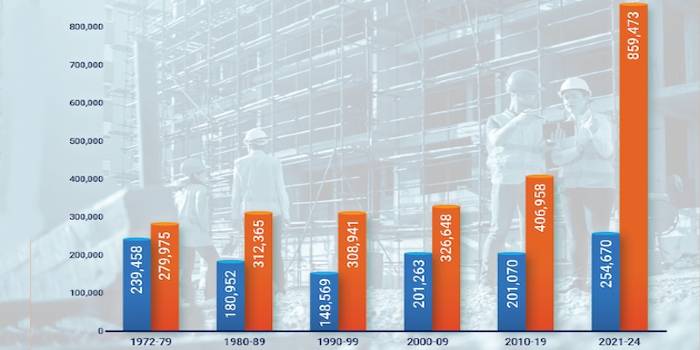
TORONTO—The annual number of new homes being built in Ontario is fewer now than it was in the 1970s, despite annual population growth in the province being nearly four times higher, finds a new study published today by the Fraser Institute, an independent, non-partisan Canadian public policy think tank.
"Despite unprecedented levels of immigration-driven population growth following the COVID-19 pandemic, Ontario has failed to ramp up homebuilding to meet housing demand," said Steven Globerman, co-author of The Crisis in Housing Affordability: Population Growth and Housing Starts 1972–2024.
Between 2022 and 2024, Canada’s population grew by an average of 1,006,142 people per year, while only 249,161 new housing units were started annually. Compare that to the 1970s when from 1972-1976, the population grew by 298,864 a year, and housing starts similarly averaged 249,045 per year.
In Ontario, from 1972-1976, housing starts averaged 92,724 a year while population growth in the province averaged 111,305 a year. From 2022 to 2024, housing starts averaged 86,650—less than in the 1970s—but the province’s population grew by 411,163 people a year, on average.
“The evidence is clear—population growth has been outpacing housing construction for decades, with predictable results,” Globerman said.
“Unless there is a substantial acceleration in homebuilding, a slowdown in population growth, or both, Ontario’s housing affordability crisis is unlikely to improve.”
Media Contact:
Steven Globerman, Senior Fellow, Fraser Institute
To arrange media interviews or for more information, please contact:
Emily Rigden, Fraser Institute
604-688-0221 ext. 620
emily.rigden@fraserinstitute.org
View Comments
The Fraser Institute is an independent Canadian public policy research and educational organization with offices in Vancouver, Calgary, Toronto, and Montreal and ties to a global network of 86 think-tanks. Its mission is to measure, study, and communicate the impact of competitive markets and government intervention on the welfare of individuals. To protect the Institute’s independence, it does not accept grants from governments or contracts for research. Visit fraserinstitute.org.
Follow the Fraser Institute on Twitter | Like us on Facebook