

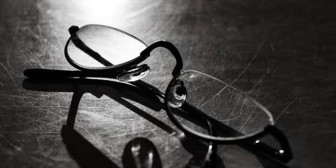
One of the natural penalties of age is presbyopia. The eye’s lens gradually stiffens, making it harder to focus things up close. Print grows blurry, restaurant menus become a test of the lighting, and holding books at arm’s length no longer works.
There is no prize for buying the most expensive pair. The purpose of glasses is to help us see clearly, not to impress the person sitting across the table;

One of the natural penalties of age is presbyopia. The eye’s lens gradually stiffens, making it harder to focus things up close. Print grows blurry, restaurant menus become a test of the lighting, and holding books at arm’s length no longer works.
In medieval Europe, monks used magnifying lenses to enlarge the written word. The invention of spectacles in Italy in the late 13th century was a significant advance. For the first time, people could wear lenses that helped compensate for declining eyesight.
Today, we have an astonishing choice of eyewear, from inexpensive readers at the pharmacy to custom-made prescription glasses costing hundreds of dollars. But is the more expensive option necessarily better? Not always.
Reading glasses magnify nearby objects. Provided the correction is appropriate, a pair costing a few dollars can accomplish the same thing as more expensive prescription glasses.
There is research to support this. A 2013 study published in Optometry and Vision Science examined the usefulness of inexpensive, ready-made reading glasses in an eye clinic in Nicaragua. Researchers found that 95.4 per cent of those examined could be helped with ready-made glasses. Only 4.6 per cent required custom-made prescriptions, largely because of differences between their eyes or other vision problems.
Among those given ready-made readers, the proportion achieving functionally good near vision rose from 38 to 97 per cent.
A Cochrane review, which examined evidence on vision correction, similarly concluded that ready-made and custom-made spectacles appeared to produce comparable visual results and rates of continued use.
But there’s a catch. Pharmacy readers are manufactured with identical magnification in both lenses. Both eyes get the same correction. They also cannot correct astigmatism, a common condition in which the shape of the eye causes light to focus unevenly.
If one eye needs a stronger lens than the other, or if there are other refractive problems, prescription glasses are the sensible choice.
They can also be designed for particular working distances, something especially useful for people spending long hours at a computer.
But don’t assume that every inexpensive pair is well made. A British study found that 48 per cent of ready-made reading glasses failed to meet international optical quality standards. Other studies have also identified imperfections in inexpensive glasses.
One other misconception deserves attention. Wearing reading glasses does not make your eyesight deteriorate faster. Neither does choosing a weaker pair in the hope of exercising your eyes. The natural ageing process continues regardless of how much magnification you use.
Benjamin Franklin understood the practical importance of getting the right lenses. In 1785, frustrated with having to alternate between glasses for reading and distance vision, he described his solution in a letter to a friend. He had his lenses cut and combined so that he could see both near and far without changing spectacles. Franklin explained that he needed only to move his eyes up or down, “as I want to see distinctly far or near, the proper glasses being always ready.”
He called them “double spectacles.” We now call them bifocals. It was an ingenious solution to an everyday problem. Not a bad philosophy for health care, either: find what works, and don’t pay for what you don’t need.
Regular eye examinations remain important. Glaucoma, cataracts and macular degeneration can develop without obvious early symptoms.
The sensible approach is to have your eyes examined, establish whether you have any underlying problems, and then decide what sort of glasses you actually need.
There is no prize for buying the most expensive pair. The purpose of glasses is to help us see clearly, not to impress the person sitting across the table.
Read next: How Anxiety Became a Prescription
Email Us | Reader Friendly | Comments