Seasonal Lag
If we are lucky enough to survive the winter, we can look forward to the majesty of the cycle of the seasons on our ever-changing home planet.
Dr. Bruce Smith , Bio and Archives--September 17, 2024
HeartlandLifestyles | Comments | Reader Friendly | Subscribe | Email Us
There are basically two kinds of people, those who prefer hot weather and those who like it colder. I’ve always been a cold weather guy. Of course, this came about in the distant past from the association of snowstorms and days off school. Where I grew up there was never enough snow and always too much sixth grade.
These days I still love the cold weather. To extend the time I can enjoy it I begin to anticipate it some time in August, although the change sometimes waits until September.
To overcome boredom many years ago, perhaps in the overabundant sixth grade days, I began to spend considerable parts of my school time thinking about non-school subjects. By sixth grade I already had quite a collection of the Golden Press nature and science guides. They were my encyclopedias of self-learning. These I would thumb through over and over again in idle moments at home and even at school. Among my favorites were Birds, Butterflies and Moths, and Insects. At the top of my all-time favorites list it was a tie between Trees and Weather. It was from Weather that this week’s understanding derives. In the 1965 edition was a half-page explanation of seasonal lag. That concept is the basis for my anticipation of winter weather and the source of much enjoyment every year as each season turns to the next.
Here’s the idea. The hottest days of the year are not when the sun’s rays are highest overhead. The hottest days come after the heat has accumulated for a while where we are. Authors Lehr and Burnett said it most clearly:
- During the year the earth, as a whole, loses precisely the same amount of heat it receives from the sun. But as the sun moves north in spring, our part of the earth gains heat faster than heat is lost. On June 22 it is receiving maximum solar radiation. The heat gain continues to exceed heat loss until maximum warmth is reached, usually in late July. Heat gain continues to exceed loss, at a diminishing rate, until about August 31. Then our part of the earth starts to lose heat faster than it receives it, and begins to cool down. The process is like starting a fire in a stove the roaring fire heats the room slowly, but the room will stay warm for a while after the fire has died down. The same heat lag accounts for the fact that the warmest time of day is usually about 3 p.m., not noon, when the sun’s rays are most intense.
This passage began my understanding of why weather phenomena occur as they do. Weather is often arbitrary, but within ranges it’s rather predictable, too.
I used to think that the earth wobbled on its axis, accounting for the seasons by this variation through the year. This isn’t true, however, and we have the pole star to prove it. Once I understood this idea, it was necessary to understand the varying angles of the sun’s rays in another way. The answer I found came from the earth’s orbit around the sun. The axis remains fixed, but our annual tour around the sun results in our orientation changing. In winter our axis is tilted away from the sun so that the Northern Hemisphere is relatively cool. In summer, as it happens, the Northern Hemisphere is tilted toward the sun so that heat gain exceeds heat loss at a faster rate than in winter.
On the annual Summer solstice, June 21, the sun is directly overhead at the Tropic of Cancer which is 23 1/2 degrees north of the Equator. If it helps, this line runs through Cuba and central India.
On the annual Winter solstice, December 21, the sun is directly overhead at the Tropic of Capricorn which is 23 ½ degrees south of the Equator. This line runs through southern Brazil and central Australia.
These dates became the basis for understanding seasonal lag and my growing optimism about cooler weather by the time August came around again.
Going back to school in the fall as a kid there were blazing hot days in our classrooms with no air conditioning. The school bus would be stiflingly hot when we boarded in the afternoon, leaving us to seek cooler seats on the shady side away from the sun. Brown leatherette seat covers reminded the girls who wore dresses to beware of burns or sit forward until the seats cooled down just a bit. We would squint through the open windows dropped down halfway and dread that stretch on a dusty gravel road, but at least there was some air when we were moving.
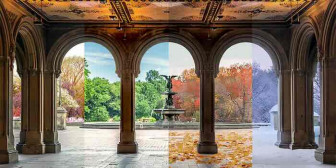
Sleepy hot late summer days soon gave way to fall days late in September and then the leaves would begin to turn bright gold and scarlet. Jacket weather began and then glorious autumn weekdays would have to be wasted in school. I gazed outside at the sugar maples in the schoolyard showing their finery. There were leaf collections some years, and a profusion of butterflies on hot flowers and on drops under apple trees. These provided some interest. What would fall be without mourning cloaks, fritillaries, commas, and my favorite butterflies the question marks? I learned to step carefully to avoid the yellow jackets who also like to draw juice from the bruised apples. There were acorns and buckeyes and hedge apples to roll. We hoped it would never rain on Saturdays or Sundays in October.
The summer heat comes every year. I watch it climb to higher and higher daily high temperatures in May, June, and July. There are stretches like we had this summer when the temperature goes to highs in the 90s for several days on end. Some years it will even rise to or above 100 degrees on miserable days here in the Heartland. That’s when I’m very happy to live in a humid area rather than a desert.
Rather than just leaning into the heat day after day as I do in July, there comes a hot stretch when begin to wonder if it might be the last one in the 90s. This year there was a real blisterer that lasted more than a week in August. That one chased the old cat off the sunny front porch and under the bushes in the shade. Surely, I thought, that will be the last of it. A wonderful cold front came down from Canada to give us cool nights again and sunny days that were not so oppressive. It became possible to work outside for more than an hour or two at a time.
But it wasn’t the last one. At the end of the month and across Labor Day we had another blast of 90s heat, but my optimism survived. It only lasted two days before an almost icy cold front passed through, bringing nighttime temperatures in the upper 40s. Now there was a welcome change! For the first time in the previous couple of months high temperatures rose only into the 70s and very low 80s. I could pause in the garden and enjoy my work, then continue down a row. Maybe we would all live to see fall again!
Here in the Heartland on September 15 as I write this it is warm again, but not as warm as it has been. Days in the middle 80s or even as high as 87 will last a few days, but it isn’t likely we’ll have any more 90s for seven months. I’m ready for my brilliant fall and somber winter. As we move through the calendar year summer will spill over into fall and fall will delay the onset of real winter. A month after the solstice, in January, we will shiver in the deep cold and grow weary of feeding the fire or paying the heat bill. Spring will approach like a lion and move toward summer like a lamb. Then we will wait for the seasonal lag to bring us the brutal heat of late summer again.
If we are lucky enough to survive the winter, we can look forward to the majesty of the cycle of the seasons on our ever-changing home planet. Imagine the forces that set it all in motion and ponder the meaning of our conscious time here. That time is our undeserved gift. Let us all make the most of it.
View Comments
Dr. Bruce Smith (Inkwell, Hearth and Plow) is a retired professor of history and a lifelong observer of politics and world events. He holds degrees from Indiana University and the University of Notre Dame. In addition to writing, he works as a caretaker and handyman. His non-fiction book The War Comes to Plum Street, about daily life in the 1930s and during World War II, may be ordered from Indiana University Press.