Far Better Than DrudgeUnfiltered News • Daily Headlines

Severe Food Shortages and Rationing Cards in Communism

Growing up in the socialist “paradise” ruled by the Communist Party was miserable


Growing up in the socialist “paradise” ruled by the Communist Party was miserable. I have memories of being hungry all the time except at Christmas time when the dear leader ordered more food sent to stores to keep the starving population compliant. The rest of the year, the bulk of decent food produced was sent to export because the dictator had decided unilaterally to pay off the debt to western banks as soon as possible while the population suffered in silence.


When I left in 1978, I did not think that the communist regime could get worse, but it did

The communist activists and police informers had healthy food because they shopped at their special grocery stores reserved for boot lickers who executed the party’s orders. Thieves stole from their work to survive and bartered stolen items for other things they needed such as medicine and food. When caught, they went to prison.

Four families in our apartment complex were fed by moms and dads who stole from work. One neighbor went to prison for embezzlement. Their children and grandchildren today sing the praises of the communist regime, in a sickening nostalgia that angers those who suffered and starved under communism between 1948-1989.

When I left in 1978, I did not think that the communist regime could get worse, but it did. The exploitation of the general population increased to new levels of despair during the 1980s.

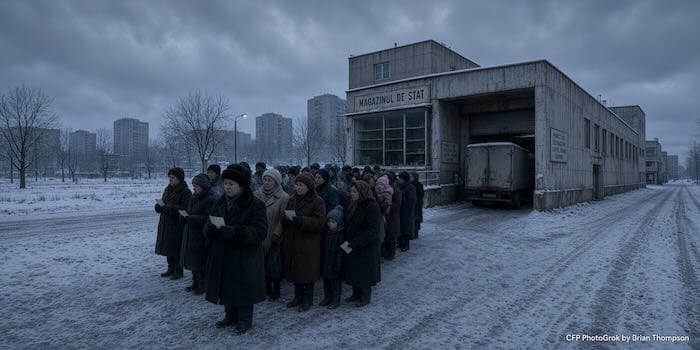
At 5 a.m., in below zero temperatures, moms and sometimes their child(ren) would stand in line for three hours, rationing coupons in gloved hands, waiting for the delivery trucks that often never arrived, for necessities such as milk, butter, meat, cooking oil, flour, and bread. Spoiled capitalists take their abundance and food for granted.

Apartments were cold; no steam was hissing from the heating coils below the window. Children would do their homework by candles, with gloves on because it was so cold, they could see their breaths; people climbed stairs in the dark, holding onto the banisters; electricity and heat had been cut off to save money for the state while the party leaders were illuminated in comfort and warmth. No standing in line for their food.


In 1980, all Soviet satellite countries had outstanding debt to western banks

People slept with coats on, covered by many comforters to keep warm. Windows were covered in ice in the morning. The weak gas flame was used for cooking, heating hands, and boiling water for sponge baths. Schools and offices were cold and dark as well.

The country was rich in petroleum and food; there was no reason for the population to starve. Where was the food? The dictator paid everything back to banks with oil, gas, and food production at the expense of the starving population who shivered in their own homes.

Ceausescu was the darling of the western world, the “maverick” who opposed the Soviet invasion of Czechoslovakia and had visions to build a massive industry and develop his country in a truly brief period. He built more refineries than Romania had oil to refine. Workers were proud to have a job that paid them enough to survive, whether the installation made a profit or not. Like most communist enterprises, production was ill-planned and did not reflect the reality of lack of profitability.

In 1980, all Soviet satellite countries had outstanding debt to western banks. The decision was made that they would postpone paying that debt. But not Romania. Ceausescu did not care that Romanians suffered, he decided to pay off the debt to the west as soon as possible. The idea sounded heroic, but it was barbaric for the people.

Everything that could have been sold to export, was gone from the domestic market. Domestic consumption shrank--Romanians were ordered to survive on extraordinarily little. Leftovers that nobody wanted to purchase in the west were sold in domestic stores--chicken legs and bones without meat.


In 1981, Ceausescu devised a chart with the number of daily calories allowed per citizen, based on their weight and the type of job they did. They were only allowed to buy a certain amount of food to meet these criteria. Remember this, leftists advocating for socialism, when you buy entire baskets of food at your capitalist grocery stores and often with EBT cards.

Ceausescu made all decisions. Various ministers and economists applauded but were silent when seeing the danger. To speak out meant that they would lose their jobs and wind up in a labor camp for daring to speak against the dear leader and his wife.

Ceausescu sold the idea as patriotic and healthy--a small country like Romania bucked the western banks and paid its debt in full at the expense of the hungry population. And people were healthy, he argued. Thin and vitamin deficient, many were sick but unable to seek medical help as doctors were scarce and so were medicines and vitamins.

Gasoline was sold with rationing coupons too, television was limited to two hours a day, mostly propaganda praising the dear leader. The miserable salaries of factory workers were cut. If they protested, they were jailed.

While people starved, trains loaded with healthy food left for export in the west. On paper, Ceausescu’s mad plan was on track and in spring 1989, Romania’s debt to the west was paid in full. But the forced export continued and so did the shortages of everything and the rationing cards.

This sad life lasted until 1989 when the dictator and his wife were executed on Christmas Day. The people had had enough of his exploitation; a planned coup got rid of this monster.


Read next: Defeating Olivia Chow On Monday Could Be The Start of Rescuing Canada From Communism

Email Us | Reader Friendly | Comments

Dr. Ileana Johnson Paugh—— Dr. Ileana Johnson Paugh, Ileana Writes is a freelance writer, author, radio commentator, and speaker. Her books, “Echoes of Communism", "Liberty on Life Support" and "U.N. Agenda 21: Environmental Piracy," "Communism 2.0: 25 Years Later" are available at Amazon in paperback and Kindle.