Solar Issues: Land, Weather, Weird Sites and Costs
Claims which are already tenuous due to rising wind and solar costs, ignore virtually all of the hidden real world costs associated with building and operating wind turbines and solar panels while keeping the grid reliable

Jack Dini , Bio and Archives--July 13, 2024
Global Warming-Energy-Environment | Comments | Reader Friendly | Subscribe | Email Us
Solar Issues
Routine power rationing and statewide blackouts are the natural consequences of attempting to run on sunshine and breezes.
There is not a single example anywhere in the world of a country or state that runs exclusively on wind or solar. (1)
Taking up vast tracts of farmland with solar panels means that land produces nothing else. While the solar panels are lucky to produce power 5-6 hours every day (20-25% of the time).
Australia’s prime agricultural land is being carpeted with endless seas of solar panels
Arthur Robinson states, “It takes roughly the land mass of California to supply all the power for the US.” (2)
A renewable energy company will soon begin clearing thousands of protected Joshua trees just outside Boron, California, including many thought to be a century old, to make way for a sprawling solar project that will generate power for 180,000 homes in wealthier coastal neighborhoods.
The controversy over this Mojave Desert project is an example of the trade-offs being made in California as state and local government officials press for a rapid expansion of clean energy. Although solar and wind fields are expected to help mitigate climate change, they are also tearing up undeveloped land, harming threatened plants and wildlife and causing concern in nearby communities, which are often small and far from the state’s cities. (3)
Another example: Australia’s prime agricultural land is being carpeted with endless seas of solar panels. (4)
Dilute and diffuse solar and wind require a staggering amount of space, and way more than their occasional weather (and/or sunshine) dependent power generation can ever hope to justify.
Weather Damage
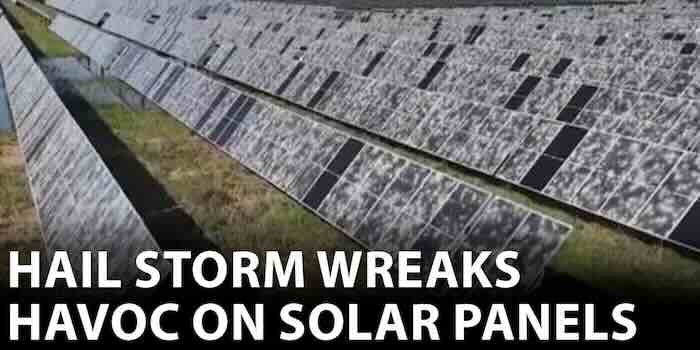
A 3,300 acre solar power plant in Texas suffered major hail damage. This was a plant so new it was still under construction. The project was started in 2022, but was not expected to be fully complete until the end of 2024. In theory it was supposed to last 35 years. (5)
It is so large that it covers 2,499 football fields. Despite the vast footprint, it was rated at only 350 MW. At noon at peak production it could generate about half of what a forty year old coal fired turbine makes a day, every day, and every night too.
This highlights the vulnerability of solar farms to the weather elements. In June 2022, hail storms in Nebraska destroyed a 14,000 panel solar facility. (6)
Now there’s concern dangerous chemicals could leak into the ground and contaminate sites.
Germany
About 90% of solar panels installed in Germany come from China, and earlier this week one of the last solar panel manufacturers closed in Germany. (7)
German factories which are close to their customers, can’t compete with distant foreign factories which have access to slave labor, fossil fueled shipping and cheap coal fired electricity, reports Joanne Nova.
China generates 60% of its electricity with coal, while Germany uses 32% coal and 30% solar and wind power. What should Germans do, bring back coal or get some slaves, asks Joanne Nova.
Solar panels are now in the top five worst slave industries in the world, yet still barely any of the morality police care. (7)
India-Stark Raving Unbelievable
India is a big country, about 1/3 the size of the US. Its population is 1.4 billion. Although that’s a lot of people, one would think that regardless, there would be spaces where they could build solar plants. Even so, they built a big one, but not on land. It’s a floating solar farm.
What has been described as the world’s largest floating solar plant in India at Omkareshwar Dam was badly damaged when a storm hit in mid-April. The damaged plant is one of three developed near the dam. The storm that damaged it had winds reported at just over 31 mph, which are actually relatively tame. (8)
The Times of India reported that an officer said that a ‘major loss’ took place to the solar panels.
The project was supposed to be the world’s largest floating PV plant, but instead it’s become a stark reminder of the limits of renewable energy and the dangers of prioritizing grand ambitions over practical realities.
The failure comes at a bad time for India as it faces a massive power shortage which is predicted to be the worst power deficit since 2009-10.
Poor nations like India come up with wasteful and silly ideas like floating solar panels that turn into useless plastic squares strewn across the land and water.
India is a poor country. They need cheap energy supplies, not government funded boondoggles that only benefit those involved in their construction. The real purpose for building the plant was to spend large amounts of money and line the pockets of those involved. (9)
True Costs
Since 2015 the tax credits for alt-energy haven’t decreased at all. Instead, they increased by a factor of 21. Wind/solar/alt energy subsidies will cost federal taxpayers $425 billion between now and 2033. (10)
Claims which are already tenuous due to rising wind and solar costs, ignore virtually all of the hidden real world costs associated with building and operating wind turbines and solar panels while keeping the grid reliable. (11)
| Existing vs, New Energy Sources | Dollars per MWh |
|---|---|
| Coal | $34.71 |
| Natural Gas Combined Cycle | $27.08 |
| Natural Gas Current Transformer | $92.88 |
| Nuclear | $37.18 |
| Wind | $272.41 |
| Solar | $471.60 |
References
- Michael Darby, “Reliance on wind and solar energy means frequent blackouts,” principia-scientific.org, March 7, 2024
- Arthur Robinson, “Sinking solar,” Access to Energy, February 2024
- Melody Petersen, “Solar project to destroy thousands of Joshua trees in Mojave Desert,” latimes.com, May 31, 2024
- “Grand land grab: wind and solar transition needs 70% of Australia’s farmland,” stopthesethings.com, March 21, 2024
- Jo Nova, “2,500 football fields of new solar panels destroyed by hail in Texas,” joannenova.com.au, March 28.2024
- P. Gosselin, “Large scale solar farms proving vulnerable, poses toxic hazard to the environment, soil,” notrickszone.com, March 21, 2024
- Jo Nova, “German solar industry collapsing: unable to make solar panels from solar power,” joannenova.com.au, May 21, 2024
- Jack Davis, “Storm ravages world’s largest floating solar panel plant, takes it offline days after launch,” westernjournal.com, May 12, 2024
- Arthur Robinson, “Sinking water,” Access to Energy, February 2024
- Robert Bryce, “Wind/solar/alt energy subsidies to cost federal taxpayers $425 billion between now and 2033,” robertbrycesubstack.com, April 4, 2024
- John Hinderbaker, “The true cost of wind and solar,” powerlineblog.com, April 3, 2024
View Comments
John William Dini, know to all as ‘Jack’, passed away at the age of 89 on June 17, 2026. He was born in Cleveland, Ohio on Nov. 14, 1936.
He published two books, a technical book on materials science and coatings and another on environmental issues. In retirement, he wrote extensively on various environmental issues for online publications.
He was a skilled leaded glass hobbyist, creating more than 20 lamps and many panels. He was a jogger for many years, competing in over 300 long distance races. He was a slow runner, not wanting to take the glory away from others. His secret was to start slow and taper. He and Anne traveled extensively, visiting over 70 countries.
He is survived by his wife, Anne, of 67 years, and sons Mike, Steve, and Paul. If you were to meet him somewhere, he would sum up his life as ‘peaches and cream’.