The Contrast between Community and the Collective
The Prisoner Part 2--The Two Towers

Dr. Lawrence Sasaki , Bio and Archives--September 16, 2026
American Politics, News | Comments | Reader Friendly | Subscribe | Email Us
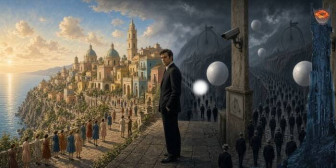
The "The Two Towers" is the title of the second of the "Lord of the Rings" trilogy written by J.R.R. Tolkien[1]. In the novel, they are two dark towers engaged in the war against Middle Earth. Here, I allude to two separate towers: one, the collective, evoking the Tower of Babel described in Genesis 11, and the second, the individual, as a "tower of strength" as depicted by Number 6 in "The Prisoner".
The Prisoner Series:
- A look at Community versus the Collective based in the television series "The Prisoner"
- The Contrast between Community and the Collective
- The Return of the British Empire--Perfidious Albion
- The Red-Green Alliance
- The Elites War on America and Russia
- “In the beginning was the Word…” John 1:1
- The Most Effective Weapon Against the Plans of the Elites
- The Prison of the Mind--Will You Be Free or Slave?
The Tower of Babel tells of man's attempt to unite and build a tower with which to invade Heaven. It is symbolic of the collective, as in the collective, man is defining a moral code apart from God, as Adam and Eve did by the eating of the tree of "the knowledge of good and evil", and then invading heaven by its own rules. In fact, the European Union has adopted Bruegel's painting "The Tower of Babel" as the blueprint for its parliament buildings.
The individual is embodied by Number 6's cry during each show's opening, "I AM A FREE MAN". However, the individual does not stand alone, but is a member of what I call community. There are stark contrasts between community and an atheistic, authoritarian collective.
For a community to function properly, it must be founded on Christianity. The collective is an atheistic facsimile of a Christian community. The further it moves away from its Christian roots, the more sordid it becomes. It began with an optimistic view that, by reason alone, a utopian society can emerge. It failed. As time went on, it moved farther from its Christian roots until we are where we are today--the Age of Non-reason, the post-modern world[2].
- In the community, all are accountable to God. In the collective, all are accountable to the state.
- The members of the community hold to a biblical world view. Law exists to restrain aberrant behaviour. The members of the collective hold to an atheistic, post-modern world view governed by feelings. Crime is not the criminal’s fault as he is the product of his environment. Rule of law is meaningless, so arbitrary law is often imposed.
- In the community, God is king and, as we are made in the image of God, the individual is king. In the collective, the King is God or rather the state is God. There are many examples of this. Adolph Hitler was idolized by his people as was Mao Tse-Tung. Vladimir Lenin and Joseph Stalin also enjoyed such adulation. These leaders exalted themselves. The writer Ayn Rand said this in her book “Atlas Shrugged”[3], through the character Dagny Taggart when she confronts her brother James, a government official.
- The community comprises individuals. People in the collective are part of the village, constantly seeking the approval of others. We see this with people constantly virtual signalling and waiting for clicks and “like”s.
- The community is founded on truth, the collective on lies and deception.
- People in the community are characterized by humility, the people in the collective by malicious narcissism.
- The community rewards individuals who are diligent, hard working and creative, where, ultimately, creativity comes from God. The collective pounds individuals into submission. There is no reward for creativity or hard work so the collective declines. Venezuela is a prime example. It was a very wealthy nation until it voted in a socialist government which maintains power by rigging elections. It was not long before the people were reduced to gleaning the city dumps for food.
- The community is based on love and mutual respect. A materialistic collective is based on greed and envy[4].
- The community understands that we are all made in the image of God, therefore all life is sacred and should be upheld. In the collective, people are not people, just things; we are just matter randomly formed. Life is inconsequential. We are easily conceived and easily discarded. The only life that matters is my own.
- Marriages in the community are based on sacrificial love. Marriage is a life-long commitment as each person understands that they need to put more into the marriage then they should expect to get out. In an atheistic collective, love is reduced to sex. In marriage, each partner looks only to see what they can get out of it. After the initial sexual attraction, more often than not, the marriage dissolves, leaving the carnage of a broken family.
- In the community, people are virtuous. In the collective, people virtue signal, even if what they are signalling is inherently evil.
- In the community, freedom means that you are free to live your life as you see fit within the biblical paradigm, and, as a result, with little government intervention. All are answerable to God as the ultimate authority. In the collective, freedom means that you are free from all moral restraint[5]. This ultimately leads to all manner of sexual perversion including pedophilia.
- In the community, wealth redistribution comes about by individuals giving freely of their time and resources. In the collective, wealth redistribution comes by taking.
- In the community, the social safety net comes from the church which sees to the needs of a person who has fallen on hard times. Initially, it sees to his physical needs, but then extends to emotional and spiritual needs, helping the person get back on his feet and once again be a productive member of the community. It addresses the whole person. The collective sees only to a person’s physical needs, keeping him is a state of dependence.
- The community comprises individuals imbued with personal responsibility, each person and family responsible for providing for themselves. The accompanying sense of accomplishment breeds a sense of optimism. The collective breeds victimhood and dependence leading to angst and depression and a sense of pessimism, and the need to numb their current situation. This explains widespread drug use among non-believers. Aldous Huxley opined that there will come a euphoric which will make even the most deplorable situation endurable[6].
- In the community, parents are the primary source for the education of their children. In the collective, “It takes a village to raise a child” leading to indoctrination.
- For the community, education is critical as it leads to an informed public, fully capable of critical thinking and able to discern what is true from what is false. Education in the collective is focused on indoctrination, producing mindless robots.
- Buildings in Christian communities preserve humanity. Homes are constructed and they tend to be individual. Even in subdivisions of identical homes, people find ways of giving their home a personal touch, be it with decor or gardening. Buildings in the collective are dehumanizing[7], one only need look at so-called low-cost housing in Britain to see that they resemble prisons comprising blocks of uniform, little cells.
- Art in the community glorifies God. Art in the collective is an act of defiance, characterized by the phrase “the artist as rebel”, much of it garbage. Many of the top rock stars of the 60s went to art school, most notably John Lennon of the Beatles and Keith Richards of the Rolling Stones.
The essence of community is captured in a video called “The Harvest--A Modern Day Parable”[8]. It tells the true story of a family in North Dakota comprising a husband and wife and four small children. The father is a farmer who plants fields of wheat. Before harvest time, the father dies leaving the widow and the four small children and the fields of wheat. The family prays for a miracle so the harvest will not be lost. One day, a convoy of combine harvesters and trucks descend on the farm and in one day the wheat is harvested and trucked to market. At the end of the day, all the families arrive and there is a huge harvest feast. This is community at its best, where one’s neighbours come to the aid of someone in need.
How does “The Prisoner” relate to this contrast? Let us examine some of the episodes.
- Episode 2: “The Chimes of Big Ben”. Number 6 allies himself with another villager. They escape by boat and plane and he arrives in London in a packing crate, but the whole episode was a deception to make him think he was somewhere where he was not and reveal his reason for resigning. This highlights the deceptive means by which the collective maintains control over its people.
- Episode 4: “Free For All”. Number 2 encourages Number 6 to enter the upcoming elections and run for the office of Number 2. The vote is rigged and Number 6 is voted into office, but he finds he has no authority. Here, people are given the illusion of choice with sham elections which is the case in most if not all socialist countries.
- Episode 5: “Schizoid Man”. Number 6 is drugged and taken to a laboratory. In this state he is trained by Pavlovian techniques to exhibit characteristics not his own and he is renamed Number 12. The approach was to strip Number 6 of his identity and render him a compliant member of the collective. Today we see that people are no longer thinking individuals, but rather part of the herd where their thinking is done for them, practically downloaded by mass media which no longer practices journalism but is an arm of the state, much like the state media of the USSR, ironically called Pravda (Truth).
- Episode 6: “The General”. A new teaching technique is introduced where information is downloaded directly into the cerebral cortex of the brain. People can parrot the information flawlessly, that is until Number 6 asks a question slightly askew, and then the responder becomes confused. Today, our opinions are shaped by what we see on our phones or the movies. Many of today’s movies, such as “The Hunger Games” and “Minority Report”, are produced to sensitize us to our dystopian future.
- Episode 8: “Dance of the Dead”. Number 6 finds a dead body on the beach with papers and a pocket radio. He takes the radio and, by doing so, is found in breach of the rules. The sentence is death, but there are no posted rules with the infraction. It is like today, where the rules of social conduct are ever shifting and of which being found in breach can render a person a non-person. What was acceptable yesterday is a transgression today.
- Episode 11: “It’s Your Funeral”. Number 6 is manipulated into reporting a plot to assassinate Number 2. He reports this to the acting Number 2. It is recorded and manipulated to cause the retiring Number 2 to distrust Number 6, so that when he reports it, he will not believe him and he can be terminated by his own people using an dupe in the village. We see this today with the labelling of truth as misinformation and the manipulation of events into narratives touted as “truth”, and how this can lead to violence.
- Episode 14: Living in Harmony. This episode is done in a western motif. Number 6 plays a sheriff who resigns and leaves, tossing his star on the desk in defiance. This delusion is created using hallucinogenic drugs. In the delusion, he ends up getting shot which wakes him and he finds that he had been fighting cardboard cutouts. His handlers end up getting caught up in the delusion which ends tragically. This is the problem with the collective. Living a life of lies and deception, it becomes impossible to separate fact from fiction, delusion from reality.
This points to the tragedy of today, that those on the left, those who have succumbed to post-modern thinking, those who have bought the lies and deception, are left with a collection of contradictory ideas in their head which are impossible to resolve. An example is the question “What is a woman?”
Ask a person on the left if they support women’s rights and they will say “Of course.” Ask them if they support trans-rights and they answer in the affirmative. Then ask, in that context, what exactly is a woman whose rights your support, and they will probably give some psycho-babble if they give you an answer at all. Also, the insanity of the trans movement is putting women at risk[9].
Ask them about climate change and renewable energy and they will say they support forcing people to drive electric cars, powered by wind mills or solar power. Forgetting that these means of power generation are very inefficient, ask them about the amount of CO2 generated in the production of car batteries, wind mills and solar panels. Ask them about all the toxic waste these technologies present. They probably don’t know, don’t want to know, or don’t care. They just want to virtue signal that they are helping to “Save the planet”. Forget about the new literature that seems to reverse the relationship: that increased temperatures give rise to increased CO2 and that the major driver of temperature is the sun.
Another example is given by Sam Harris, one of the New Atheists. He argues that man does not possess free will. Some of his arguments are a little circular such as “You can do what you decide to do — but you cannot decide what you will decide to do.” Unfortunately, arguing that free will does not exist is in itself an act of free will and he ends up destroying his own position.
Collectivism, as a whole, fails because it de-incentivises people. There is a story of a Swedish professor who did an experiment with his students on equality of results. I am not sure if it is true or urban legend. It is documented in “Why Socialism Fails & How It Survives”[10]. An economics professor challenged his student’s belief in socialism with an experiment. The class agreed to equalize all test grades. No matter how hard—or how little—each student worked, they would all receive the class average as their grade. The first test resulted in an average of 8 out of 10, but the second dropped to 6, and by the third the grade was 4. The professor’s conclusion was simple: “When reward is detached from effort, incentive dies. When no one benefits from working harder, no one works harder.”
References
- J.R.R. Tolkien, "The Two Towers", George Allen & Unwin, Nov 11, 1954.
- Dr. Francis Schaeffer, “How Should We Then Live, Episode 7: The Age of Non-Reason”, Gospel Films Distribution, 1961.
- Ayn Rand, "Atlas Shrugged", Penguin Books, 1957.
- Steve Rossiter, Another Form of Slavery, Sep 13, 2026.
- Victor Joecks, The Difference Between Liberty and License, Aug 14, 2026.
- Aldous Huxley on the Ultimate Revolution, 1962, Berkley Address
- Paul Joseph Watson, "Why Modern Architecture SUCKS", June 30, 2017.
- The Harvest, 1996.
- Emmy Griffin, Canada’s Cruel and Unusual View of Female Inmates, Aug 14, 2026.
- Dr Gordon Jones, Why Socialism Fails & How it Survives, April 14, 2025.
View Comments
Dr. Lawrence Sasaki has a PhD in Electrical Engineering in the field of electronic music. He is currently employed in the area of digital design verification and has worked on products spanning consumer to enterprise.