The Final Fire
But we were safe. I threw my arm around my little brother’s shoulder and gave him a quick squeeze. I then plopped down for a quick blow with my hot sweaty head in my hands

John Burtis , Bio and Archives--August 17, 2026
Lifestyles | Comments | Reader Friendly | Subscribe | Email Us
Dennis Smith’s novel, The Final Fire, debuted in 1975, and was a Book of the Month Club edition. My final fire took place a few years earlier, far removed from New York City and resulted in no books.
It is fitting, given the intervening years, that I tell the story of my final fire; a conflagration which also became my younger brother’s last fire.
Both my brother, Jeffrey, who was a few years younger than me, and I served in the Port Crane, NY, Fire Department, Fire Station 37 in the Broome County Fire and EMS Services. I joined in 1967 and Jeff entered training in 1970 and our shared progress was overseen by Chief Ernest S. “Ernie” Youngs (See: Ernest S. Youngs--a man for all) seasons, Canada Free Press, May 31, 2006)
Jeffrey left to attend Texas Christian University in the September of 1971, while I entered the Santa Monica, CA, Police Department in December of 1971 from UCLA, where I was studying. I had once called Chief Youngs from my dorm room when atmospheric skip brought him into Sproul Hall’s fourth floor on my fire receiver, “Loud and clear,” I said. We both had a good laugh.
Jeff and I have often tried to establish how we got to the fire alarm at the North Fenton Market, which soon became "The Great North Fenton Market Fire” in local lore. I suspect we caught an engine responding from Station 37 on Canal Street in Port Crane. Our task force response featured the chief’s red and white Chrysler, the tanker, the pumper and possibly the FD ambulance 101. It was a long run of about seven miles at Code 3.
Light smoke was showing from above the roof on our arrival, illuminated by the engine’s spot light as other firefighters scurried about hooking up the hose line between the tanker and the pumper. Soon the first line was cracking loudly and whistling as it expanded and grew heavy with the water.
Chief Ernest S. “Ernie” Youngs, attired as he always was in lowered fire boots, a green plaid hunting jacket, an insulated gray cap and well worn tan leather gloves, greeted us upon our arrival in front of the glass doors on the street side of the supermarket. He explained, in his always recognizably hoarse voice from years of being an inveterate cigar smoker, that he wasn’t entirely sure what we had but he said that Jeff and I would take the first inch and a half attack line down the main aisle, keeping watch on changing conditions as we moved along, and not to take any undue risks as the market was large, the actual fire location and severity were unknown and the main aisle was very long.
I had pulled on turnout pants over bunker boots my preferred get up, my personal Globe fire coat with its Scotchlite reflective yellow JB on the back, because the issue jackets were always too short, and my MSA yellow topgard helmet with the blue two inch reflective 37 on each side. Jeff donned his black MSA helmet, his issue coat and he pulled up his boots.
After forcing entry by cracking the swinging heavy tempered and locked glass doors, while the interior was illuminated from the outside and with the inside lights, the two of us started slowly down the main aisle. I had the nozzle with my right hand on the hose, while Jeff walked behind me pulling and keeping the hose line taught.
While walking along and watching for anything untoward we saw no evidence of what we would soon encounter. There was no warnings felt or heard, just the fading sounds of pumps, shouts and radio calls broadcast over the external speakers.
We reached the end of the aisle and turned right where we spotted the concrete stairway leading to the basement. From the top of the steps I could see two swinging doors with an orange/yellow glow appearing behind the two glass windows.
We started clomping down those steps with their rubber inserts.
About halfway down, the doors blew open with a growing fireball expanding outward and upward. I turned to Jeff over my right shoulder and hollered, “We’ve gotta back out.” With eyes as big as saucers he nodded and we walked up the stairs backwards. Luckily, Don Shelley was in the exterior doorway and began pulling the line outside when he noticed our retreat once we made it to the main aisle.
As we stopped briefly with the long display counters on both sides of us, the flames grew from floor to ceiling and we began backing out with a bit more rapidity, one of the more difficult retrograde maneuvers in firefighting when you retreat in the face of a rapidly expanding flame front stopping your forward progress.
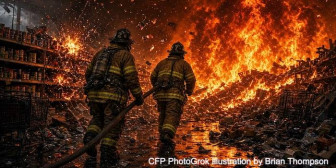
On we went. I adjusted the nozzle to a semi-fog application with the wide open supply valve giving us some 80 gpm. It didn’t even make a dent in that roiling and charging wall of fire.
We continued backing out and I never dared to look over my shoulder while concentrating on my footing, the hose and the nozzle. Around us was a hellscape. Jeff always mentions the flames impinging on rows of cans and the radiant heat exploding them.
We finally arrived at the entrance where we were pulled to safety.
I have no idea how long we had been inside, but the cold early morning air felt terrific. Meanwhile, the fire had spread to the entire interior. But we were safe. I threw my arm around my little brother’s shoulder and gave him a quick squeeze. I then plopped down for a quick blow with my hot sweaty head in my hands and watched Tanker 39 with Carol Chandler and Jim Flynn going through their practiced evolutions getting a line ready for the fire and supplying our pumper with another one.
The final fire was finally extinguished after a three or four hour battle, then salvage and clean up began.
Jeff went back to Texas and got married. I later passed a woman in a hallway and ten years later I married her - Betsy, and we’ve been together for 34 years. Fires? I never want to fight another one. But if I had to, with lives at stake, I would. Of course I would because I always keep a turnout suit in the car. I have done so since 1967.
John Burtis is a retired Santa Monica, CA, police officer and a former Broome County, NY, firefighter and ran with Fire Stations 37, 35 and 55. He may be reached at letters@canadafreepress.com.
View Comments
John Burtis is a former Broome County, NY firefighter, a retired Santa Monica, CA, police officer. He obtained his BA in European History at Boston University and is fluent in German. He resides in NH with his wife, Betsy.