Far Better Than DrudgeUnfiltered News • Daily Headlines

The Hen with the Golden Chicks

Finally safe and at peace, after a long and tumultuous history of invading hordes of barbarians, burial, theft, damage, melting, and destruction;


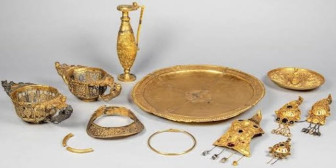
The most valuable archeological find in Romania was Closca cu Puii de Aur (The Hen with the Golden Chicks). Discovered in 1837, in the village of Pietroasele, Buzau County, by two farmers, Ion Lemnaru and Stan Avram, on Istrita Hill, the treasure was buried under a large boulder.


An artistic treasure of pure gold was composed of twenty-two items: a large tray, cups, necklaces, and brooches with precious stones, shining in the rich dirt. All pieces were hidden behind a large tray, like chicks under their mother’s feathers, hence the name, someone thought. Maybe some of the pieces looked like a hen with her chicks?

What did the two farmers do with all this treasure they found? It is not easy to keep your silence for a year in the small village until someone decides to report the find to the authorities.

Before someone reported them, Lemnaru and Avram found an Albanian entrepreneur, Anastase Verusi, who was building a bridge over the river Cilnau. Verusi gave them 4,000 piastri (at the time, Romania did not have her official coins, it used whatever coins were accepted on the market from various neighboring empires), a good pay day for the two farmers but not enough for such a historical treasure. Verusi split the tray into four pieces with an ax (what a horror) and squashed other pieces to fit them into his luggage.

The sale did not go unnoticed and someone from the village told the authorities about the sale. Verusi and the two farmers were arrested while the police tried to reclaim all pieces.

From the original twenty-two, only twelve are found: the large tray, a jug, a cup with mythological gods in base-relief, three necklaces, four brooches, and two vases, all weighing in at approximately twenty kilograms of gold (44.09 pounds). Some consider the largest of the brooches, an eagle, as the Hen. The other ten pieces have disappeared, melted down, and sold as gold ingots. The remaining twelve pieces were sent to the museum in Bucharest.


Whose treasure was this and how old was it? Archeologists believed that it belonged to the Visigoths, a Germanic people. The proof was the runic inscription on one of the necklaces – Gutani Hailag (holy object of the Goths). It was believed to have belonged to King Athanaric. The Visigoths buried it in a hurry when they had to flee before the arrival of the invading Huns in 375 A.D. They never went back to claim their treasure, and it remained in the ground for fifteen hundred years until the two farmers found it under a large boulder that they were moving to make the field ready for agricultural purposes.

On November 20, 1875, inside the University of Bucharest where the history museum was located, a young man, Dimitrie Pantazescu, was hiding on a floor above the museum where the treasure was displayed. An excellent acrobat, he cut the floor during the night and hung an umbrella through the hole to catch the falling rubble; the intense snowstorm outside gave him cover for any cutting noise. He lowered himself through the hole with a rope tied to a table, stole the treasure, stuffed it into a bag made from trousers, and, in the morning, exited the building with the treasure, a perfect crime. Or was it?

Later he was arrested by police when a gold watch that did not belong to him (had someone else’s initials inside) was found in his pocket. Inside there was also a curious key inside a box locket.

When the police searched his apartment, they found the treasure hidden inside a piano. Sadly, part of the treasure was split with his accomplice, a silversmith. 


They found in his possession part of what was left of the large tray after melting, and pieces of the necklace with the runic inscription. Both were sent to prison for six and three years respectively and what is left of the treasure was crudely repaired.

The Hen with the Golden Chicks had been repaired before this theft in 1867 in Paris, by a French jeweler at the Universal Exhibition.

In 1884, the building in which the treasure was housed caught on fire. To say that this treasure was bad luck, it is an understatement. Once again, to save what was left of the treasure, the caretakers threw it out the window. During the fall, the pieces got damaged again. It truly seemed that this treasure was cursed.

King Carol I of Romania sent the treasure to Berlin to be repaired by a master jeweler, Paul Telge, who was horrified by the condition of the exquisite treasure. Despite the prior repairs that were substandard, Telge restored the pieces, and made copies for the German museums.

During WWI, the government ordered all treasures to be sent to its allies in Moscow for safekeeping, right before the Germans invaded Romania. In 1917, The Hen and the Golden Chicks was sent to Moscow as well, a Moscow that was under the Bolshevik Revolution.

The Russians kept it until 1956 and did not seem willing to give it back to its rightful owners. Khrushchev eventually returned the twelve gold pieces back to Romania.

The treasure is now located since 1972 at the Romanian National History Museum in Bucharest, in the Treasury Hall, finally safe and at peace, after a long and tumultuous history of invading hordes of barbarians, burial, theft, damage, melting, and destruction.


Read next: Rubio's Golden Shield: How America Responds to Canada's EU Defection

Email Us | Reader Friendly | Comments

Dr. Ileana Johnson Paugh—— Dr. Ileana Johnson Paugh, Ileana Writes is a freelance writer, author, radio commentator, and speaker. Her books, “Echoes of Communism", "Liberty on Life Support" and "U.N. Agenda 21: Environmental Piracy," "Communism 2.0: 25 Years Later" are available at Amazon in paperback and Kindle.