The Tradescants

Wes Porter , Bio and Archives--July 22, 2018
Lifestyles | Comments | Reader Friendly | Subscribe | Email Us
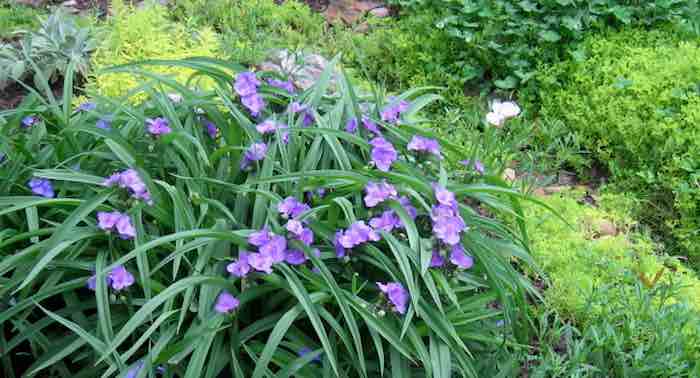 Spiderwort in the perennial border. Perhaps Wandering Willy decorating the house. Both are botanically Tradescantia, commemorating the John Tradescants, father and son, plant collectors, botanists and gardeners to British Stuart royalty. Between them, they introduced dozens of new plants into cultivation, many which remain popular to this day.
The Tradescants were probably of Dutch origin, perhaps settling in Suffolk. It was there it is believed that John Tradescant the Elder was born in 1570. His first few decades remain a mystery. Somehow, somewhere, he was educated, trained as a gardener although, strangely, born with no sense of smell, and achieved professional standing.
Spiderwort in the perennial border. Perhaps Wandering Willy decorating the house. Both are botanically Tradescantia, commemorating the John Tradescants, father and son, plant collectors, botanists and gardeners to British Stuart royalty. Between them, they introduced dozens of new plants into cultivation, many which remain popular to this day.
The Tradescants were probably of Dutch origin, perhaps settling in Suffolk. It was there it is believed that John Tradescant the Elder was born in 1570. His first few decades remain a mystery. Somehow, somewhere, he was educated, trained as a gardener although, strangely, born with no sense of smell, and achieved professional standing.By the age of 40 he was head gardener to Robert Cecil, 1st Earl of Salisbury. He appears to have travelled on collecting trips to Holland, already a hotbed of horticulture. In fact the first mention in writing of him is a trip for Cecil in 1610 Two years prior to this he married Elizabeth Day and a son arrived in 1608 when they were living in Meopham, Kent. Ten years later in 1618, Tradescant made a not very successful trip to northern Russia, although he may have brought back larch. But his career was progressing. In 1623, he moved on to become gardener to George Villiers, 1st Duke of Buckingham, remaining in that post until that influential noble's assassination in 1628. Given Villiers' influence with the king, Tradescant was appointed gardener two years later, to Charles I's Henrietta Maria, "the rose and lily queen", officially, 'Keeper of His Majesty's Gardens, Vines and Silkworms' at the queen's minor palace of Oatlands Place in Surrey. In 1628 he purchased a house in Lambeth on the south bank of the Thames in London and established a botanical garden. In this was displayed new and for the time, wonderous offerings: pear trees from Spain, tulips from Haarlem, Dutch snake's head fritillarias, linden, horse chestnut, false acacia trees, scented stock, cos lettuce, white jasmine, white lupine. Passionate about orchard fruit trees he introduced and grew varieties of nectarines, vines, cherries, medlars, walnuts, pomegranates, quinces, and mulberries.
At some point in time, it is believed he made collecting trips to Algeria and the Levant. Plants from those regions arriving in England point to Tradescant the Elder. These added to the Lambeth gardens to the point where there were more than 770 varieties attracting more than a little attention. John Parkinson, royal apothecary, for example wrote of Tradescant as "that worthy, curious, diligent searcher and presenter of all natures rarities and varieties." The famed herbalist and early botanist could admire new varieties of rose, narcissus, lily, anemone, iris, clematis--plus plants direct from North America where his son was diligently collecting. In fact, son John Tradescant the Younger was also making horticultural history. Born in 1608 and schooled at Canterbury, he married Jane Hurte, by whom he had a son and daughter, but Jane died in 1634. His plant collecting trips to eastern North America were an immense success. He travelled to Virginia three times between 1628 to 1637, adventurous travel in those days and not without some risk. Among his introductions were the American sycamore, tulip tree, magnolias, bald cypress, red maple, Virginia creeper, dogwood, spiderwort, asters, phlox, golden rod, yucca, scarlet runner bean, and passion flower and possibly pineapple. Following the death of his father in 1638, he too was appointed gardener to the king, the same year marrying Hester Pookes. John the Younger died, aged 54 on 22 April 1662. He had inherited his father's Lambeth botanical garden and house. The latter sheltered the first museum open to the public, the Musaeum Tradescantianum, founded by John the Elder. On display were items he had collected on his travels added to later by his son. Hester survived him but parted with the museum--say were to say was cheated of it--a few years later. She drowned--some say despondent--in a shallow pool in the garden in 1668. The house survived over two hundred years, only to be torn down in the late 19th century.
View Comments
Wes Porter——Bio and Archives
Wes Porter is a horticultural consultant and writer based in Toronto. Wes has over 40 years of experience in both temperate and tropical horticulture from three continents.