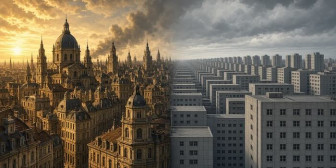
After the lockdowns public buildings, restaurants, fast food chains, and even apartment complexes and homes had undergone a similar transformation to various shades of grey, black, brown, and beige. Maybe paint was only offered in grey and it was cheap?
Fast food buildings removed large windows and added small, prison-like windows, and the previously happy colors and signs disappeared. The choices of towels, furniture, cars, clothes, and other products have narrowed to the same basic hues of gray, black, beige, and brown. I knew it as Bauhaus utilitarian ugly.
Granted that lighter colors are less showy and easier to match more tastes, then why the previous opulence of colors and choices? Was it that the well-heeled wanted simpler and minimalist lines to show off their good taste? There is no denying that homes and cars painted in less showy colors sell much easier and quicker.
Austrian architect Adolf Loos said in his 1908 essay “Ornament and Crime” that “evolved people gravitated toward clean lines and plain surfaces,” unornamented and clutter-free.
Le Corbusier, the “father” of modern architecture, wrote that “color is suited to simple races, peasants, and savages.” Rich Americans call those who like bright colors, Lilly Pulitzer people. The Lilly clothing line is famous for bright hues of pink, blue, yellow, orange, and green.
Bauhaus spread internationally to the United States and to Tel Aviv via Jewish Bauhaus architect immigrants. According to sources, “The White City of Tel Aviv has the highest concentration of Bauhaus architecture in the world.”
As Bauhaus spread increasingly across the world, selected and pushed by globalist corporate controllers, it is no surprise that the color chosen for this decade is grey and the style is Bauhaus utilitarian.
When I visited my favorite department store, which was always decorated with red, white, and green way before the Christmas season, decorations displayed a gray table with gray chairs, gray plates, black glasses, and white napkin holders. One solitaire painting of a red bush surrounded by green background was overlooking the funereal décor.
This is not just about depressing the population with ugly buildings, cars, and shades of gray, it is about the global transformation of the west into a socialist/communist society to better control the naïve population in every way. And the uniform uglification of architecture is just one way to do so.