The World’s Columbian Exposition--Chicago, Summer of 1893
Survival in Tough Times: If I could go back in time. . .

Dr. Bruce Smith , Bio and Archives--June 21, 2024
HeartlandLifestyles | Comments | Reader Friendly | Subscribe | Email Us
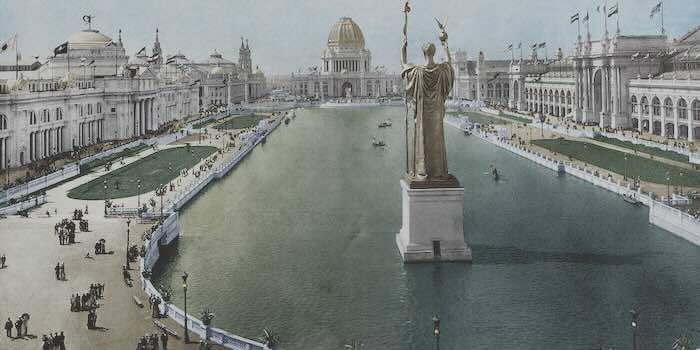
The last third of the 19th century was my original academic focus area. It had everything a young man with imagination and a thirst for knowledge could ask for. There were railroads, covered wagons, the frontier, Indian conflicts, bonanza farming, Reconstruction politics and the bloody shirt, immigration issues, free markets, big city political chicanery, industrialization, manifest destiny, labor unrest, economic depressions, westward expansion, sod houses and cabins and mansions, the Dakota boom, timber and mineral resources, and entrepreneurs, gold rushes, all in the context of a noble experiment in self-government. Some people called it the Gilded Age, but that’s a pejorative term.
Few cities were ever so favorably sited for spectacular growth
In the last decade of the 19th century there came a world’s fair that would document the industrial achievement of a free people in the New World. Coinciding with the anniversary of the first voyage of Columbus to the New World, it would be set in a great city where just sixty years before there had been no city at all. It became known as the World’s Columbian Exposition.
Exactly sixty years before, Chicago had been a tiny settlement in the marsh along the edge of Lake Michigan. Fewer than 350 people lived there. Incorporated as a town in 1833, and then as a city in 1837, it underwent a stunning growth that saw it emerge as a major metropolis. Perfectly placed near the southern tip of Lake Michigan, the lakes served as a great fence to direct the commerce of the northern prairies and plains through its streets, sending it to all points east. The capital and trade and muscle of the Northeast came the opposite direction to pass through Chicago to all points west. Few cities were ever so favorably sited for spectacular growth.
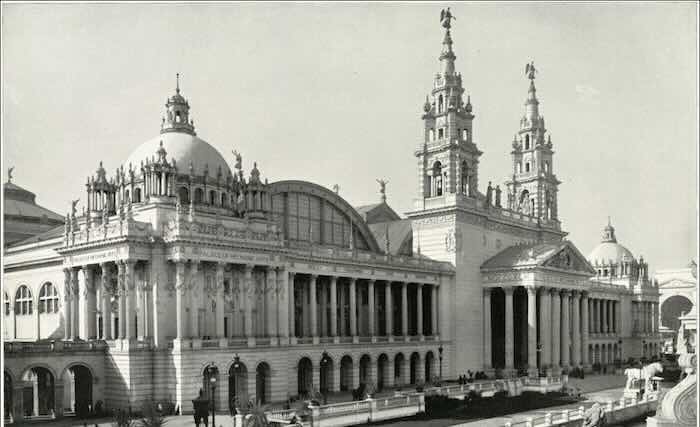
Chicago--The capital of the Midwest
The first locomotive arrived by ship in 1848, and that’s when the real boom began. It quickly became a rail center, the middle point between the great West and the eastern seaboard, with direct connections both directions. In the era before the Civil War and consolidated “union” depots, railroads typically entered only part way into a city. Goods were then conveyed by teamsters from one rail head to the rail services on the other side of town where they were loaded onto train cars again and the shipment resumed.
Boasting 30,000 residents in 1850, it had 90,000 by 1860. The population grew to over 300,000 as the decade of the 1870s began, and then disaster struck. An urban fire in October of 1871 turned more than 3.5 square miles of the city to ash and left 100,000 homeless. In spite of a major depression that began in 1873, the city had been rebuilt by 1880 and boasted a 500,000 population. That figure doubled again in just the next ten years. By 1890 there were more than one million souls living in lusty Chicago. The spiral continued into the new century.
Many have thought of Chicago as the capital of the Midwest, so the Exposition celebrated both the country and the great new city it had spawned. Carl Sandburg, poet of the Heartland, gave its brashness a pithy portrait:
Chicago
Hog Butcher for the World,
Tool Maker, Stacker of Wheat,
Player with Railroads and the Nation's Freight Handler;
Stormy, husky, brawling,
City of the Big Shoulders:
They tell me you are wicked and I believe them, for I
have seen your painted women under the gas lamps
luring the farm boys.
And they tell me you are crooked and I answer: Yes, it
is true I have seen the gunman kill and go free to
kill again.
And they tell me you are brutal and my reply is: On the
faces of women and children I have seen the marks
of wanton hunger.
And having answered so I turn once more to those who
sneer at this my city, and I give them back the sneer
and say to them:
Come and show me another city with lifted head singing
so proud to be alive and coarse and strong and cunning.
Flinging magnetic curses amid the toil of piling job on
job, here is a tall bold slugger set vivid against the
little soft cities;
Fierce as a dog with tongue lapping for action, cunning
as a savage pitted against the wilderness,
Bareheaded,
Shoveling,
Wrecking,
Planning,
Building, breaking, rebuilding,
Under the smoke, dust all over his mouth, laughing with
white teeth,
Under the terrible burden of destiny laughing as a young
man laughs,
Laughing even as an ignorant fighter laughs who has
never lost a battle,
Bragging and laughing that under his wrist is the pulse.
and under his ribs the heart of the people,
Laughing!
Laughing the stormy, husky, brawling laughter of
Youth, half-naked, sweating, proud to be Hog
Butcher, Tool Maker, Stacker of Wheat, Player with
Railroads and Freight Handler to the Nation.
Tesla, Westinghouse, Ford and Edison were there
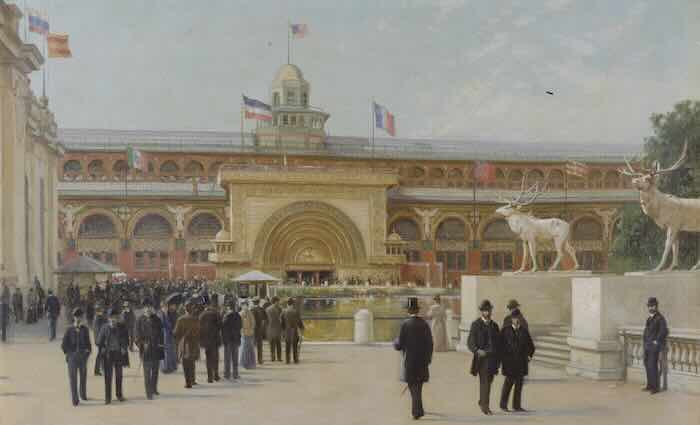
Like the Crystal Palace Exposition in London in 1851, the Centennial Exposition in Philadelphia in 1876, and the Exposition Universelle in Paris in 1889, the World’s Columbian Exposition marked the state of achievement in industry, trade, culture, and the arts, in the Western World, surpassing all that had come before. More than 25 million people visited it, most of them via railroads, making it an unprecedented cultural event in the nation’s history.
Frederick Law Olmstead designed the grounds. Daniel Burnham and Louis Sullivan contributed building designs for the great exhibition halls on the 200-acre site. After her visit, Katherine Lee Bates wrote of ‘alabaster cities’ in her poem America. At a meeting of the American Historical Association in Chicago that summer, Frederick Jackson Turner presented his paper The Significance of the Frontier in American History. For historians who came after him, the coincidence of Turner’s paper with the closing of the frontier indicated in the maps of the 1890 census, along with the monumental World’s Fair all served to mark 1893 as a watershed year. Tesla and Westinghouse and Ford and Edison were there.
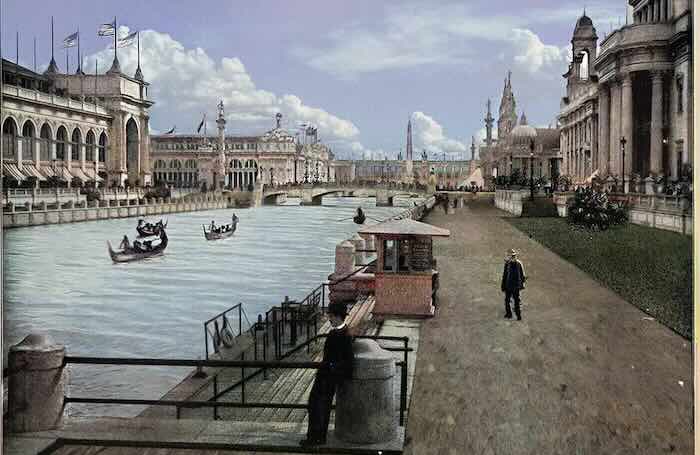
The Columbian Exposition was the celebration of that liberating system of capitalism
No one ever said it better than Ayn Rand, the great champion of freedom and market capitalism. “The nineteenth century was the ultimate product and expression of the intellectual trend of the Renaissance and the Age of Reason, which means: of a predominantly Aristotelian philosophy. And, for the first time in history, it created a new economic system, the necessary corollary of political freedom, a system of free trade on a free market: capitalism.” The Columbian Exposition was the celebration of that liberating system of capitalism. More than a million material artifacts of this progress came to the grounds in Chicago. What a fair it was.
Over the years its glory and interest has grown in my imagination. Oh, to be able to walk the streets of the White City and to enter the buildings and see the evidence of the greatest advances in technology and material advancement ever assembled. I go there often in my imagination, and I am awed and humbled every time.
Luminaries, the famous, and the infamous who visited the Exposition, stories, images, and much more can be found here:
View Comments
Dr. Bruce Smith (Inkwell, Hearth and Plow) is a retired professor of history and a lifelong observer of politics and world events. He holds degrees from Indiana University and the University of Notre Dame. In addition to writing, he works as a caretaker and handyman. His non-fiction book The War Comes to Plum Street, about daily life in the 1930s and during World War II, may be ordered from Indiana University Press.