Today’s policymakers should learn lessons from Chrétien’s historic 1995 federal budget
30th Anniversary of the 1995 Budget: Lessons to Improve Canada’s Federal Finances Today

Fraser Institute , Bio and Archives--March 6, 2025
Canadian News, Opinion | Comments | Reader Friendly | Subscribe | Email Us
VANCOUVER—This year marks the 30th anniversary of the Chrétien Liberal government’s 1995 federal budget—one of the most important budgets in Canadian history—which contains key lessons for today’s federal and provincial policymakers, finds a new study published today by the Fraser Institute, an independent, non-partisan Canadian public policy think-tank.
“To improve the dismal state of federal finances, policymakers in Ottawa should apply the key lessons of the 1995 budget to the upcoming 2025 federal budget,” said Jake Fuss, director of fiscal studies at the Fraser Institute and co-author of 30th Anniversary of the 1995 Budget: Lessons to Improve Canada’s Federal Finances Today.
After decades of budget deficits and debt accumulation brought Canada to the brink of a fiscal crisis, the 1995 federal budget reduced spending, imposed clear and effective limits on new spending and borrowing, and established a swift path to a balanced budget. In addition, the stronger financial foundation set by the 1995 budget allowed for largescale tax relief over several years aimed at making Canada more competitive and attractive to investors and entrepreneurs. The results were almost two decades of prosperity.
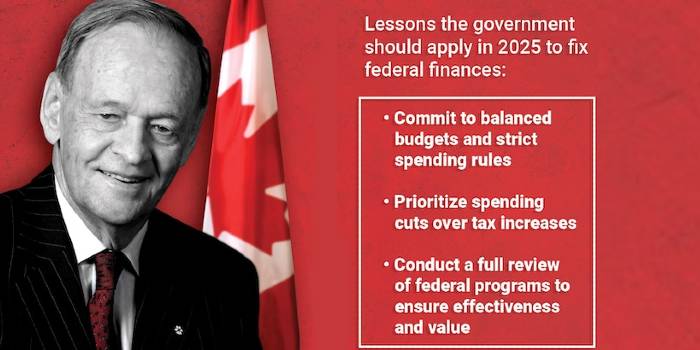
Fast-forward to today—due to successive years of large deficits and debt accumulation, federal finances have markedly deteriorated. To reverse course, in its upcoming budget the federal government should emulate the 1995 budget reforms including:
- Produce a plan to balance the budget within three years and impose clear and strict rules for spending and borrowing.
- Conduct a comprehensive review of all federal programs and agencies (with no exceptions) and reduce or eliminate wasteful spending.
- Use spending reductions—not tax increases—to reduce the deficit.
“Back in 1995, the comprehensive nature of spending reductions and reforms produced a smaller but more effective federal government, which should be the goal for today’s policymakers,” said Grady Munro, study co-author and policy analyst at the Fraser Institute.
Media Contact:
Jake Fuss, Director of Fiscal Studies
Grady Munro, Policy Analyst, Fraser Institute
To arrange media interviews or for more information, please contact:
Bryn Weese, Fraser Institute
604-688-0221 ext. 589
bryn.weese@fraserinstitute.org
View Comments
The Fraser Institute is an independent Canadian public policy research and educational organization with offices in Vancouver, Calgary, Toronto, and Montreal and ties to a global network of 86 think-tanks. Its mission is to measure, study, and communicate the impact of competitive markets and government intervention on the welfare of individuals. To protect the Institute’s independence, it does not accept grants from governments or contracts for research. Visit fraserinstitute.org.
Follow the Fraser Institute on Twitter | Like us on Facebook