Trudeau is not our Country—CANADA Is
Meanwhile the ‘Pandemic’ that never was is over, forcing all that promoted it to run for cover

Judi McLeod , Bio and Archives--February 17, 2022
Cover Story | Comments | Reader Friendly | Subscribe | Email Us
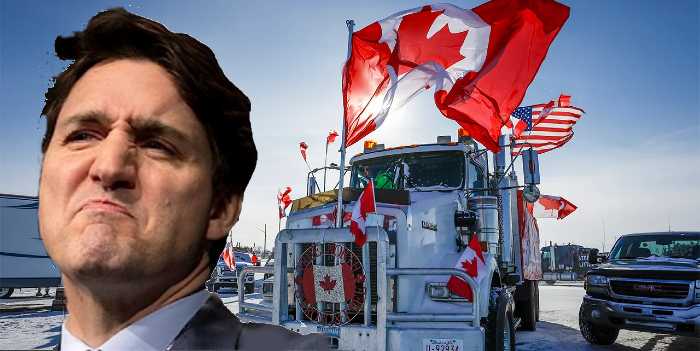 Imperative above all to remember in the quagmire that Justin Trudeau has left Canada in: Trudeau is not our country—Canada is.
Only a Trust Fund Baby with hopeless Delusions of Grandeur—which Trudeau basically is, would freeze the bank accounts of all enemies—and in the same breath remind all those affected that this will be upon us—“FOREVER!
Long lost in the annals of time is that what is happening right now in Canada is really what began happening when Trudeau threw in with Barack Obama’s Fundamental Transformation of America, extending his takeover to the Fundamental Transformation of Canada.
Imperative above all to remember in the quagmire that Justin Trudeau has left Canada in: Trudeau is not our country—Canada is.
Only a Trust Fund Baby with hopeless Delusions of Grandeur—which Trudeau basically is, would freeze the bank accounts of all enemies—and in the same breath remind all those affected that this will be upon us—“FOREVER!
Long lost in the annals of time is that what is happening right now in Canada is really what began happening when Trudeau threw in with Barack Obama’s Fundamental Transformation of America, extending his takeover to the Fundamental Transformation of Canada.They wanted all of North America under their control
Proof of this for anyone looking goes back to the Canadian Federal Election of 2015, when Obama dispatched his top election campaign team members to elect Trudeau, the insipid leader of Canada’s Liberal Party as Canada’s Prime Minister. "Barack Obama's promise to transform America was too modest. He is transforming the whole world before our eyes. Do you see it yet?" (Michael Goodwin, New York Post, March 22, 2015). Truer words have never been spoken, and here's hoping Canada's Prime Minister Stephen Harper sees it because Canada, heading toward an Oct. 19, 2015 federal election, is next on Obama's election takeover hit list. Fresh out of the Israel election, where they failed to dump Prime Minister Benjamin Netanyahu in spite of millions of dollars, top Obama campaign experts are still in Canada working to topple our staunchly pro-Israel, Christian, conservative prime minister. Why is the Obama campaign team working Canada? Primarily because current circumstances make The Land of the Maple Leaf easy pickings. The Justin Trudeau-led Liberal Party and Tom Mulcair-led New Democratic Party (NDP)—who have tried it twice before and came close—are poised to form a Coalition to rid Canada of Israel-loving Prime Minister Stephen Harper. To the U.S., Canada is the country next door, to Obama it's home of the architects of the maligned Keystone XL Pipeline and home to the world's Number One elected defender of Israel Prime Minister Benjamin Netanyahu. The Harper government shouldn't waste any time launching the same sort of bipartisan investigation into the 350,000 tax dollars paid out from the U.S. State Department that was part of the recent meddling of the Obama campaign team in Israel.Canada, unlike the U.S., should not wait until the horse is out of the barn and should not wait for rigged election polls heralding a Liberal/NDP election day coalition victory. All common sense says they.should.start.the.election.fraud.investigation.now. Now that the dust is settled we know that Obama's role in the Israel election was even larger than originally reported: "President Obama's role during the Israeli elections was larger than reported, according to a pollster for Israeli Prime Minister Benjamin Netanyahu's Likud party. (The Hill, March 22, 2015)
"What was not well reported in the American media is that President Obama and his allies were playing in the election to defeat Prime Minister Netanyahu," John McLaughlin, a Republican strategist, said in an interview on John Catsimatidis's "The Cats Roundtable" radio show broadcast Sunday on AM 970 in New York. "There was money moving that included taxpayer U.S. dollars, through non-profit organizations. And there were various liberal groups in the United States that were raising millions to fund a campaign called V15 against Prime Minister Netanyahu," McLaughlin said. "He noted that the effort to oust Netanyahu was guided by former Obama political operative Jeremy Bird, who "set up an Obama for America-like organization in Israel called V15 that was running extremely negative ads against the prime minister." "The ads hurt Netanyahu in the polls, said McLaughlin, who added the Israeli leader rebounded after delivering a speech to Congress early this month, prompting more critical V15 ads."
Obama's dabbling in the elections of foreign nations is supported by meddlers all the way from financier George Soros, to Brad Pitt, from the Rockefeller Brothers Fund to Internet giant Google
Obama's dabbling in the elections of foreign nations is supported by meddlers all the way from financier George Soros, to Brad Pitt, from the Rockefeller Brothers Fund to Internet giant Google. How can he lose? This is how an election was almost stolen in Israel: "A project of the Peaceworks Foundation, One Voice International (OVI) is an international grassroots initiative that was established in 2002 by social entrepreneur Daniel Lubetzky and several Palestinian and Israeli colleagues. (Discover the Networks)"OVI's two principal branches are One Voice Israel, headquartered in Tel Aviv, and One Voice Palestine, based in Ramallah and Gaza City. Each of these branches is far more inclined to blame Israel, rather than the Palestinians, for whatever conflicts emerge between the two sides. OV Israel, for instance, derides what it calls the "dangerous levels of apathy, cynicism, and disinterest in the two-state solution among the Israeli public." "While OVI's work is "concentrated in Israel and Palestine," the organization also has branches titled One Voice United States (OVUS) and One Voice Europe (OVE), which engage policymakers, legislators, think tanks, and advocacy organizations in their respective locales. OVUS staff, for instance, maintain regular contact with the White House, the State Department, and Congress. "A key board member of OVI is Faisal Abdul Rauf, the Muslim cleric who sought to build the so-called "Ground Zero Mosque" in New York. And the Movement's "Entertainment Council" includes such luminaries as Jason Alexander, Danny Devito, Joel Fields, Edward Norton, and Brad Pitt. "The aforementioned Peaceworks Foundation (PF)—a recipient of State Department funding and a key financial backer of OVI—came under scrutiny in February 2015 in the aftermath of a January congressional letter suggesting that PF's efforts to help OVI unseat Netanyahu in Israel may have been in violation of U.S. tax law. At issue was the fact that PF's status as a 501(c)(3) nonprofit legally precluded it from engaging in foreign or domestic political campaign activities; thus the Foundation's funding of OVI's anti-Netanyahu efforts were illegal. In response to the congressional letter, PF quickly created a new organization, PeaceWorks Action Inc. (PWA), which was free to spend money—including funds derived from PF—on whatever political matters it wished to support. "OVI is also funded by a host of other foundations, corporations, individuals, and governments—Israeli, Palestinian, and international. Among these funders—or "partners," as One Voice calls them—are the Association of British Muslims, British Muslims for a Secular Democracy, the Christian Muslim Forum, the Ford Foundation, Google, the Nathan Cummings Foundation, the New Israel Fund, the Righteous Persons Foundation, the Rockefeller Brothers Fund, the U.S. State Department, and the William & Flora Hewlett Foundation. For a more comprehensive listing of OVI's funding partners, click here.
In Canada, Obama's campaign team is guiding the election campaigns of both the Liberals and the NDP: "Justin Trudeau's Liberals have quietly been getting regular advice from Jennifer O'Malley Dillon, Barack Obama's deputy campaign manager in the last U.S. presidential campaign. (Globe & Mail, Dec. 26, 2014)
"Somewhat more openly, Tom Mulcair's New Democrats have been receiving guidance from Jeremy Bird, who was Mr. Obama's national field director. "Look closely enough, and it is possible to see the influence of those and other prominent Democrats on the Liberals' and NDP's election preparations—just not in the ways one might expect, based on some of the hype about high-tech methods set to be imported. "Insiders from both parties concede that some of the most ambitious techniques from the Obama campaigns—the sort that are said to use advanced data analytics to target messages to individual voters—are not applicable in a country with less money in its political system, stricter privacy laws that limit access to personal information, and a less predictable electorate than one in which voters register to support one of two parties. "As an example of Mr. Bird's input, New Democrats instead point to the "days of action" they have been holding every month or two, in which teams of canvassers talk to voters about a specific policy proposal or issue. Although part of the objective is to collect data about potential supporters, the point is mostly to engage and train volunteers in the hope of having a force ready to roll when the campaign begins in earnest. "The Liberals have been nudged toward more volunteer training as well. And as further evidence of taking advice from the Americans, party sources point to the $3 contributions they have been soliciting from first-time donors—a minuscule amount meant to get people in the habit of giving so that larger amounts can be sought in future. If those do not jump out as revolutionary concepts, that is somewhat the point. Much of what Democratic consultants are preaching is a sort of return to basics for parties that long neglected the painstaking work needed to build national grassroots organizations. "For a time, parties got away with that neglect more easily. Television advertising and other mass communication allowed them to get their messages out. Paid phone banks became a preferred way of identifying supporters and ensuring they voted without too many on-the-ground volunteers. Lax fundraising rules allowed the Liberals to get by mostly on corporate and large individual contributions, and the NDP on union ones. "Today, changing media consumption habits make it increasingly difficult to reach voters through mass communication, people are harder to reach by phone because they have done away with land lines or have caller ID, and corporate, union and large personal donations are banned. So parties and candidates have to work harder and more creatively to capture the attention (and dollars) of an electorate that can more easily tune them out—something that social media and other online tools can help with, but that also requires direct personal contact. "What's been proven is that successful campaigns use an integrated approach to reach voters in one-on-one conversations, whether that's online or on the ground," Mr. Bird says. "This grassroots outreach is hard work and requires a deeper investment." (Ms. O'Malley Dillon did not respond to requests for comment.) "Low levels of civic engagement do not make it easy to get boots on the ground, but this is where the Democrats' experience comes in handy. Granted, Mr. Obama was a once-in-a-lifetime candidate, engaging people who otherwise would have been bystanders. But courtesy of their deeper pockets and other resources, they were also able to test engagement methods, some of which apply in Canada. "In the broader sense, those include empowering volunteers and making them feel part of a community. So the Liberals and New Democrats now have a better sense of how quickly they need to establish personal contact after someone expresses interest in helping; how best to keep that person engaged between (rather than just during) campaigns; how they can make her feel trusted, for instance, by giving her access to their database to enter findings from a canvass rather than just asking her to hand over her clipboards. "More nuanced are recommendations for the wording of e-mails to prospective volunteers and donors to elicit the best response, and how often to ask for help before a saturation point is reached. "And as they encourage Canadian parties to use two versions of most communications to gauge which works better, they can advise what to test. (When fundraising, for example, it is apparently worth checking which dollar amounts work best. Whom the request ostensibly comes from does not make a huge difference.) "As the election draws closer, the parties' focus and the Democrats' advice will shift from organization-building to connecting with the broader electorate. And by no means is that advice limited to the basics. Liberals acknowledge, for instance, that Ms. O'Malley Dillon is helping them use their limited data to make headway on voter analytics, on which they have lagged even by Canadian standards. "But for now at least, the guidance on grassroots mobilization could give the Liberals and New Democrats an advantage, relative to whom they are up against. "The governing Conservatives are not known to be working with veterans of recent campaigns in the United States or elsewhere. Consistently outflanking their rivals on fundraising, they likely do not need help there. But partly in response to a shortage of volunteers at the riding level, their voter outreach in recent campaigns has been heavily centralized—including through reliance on phone banks. "If that approach offers diminishing returns, as even some veterans of Conservative campaigns concede it might, they may wind up behind their rivals in adapting more traditional grassroots activism to the 21st century."The following covers the track record of Obama's campaign team in Canada to date:
New Democratic Party:
- Top Obama campaign official fires up NDP convention crowd
- "One of Barack Obama's chief campaign strategists has told Canada's New Democrats to get started right now with on-the-ground organizing for the 2015 election campaign. Jeremy Bird, who served as national field director for the Democrats in the 2012 presidential election, was in Ottawa on Thursday to give the NDP his advice for winning over the voters. (Toronto Star, Jan. 16, 2014)
- "Former Obama adviser tells NDP to build strong ground game, meaningful relationships with voters, and Moneyball-style analytics to win election (Hill Times, April 13, 2013)
Liberal Party:
- "Obama campaign director Mitch Stewart consulted with Trudeau's strategists during his leadership bid (Macleans, January 6, 2014)
- "At the Liberal convention, two of the keynote speakers for the convention are managers from the Obama campaigns. One of those is the millennial digital guru Teddy Goff. Not yet 30, Goff was director of Barack Obama's digital strategy in 2012, and ran a voter outreach program credited with helping him win re-election (CBC, February 20, 2014)
- "The first day of the convention also featured a conversation between Liberal MP Chrystia Freeland and U.S. economist Larry Summers, adviser to American President Barack Obama (Globe and Mail, February 21, 2014)
- Barack Obama's assistant campaign manager, Jennifer O'Malley Dillon, spoke to Liberal delegates (Globe and Mail, February 22, 2014)
- "Two U.S. Democrats, behind-the-scenes strategists in President Barack Obama's winning 2008 campaign, will be lending some advice to federal Liberals at their convention this month. Rich Mintz, a vice-president of Blue State Digital, and Tom McMahon, a chief architect of the Democrats' so-called "50-state strategy" leading up to their 2008 victory, will be panelists on Jan. 14, when Liberals meet for their big biennial gathering in Ottawa. The session is titled "Lessons Learned" from the 2004 and 2008 Democratic campaigns (Toronto Star, January 5, 2012)
- "Mitch Stewart, who was the battleground-states director for the Obama campaign, has been sought out to speak to Trudeau's strategists on Thursday, according to officials with the Trudeau campaign. (Toronto Star, November 12, 2012)
- "In February 2009, it was reported that the Liberals purchased (at a discount) fundraising programs from the Democrats: The other glimmer of Liberal hope is political weaponry they have purchased from the Barack Obama campaign. Specifically, they have purchased computer programs and donor-targeting technology at a discount from the friendly U. S. Democrats and plan to unleash hundreds of gigabytes at crafting a master list of donors while combing the country for new support (National Post, February 3, 2009)
- "The Liberals brought the American co-founder of the VAN system, Mark Sullivan, to their convention in Vancouver, but his name did not appear on the official program released to media and sessions he led were closed to the media (Macleans, April 30, 2009)
- " Justin Trudeau bought a separate database from U.S. Democrats for his leadership campaign (Toronto Star, December 27, 2012)
- "Liberal MP Dominic LeBlanc met informally days ago with Jamal Simmons, a Democratic political analyst and Obama supporter who made frequent appearances on CNN in the last year (New Brunswick Telegraph-Journal, November 18, 2008)"
Fourteen months later, the newly-elected Trudeau held an official state dinner for then Obama vice president Joe Biden who openly lauded Trudeau as new ‘leader of the West’
Fourteen months later, the newly-elected Trudeau held an official state dinner for then Obama vice president Joe Biden who openly lauded Trudeau as new ‘leader of the West’. Safe to say that feckless Trudeau has been a self-made Legend in His Own Mind ever since. All would have went well for him had it not been for the truckers taking over Ottawa with ‘Freedom Convoy 2022’ leading to, an international protest against government tyranny, sticking more steadfastly than any store-bought glue. Trudeau’s puny insistence that “the blockade must end!” is drowned out by the truckers’ unstoppable chant of “FREEDOM!” And now Trudeau’s own massive stupidity is starting to catch up with him. Until now, The Great Reset has survived in the shadowy realm of obscurity—safely hidden there until globalists were ready to pounce their plans on an unsuspecting world. The element of surprise is necessary to see it through. But almost overnight, the first rule of the Global reset: “-- More...You will own nothing and be happy”, is already on full display in Canada. Nothing, not even Trudeau can stand in the way of the Great Reset. And no one knows that better than Klaus Schwab and the global gangs. Almost comically, they were counting on Trust Fund Baby Justin Trudeau to forge ahead with their ruthless plan—but he jumped the shark instead. No one thought to tell Trudeau to keep his powder dry, and because he didn’t his mistakes are outing others in the the Great Reset lineup—including his deadly deputy prime minister Chrystia Freeland. How long will the cunning Klaus Schwab put up with a ‘young leader’ who because of his own arrogance keeps letting the cat out of the bag? How long before Trudeau, scorned as prime minister and cast aside by the Great Reset cabal has nowhere left to run? We can now see it coming, even in the midst of the all the Fake News. Meanwhile the ‘Pandemic’ that never was is over, forcing all that promoted it to run for cover. Trudeau is not our country, Canada is. Canada is its truckers and not Justin Trudeau. In God, not government, we trust!"View Comments
Judi McLeod——Bio and Archives
-- Judi McLeod, Founder, Owner and Editor of Canada Free Press, is an award-winning journalist with more than 30 years’ experience in the print and online media. A former Toronto Sun columnist, she also worked for the Kingston Whig Standard. Her work has appeared throughout the ‘Net, including on Rush Limbaugh and Fox News.