Watching the Spots
Solar radiation and the effects on earth's climate

Dr. Klaus L.E. Kaiser , Bio and Archives--April 14, 2012
Global Warming-Energy-Environment | Comments | Reader Friendly | Subscribe | Email Us
 ...the sunspots that is. You might ask why?
The number of sunspots on the sun is changing all the time. That number is highly linked to changes in the earth’s climate. The more sunspots there are the more radiation comes to earth. In turn, more radiation means more energy received and warmer climate on earth.
...the sunspots that is. You might ask why?
The number of sunspots on the sun is changing all the time. That number is highly linked to changes in the earth’s climate. The more sunspots there are the more radiation comes to earth. In turn, more radiation means more energy received and warmer climate on earth.
Sunspots and Energy Radiation
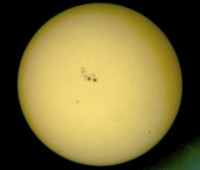
A higher number of sunspots (dark areas, Fig. 1) on the sun’s surface results in more radiation energy sent out by the sun. This is somewhat counter-intuitive. The spots themselves are colder than the other parts of the sun’s surface. Consequently, one might think that the emitted radiation energy would decline with the number of spots, but the opposite is true. The reason is that the number of sunspots is also well correlated with perturbances and sunflares. Such flares often extend for millions of miles from the sun’s surface and are known to produce strong fields of electro-magnetic wave energy. On some days, your cell phone may not work at a remote place where it usually does. When that happens, it can be because of large magnetic field disturbances in the earth’s atmosphere due to (electro)-magnetic storms arriving from the sun. In fact, a few years ago, the entire electric grid collapsed from such a storm in the Province of Quebec.
The lesson then is that the sunspots do matter.
Sunspots over the last Four centuries
Sunspots have been observed on and off by various astronomers over the last 2,000 years, but regular recordings have only available for the last three to four centuries. Sunspots appear and disappear with some kind of regularity. These cycles are called “Solar cycles” or “Solar magnetic activity cycles” and culminate at variable times, but are averaging approximately 11 years. On top of such short term cycles, there are more irregular longer term cycles of periods of strong or weak intensity. Fig. 2 demonstrates that. During the Maunder Minimum (approximately 1650 to 1725) and the first quarter of the 19th century, and again for a period around the year 1900, the 11-year cycle peaks (maxima) were much smaller than in the intervening times or since then.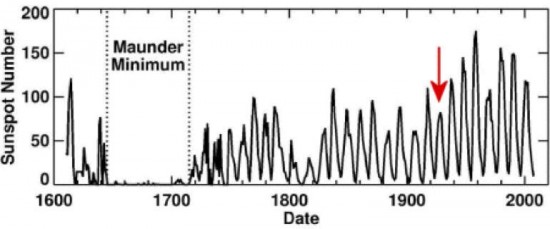 Of particular interest is the Maunder Minimum during the second half of the 17th and the early 18th century. It was period of extraordinary cold winters in Europe and North America called the “Little Ice Age.” The painter Jan Grif(f)ier (the elder, ca. 1652–1718) recorded the situation in his work The Great Frost in 1683. Many people succumbed to the severe temperatures and concurrent lack of food from the shortened lengths of the growing seasons.
 When looking at the longer term variations of the peaks of sunspot cycles, one may wonder when the next strong (longer-term) downturn may come about. Some ominous signs are on the horizon: According to predictions by NASA scientists, the current cycle will reach its peak later this year or in 2013, but at a lower maximum than in the previous cycles, more or less reminiscent of the peak in 1928 (indicated by the red arrow) is anticipated to follow thereafter. The next minimum number of spots will then occur around 2019 and, after that, all bets are off.
Current longer term predictions by NASA are for low activity over several decades to come. If that comes true, another mini-ice-age could be in the offing as well.
Watch the spots and keep warm!
When looking at the longer term variations of the peaks of sunspot cycles, one may wonder when the next strong (longer-term) downturn may come about. Some ominous signs are on the horizon: According to predictions by NASA scientists, the current cycle will reach its peak later this year or in 2013, but at a lower maximum than in the previous cycles, more or less reminiscent of the peak in 1928 (indicated by the red arrow) is anticipated to follow thereafter. The next minimum number of spots will then occur around 2019 and, after that, all bets are off.
Current longer term predictions by NASA are for low activity over several decades to come. If that comes true, another mini-ice-age could be in the offing as well.
Watch the spots and keep warm!View Comments
Dr. Klaus L.E. Kaiser——Bio and Archives
Dr. Klaus L.E. Kaiser is author of CONVENIENT MYTHS, the green revolution – perceptions, politics, and facts Convenient Myths