

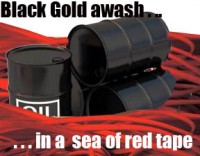
 Most people do not understand what drives the price of oil but readily accept the explanation pushed by this administration that it is the unbounded greed of oil companies and their “fat cat owners.” Oil companies are publicly traded and many Americans and other foreign nationals or entities can own stock or bonds in these firms.
Most economists agree that the oil industry is an oligopoly, a market dominated by a few sellers, synonymous in developed countries with “big business.” An insidious form of oligopoly, which dominates the oil industry, is the cartel. The cartel’s firms join forces to control production, sale, and the price of oil.
Who Controls the Price of Oil?
Liberals believe that supplies should be rationed through deliberate higher prices in order to protect the planet from unnecessary pollution.
 Most people do not understand what drives the price of oil but readily accept the explanation pushed by this administration that it is the unbounded greed of oil companies and their “fat cat owners.” Oil companies are publicly traded and many Americans and other foreign nationals or entities can own stock or bonds in these firms.
Most economists agree that the oil industry is an oligopoly, a market dominated by a few sellers, synonymous in developed countries with “big business.” An insidious form of oligopoly, which dominates the oil industry, is the cartel. The cartel’s firms join forces to control production, sale, and the price of oil.
OPEC, the most notable and successful cartel, controls 44 percent of the world’s crude oil production and 79 percent of world’s crude oil reserves. By restricting output, its members, Algeria, Angola, Ecuador, Iran, Iraq, Kuwait, Libya, Nigeria, Qatar, Saudi Arabia, United Arab Emirates and Venezuela, quadrupled the price of oil between 1973-1974 and 1979-1980.
OPEC should not be able to burden consumers to the same extent now because large oil reserves were discovered in Alaska, North Sea, Canada, and the Gulf of Mexico. However our business-killing EPA regulations and Obama’s seven-year moratorium on drilling in the Gulf do.
When oligopolists organize themselves in a successful cartel such as OPEC, prices will be higher and outputs lower. Cartels are illegal in the U.S. even though some companies such as railroad and gas pipeline transportation behave like cartels under regulations that prevent firms from undercutting prices.
According to the Wall Street Journal, Exxon’s margin of profit for both oil and gas ranks #60. There are 59 more profitable industries than the oil industry. Oil and gas firms profit 8 cents per dollar of sales. Pharmaceuticals profit 20 cents and banks profit 18 cents per dollar of sales.
According to the Report to Congress made in April 2008 called “Oil Industry and Profit Review,” the factors contributing to high gas prices were:
- world unrest
- increases in the price of crude oil that pushed the spot price of West Texas Intermediate (a key oil price in determining market prices)
- tight market conditions
- demand growth in China, India and other parts of the developing world
- political unrest in Nigeria, Venezuela, Iraq, Iran and other parts of the world
- the decline of the value of the U.S. dollar on world currency markets
- investment strategies of financial firms on the oil futures markets
- volatility of the world oil and financial markets
- refineries are not particularly profitable
- environmentalists fight planning and construction every step of the way
- government red tape makes the task almost impossible
Read next: Electricity prices across Canada up 88% since 2000
Email Us | Reader Friendly | Comments
Dr. Ileana Johnson Paugh——Bio and Archives
Dr. Ileana Johnson Paugh, Ileana Writes is a freelance writer, author, radio commentator, and speaker. Her books, “Echoes of Communism", "Liberty on Life Support" and "U.N. Agenda 21: Environmental Piracy," "Communism 2.0: 25 Years Later" are available at Amazon in paperback and Kindle.