Zero Carbon Equals Economic Catastrophe
Despite the UN's claims to the contrary, the evidence is mounting that emissions reductions harm our economies.

Sierra Rayne , Bio and Archives--July 12, 2014
Global Warming-Energy-Environment | Comments | Reader Friendly | Subscribe | Email Us
Apparently "zero carbon and economic growth can go together, UN study says." The Guardian is featuring a new UN study led by Jeffrey Sachs, and released by the UN secretary general Ban Ki-moon, called "Pathways to Deep Decarbonization."
Anytime I hear that a UN study says something, I assume reality will be the complete opposite. And in this case, once again, it will be. Quite simply, concepts like "zero carbon" and "deep decarbonization" will result in severe economic harm. And the data to support these concerns are unequivocal. Everywhere we look, jurisdictions that have taken measures to reduce carbon dioxide emissions have seen substantial economic damage. We can list a few -- British Columbia, Denmark, the United Kingdom, Australia, and on it goes. The UN study attempts to model the impacts of massive reductions in carbon dioxide emissions on the economies of 15 nations over the coming decades. For the following non-Annex I parties to the United Nations Framework Convention on Climate Change, there are no reliable and continuous historical carbon dioxide emission records: Brazil, China, India, Indonesia, Mexico, South Africa, and South Korea. Other than perhaps South Korea, I'd also be skeptical of the economic data coming from these nations. Any subsequent UN attempts to discuss the greenhouse gas emission trends -- and potential impacts thereon -- for these countries is effectively a waste of time. Garbage data in equals garbage data out.
If we restrict our analyses to the Annex I Western nations with more reliable economic and emissions datasets considered in this UN report -- i.e., Australia, Canada, France, Germany, the UK, and the USA -- the negative effects of decarbonization are clear. Between 1990 and 2000, the average annual real per capita GDP growth rate among these nations was 2.2 percent and per capita carbon dioxide emissions were approximately steady (increasing slightly at 0.02 percent per year). There was no hint of a significant correlation between economic growth and carbon dioxide emissions (p=0.97). From 2000 to 2006, per capita carbon dioxide concentrations had generally started to fall, but only slightly -- at an average of 0.4 percent per year. Economic growth averaged 1.7 percent annually. Once again, no evidence of a significant correlation between carbon dioxide emissions and economic growth was present (p=0.43). Then along comes the 2006 to 2012 period, whereby all of these nations began implementing a range of measures designed specifically to reduce greenhouse gas emissions. And it worked. Over this time-frame, all countries saw significant declines in per capita carbon dioxide emissions, ranging from 0.4 percent per year for Germany up to 3 percent annually for the UK, averaging 1.8 percent annually for the six nations. Annual economic growth plummeted, averaging just 0.4 percent for the group. But here is where the difference is. From 2006 to 2012, a highly statistically significant relationship (p=0.002, r=0.97) existed between per capita carbon dioxide emission reductions and economic growth, as the figure below shows.
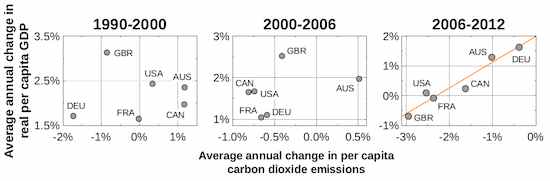 The lack of correlation between changes in carbon dioxide emissions and economic growth during the 1990-2000 and 2000-2006 periods breaks the general causation argument that lower economic growth will result in lower emissions. Conversely, the strong relationship we see between 2006 and 2012 supports the view held by many -- that efforts to purposefully reduce carbon dioxide emissions will harm our economies.
If economic growth -- or a lack thereof -- was a robust, general determinant of carbon dioxide emissions among these developed nations, we would expect to see significant correlations between the variables in all three time periods. But that's not what we find. From 1990 to 2006, when carbon dioxide emissions were changing very little among the nations, economic growth appears to have been largely decoupled from carbon dioxide emission trends. After 2006, once these nations collectively began focusing on emissions reductions through a variety of mechanisms and emissions started to decline substantially, then a clear relationship emerged between emissions and growth rates.
Other factors are also at play in defining growth rates, particularly in the period including and following the global financial crisis. That said, the emergence of this strong correlation -- along with the other region-specific evidence put forward to date in prior articles -- is very suggestive of a linkage between efforts to reduce greenhouse gas emissions and subsequent economic damage.
For these reasons, the UN's claims that these national economies will grow at relatively rapid rates even as they are effectively entirely decarbonized over the span of only a few decades seems implausible given the recent evidence at hand. The developing nations get this already, which is why "India, Brazil, South Africa and China have said they will not agree to any binding cuts in their emissions." Why? Because they recognize severe economic damage will result.
What kind of emissions reductions is the UN report thinking are required?
The lack of correlation between changes in carbon dioxide emissions and economic growth during the 1990-2000 and 2000-2006 periods breaks the general causation argument that lower economic growth will result in lower emissions. Conversely, the strong relationship we see between 2006 and 2012 supports the view held by many -- that efforts to purposefully reduce carbon dioxide emissions will harm our economies.
If economic growth -- or a lack thereof -- was a robust, general determinant of carbon dioxide emissions among these developed nations, we would expect to see significant correlations between the variables in all three time periods. But that's not what we find. From 1990 to 2006, when carbon dioxide emissions were changing very little among the nations, economic growth appears to have been largely decoupled from carbon dioxide emission trends. After 2006, once these nations collectively began focusing on emissions reductions through a variety of mechanisms and emissions started to decline substantially, then a clear relationship emerged between emissions and growth rates.
Other factors are also at play in defining growth rates, particularly in the period including and following the global financial crisis. That said, the emergence of this strong correlation -- along with the other region-specific evidence put forward to date in prior articles -- is very suggestive of a linkage between efforts to reduce greenhouse gas emissions and subsequent economic damage.
For these reasons, the UN's claims that these national economies will grow at relatively rapid rates even as they are effectively entirely decarbonized over the span of only a few decades seems implausible given the recent evidence at hand. The developing nations get this already, which is why "India, Brazil, South Africa and China have said they will not agree to any binding cuts in their emissions." Why? Because they recognize severe economic damage will result.
What kind of emissions reductions is the UN report thinking are required?
"This 2050 level translates to a benchmark of 1.6 tons of CO2-energy emissions per capita by 2050, assuming a global population of 9.5 billion by 2050, in line with the medium fertility projection of the UN Population Division."To get to these levels would require the following percentage reductions from current emissions over the next 35 years: Australia, 91%; Canada, 90%; France, 71%; Germany, 84%; the UK, 79%; and the USA, 91%. Emissions reductions of over 90 percent in just over three decades while maintaining strong economic growth? Not likely, given what we've seen over the past several years in nations that have made concerted efforts to cut emissions even modestly. Unsurprisingly, the UN proposal reads like an exercise in central planning:
"The Country Teams underscore that successful implementation of national DDPs [Deep Decarbonization Pathways] depends on 'directed technological change' -- that is technological change that is propelled through an organized, sustained, and funded effort engaging government, academia, and business with targeted technological outcomes in mind. No Country Research Team was comfortable assuming that their country alone could develop the requisite low-carbon technologies. Likewise, market forces alone will not be sufficient to promote the required RDD&D [research, development, demonstration, and diffusion] at the right scale, timing, and coordination across economies and sectors -- even when these market forces are guided by potential large profits from the generation of new intellectual property. Technological success will therefore require a globally coordinated effort in technology development, built on technology roadmaps for each of the key, pre-commercial low-carbon technologies. Directed technological change should not be conceived as picking winners, but as making sure the market has enough winners to pick from to achieve cost-effective low-carbon outcomes."In sum, we can't rely on the free market, so a group of globalist individuals will choose the most promising technologies -- but remember, we're not picking winners. No, of course not. Actually, picking winners is exactly what the UN is proposing. Who will pick these winners? A group of well-connected, and undoubtedly financially vested, people in "government, academia, and business." Sounds like a perfect recipe for crony capitalism, all on the taxpayer's dime. Of course, this statement from the UN report also cannot go without comment:
"The overall relation between cumulative GHG emissions and global temperature increase has been determined to be approximately linear."Sure it is. That's why the plot of global temperature versus cumulative global GHG emissions by year since 1998 looks like this.
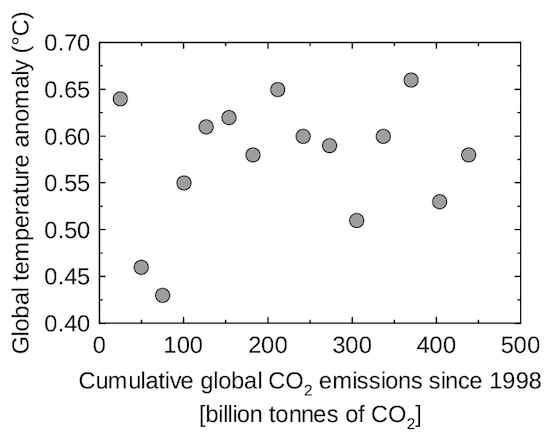 Well, I guess it is approximately linear. A horizontal line perhaps, with no statistically significant relationship between global carbon dioxide emissions and global temperature since at least 1998.
More of these spin efforts will be attempted as the alarmists try to build an international case for a 2015 Global Climate Accord, but they must be rejected. All the economic and climate policy datasets so far tell a consistent story -- zero carbon is inconsistent with strong and stable economic growth at this point in time.
Well, I guess it is approximately linear. A horizontal line perhaps, with no statistically significant relationship between global carbon dioxide emissions and global temperature since at least 1998.
More of these spin efforts will be attempted as the alarmists try to build an international case for a 2015 Global Climate Accord, but they must be rejected. All the economic and climate policy datasets so far tell a consistent story -- zero carbon is inconsistent with strong and stable economic growth at this point in time.
View Comments
Sierra Rayne——Bio and Archives
Sierra Rayne holds a Ph.D. in Chemistry and writes regularly on environment, energy, and national security topics. He can be found on Twitter at @srayne_ca