

By News on the Net -- Lori Naranjo——Bio and Archives--September 2, 2026
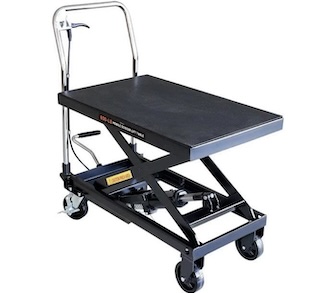
Canadian workshops and stores handle a great deal by hand, and the injuries that come from it accumulate quietly. A scissor lift table raises a load by about two and a half feet, which is not much height and is exactly the gap that matters.
Almost nothing in a workplace needs to go high. What things need is to arrive at the same level as whatever they are moving to, and the difference between a pallet on the floor and a bench top is roughly that distance. A scissor lift table exists for the gap rather than the height.

A workbench sits near thirty six inches, a truck tail lift somewhere between two and four feet, and a conveyor wherever it was installed. A table that spans that range lets a load be slid across rather than lifted across.
Sliding is the objective. A 660 pound scissor lift table set level with the destination turns a lift into a push, and pushing at waist height is a fundamentally different demand on the back than lifting from the floor.
Guidance across every jurisdiction says the same thing. Keep loads between mid thigh and shoulder height, keep them close to the body, and avoid bending and twisting, and a height adjustable surface addresses all three at once.
Working out how to avoid lifting injuries at work usually ends here: raising a table with a hand lever means letting go of whatever is on it. Pedal operation leaves both hands free to steady a load while it moves, which is when an unstable item is most likely to shift.
Capacity assumes weight distributed across the platform. Anything overhanging the edge loads the scissor mechanism unevenly, and a long item balanced across a small table is the arrangement most likely to tip it.
A mobile table rolls to where it is needed and locks there. Moving a raised load on castors puts a high center of gravity on small wheels, and the correct sequence is lower, unlock, move, lock, and raise again.

• Lift table: removes the height difference
• Pallet truck: removes the carry, not the bend
• Hoist: removes the lift, needs a fixed point
• Strength: turns lifting into sliding at waist height
• Strength: both hands stay on the load
• Limit: overhanging loads unbalance the mechanism
• Limit: move it lowered rather than raised
Weighed against a bench and a pair of hands, a table costs floor space and returns the bend that used to happen forty times a day. A parts shop near Halifax put one between the receiving door and the shelving and describes the change as nobody kneeling on the floor any more.
Canadian employers increasingly change the task rather than the technique, following guidance that treats equipment as a more reliable control than instruction, which has moved height adjustable surfaces into ordinary workshops.
That shift toward designing the lift out is why the material handling equipment TMG Industrial supplies is specified by working height as much as by capacity.
-- Lori Naranjo covers topics of New Technology in the digital age.
View Comments
News from around the world