

By Fraser Institute ——Bio and Archives--March 20, 2025
Canadian News, Opinion | CFP Comments | Subscribe | Email Us
VANCOUVER—Despite fears about mass unemployment, the adoption of artificial intelligence (AI), like past major technological innovations, will transform economies, raise living standards, and likely contribute to net job creation, finds a new study published today by the Fraser Institute, an independent, non-partisan Canadian public policy think-tank.

“Like the printing press, the steam engine, the telephone and computers, AI is a transformative innovation that will likely have profound economic and social consequences, create new opportunities, and be a net positive economic development in the long run,” said Steven Globerman, Fraser Institute senior fellow and author of What the History of Technological Change Tells Us About the Likely Economic Consequences of Artificial Intelligence.
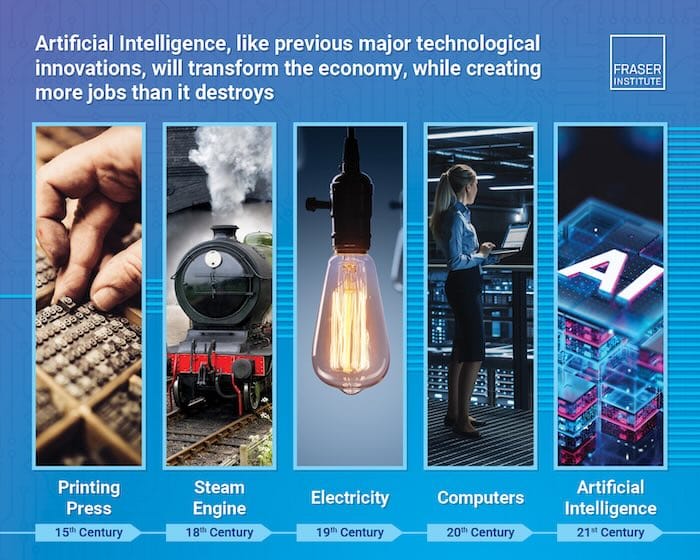

Notwithstanding the positive economic effects of previous major technological innovations, some observers want strict government regulations of AI to protect workers from mass unemployment and reduced wages. Historical experience with previous so-called General Purpose Technologies (for example, the printing press, the steam engine, telephones and computers) suggests that these fears are largely unfounded.
In particular, the adoption of other General Purpose Technologies has generally been a slow process, often taking decades to be widely used in business. This is also proving to be the case with AI, which will provide time for businesses and workers to adapt to this innovation and the changing business environment.
Crucially, while AI will bring about a decline in demand for specific occupations and skills, the rise of new businesses and industrial activities linked to AI will create demand for new skills and jobs complementary to AI. In other words, if the experience of previous technological breakthroughs are a guide, AI will create more new jobs than it displaces.
“History shows that major innovations lead to the creation of new industries and jobs, and while some occupations may disappear due to AI, the overall impact of AI will be to expand employment opportunities and increase wages” Globerman said.
Media Contact:
Steven Globerman, Senior Fellow, Fraser Institute
To arrange media interviews or for more information, please contact:
Emily Rigden, Fraser Institute
604-688-0221 ext. 620
emily.rigden@fraserinstitute.org
View Comments
The Fraser Institute is an independent Canadian public policy research and educational organization with offices in Vancouver, Calgary, Toronto, and Montreal and ties to a global network of 86 think-tanks. Its mission is to measure, study, and communicate the impact of competitive markets and government intervention on the welfare of individuals. To protect the Institute’s independence, it does not accept grants from governments or contracts for research. Visit fraserinstitute.org.
Follow the Fraser Institute on Twitter | Like us on Facebook