

By Dr. Lawrence Sasaki ——Bio and Archives--November 18, 2026
So then because thou art lukewarm, and neither cold nor hot, I will vomit you out of my mouth. Revelation 3:16
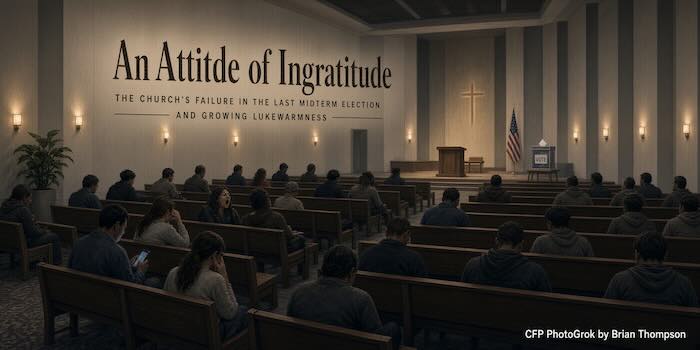
Soon, Thanksgiving will be upon us. A time of family, friends and sharing a meal, thanking the Lord for His bounty. But, there is a lot of ingratitude as exemplified by the results of the recent midterm elections. Voters did not get what they wanted from the Republican party and they punished them. In “I Want What I Want When I Want It”[1], Steve Rossiter highlights that we have devolved into an impatient, entitlement mentality.

This attitude, in the wider postmodern world driven by “my” feelings, is understandable. Unfortunately, the Spirit of the Age has seeped into the church producing narcissistic Christians which is an oxymoron. Chuck Lawless calls ingratitude a sin. In “7 Things the Sin of Ingratitude Reveals about Us”[2], he says
It’s Thanksgiving season, when we spend time expressing our gratitude to God and each other. I fear, though, that our thanksgiving is too often limited to the holiday we will celebrate next week. We’re like the nine healed lepers who failed to return to Jesus with praise and thanksgiving (Luke 17:11-19). What, then, does the sin of ingratitude reveal about us?
He highlights that ingratitude reveals covetousness, pride, selfishness, narcissism, materialism, unthankfulness, and false worship. This ingratitude belies a lukewarm faith.
The charismatic movement of the 1970s has produced shallow Christians as evidenced by the coming and going of various spiritual fads in the church.
In the evangelical world, this all ties in with “cheap grace”, that all I have to do is utter the “sinner's prayer” and that's all I need to do. Such shallowness leads to licence and other anti-biblical behaviour. Faith demands total commitment. Jesus Himself said that the cost of faith is everything.
He that loveth father or mother more than me is not worthy of me: and he that loveth son or daughter more than me is not worthy of me. Matthew 10:37
He is saying that He must be all in all in our lives. Anything less falls woefully short. This goes back to the first and great commandment
And thou shalt love the LORD thy God with all thine heart, and with all thy soul, and with all thy might. Deuteronomy 6:5
We are to live a life of faith in action.
Even so faith, if it hath not works, is dead, being alone. 18Yea, a man may say, Thou hast faith, and I have works: shew me thy faith without thy works, and I will shew thee my faith by my works. 19Thou believest that there is one God; thou doest well: the devils also believe, and tremble. 20But wilt thou know, O vain man, that faith without works is dead? James 2:17-20
James is saying that faith apart from works is dead. We do not do works to earn salvation. Salvation is a free gift. Our works come out of us because we are saved. If your life does not reflect the risen Saviour, your faith is dead. What are works? It is being salt and light to a dying world, not living a cloistered life of faux-worship but confronting evil where it lives.
The sad part is that most Christians are slaves and don't know it. This is what I talked about in “The Prison of the Mind--Will You Be Free or Slave”[3]. We think we are free in Christ, but we are locked in a prison of our own minds. We have built it, brick by brick, bar by bar until we are totally confined. We see the world dying around us and we are unable to do anything about it. We know the solution, but we daren't speak it. We think we are safe in our little enclaves, but when the world dies, we will die with it. The light will go out, and we will be in a very dark place indeed.
We have trusted in man, and that trust has been misplaced.
Thus saith the LORD; Cursed be the man that trusteth in man, and maketh flesh his arm, and whose heart departeth from the LORD. Jeremiah 17:5
In “Letter to the American Church”[4], Erik Metaxas cites the parable of the talents. To one was given ten talents, to another five talents and to the last one talent. The first two acted upon the trust bestowed up them and gained an increase for which they were justly rewarded. The last one, fearing his “harsh Master”, buried it so that it would still be there when the master returned. This applies to us. Are we proclaiming “Thus saith the Lord” or are we taking our talent and burying it by playing it safe? It is a chilling thought, as the fate of the one who buried his talent is our fate.
And cast ye the unprofitable servant into outer darkness: there shall be weeping and gnashing of teeth. Matthew 25:30
This is what Paul warned the Hebrews about, being unfaithful by playing it safe[5], hiding in synagogues during Nero’s persecution of the church.
I remember, during the “Arab Spring”, a video surfacing of Islamists addressing seven Christians. There they were, wearing orange jump suits, kneeling on the beach. Each was given a choice, recant or be beheaded. Each one chose to stand with Christ, and each one was beheaded.
Polycarp is another who had to make a choice, to recant or die. He chose to stand with Christ. His dying words have become immortal: “Eighty-six years I have served Him, and He hath done me no wrong. How then can I blaspheme my King and my Savior?” Only true conviction and courage would result in such boldness.
Do we have that kind of faith? Or are we just saying we have faith? Do we fear God or do we fear man? Do we cringe at the thought of being called out as a homophobe, a misogynist, a transphobe, a “conspiracy theorist”, an Islamophobe, a “white supremacist” by a leftist social media mob? Does our standing in the crowd mean that much to us? Or do we fear the consequences of our mishandling of the talents God has given us? Is our faith that shallow? Remember what Jesus said:
And fear not them which kill the body, but are not able to kill the soul: but rather fear him which is able to destroy both soul and body in hell. Matthew 10:28
There is a storm brewing on the horizon. Do we have the conviction of these men to stand strong in the faith? Or will we stand aside and try to wait out the storm? If so, what do you think you will hear come judgement day?
His lord said unto him, Well done, thou good and faithful servant: . . . enter thou into the joy of thy lord. Matthew 25:21
Or
Cast ye the unprofitable servant into outer darkness: there shall be weeping and gnashing of teeth. Matthew 25:30
It is time cast off the shackles of our minds and be free in the Lord. There is a world out there that needs Jesus. Think about it. The choice is yours.
View Comments