

By Dr. Ileana Johnson Paugh ——Bio and Archives--June 13, 2016


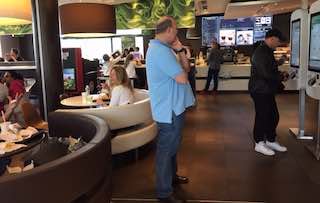 Unable to find the hotel immediately, we stopped at an ultra-modern Donald’s to ask for directions since I speak Italian fluently. A most unusual fast food restaurant, this McDonald’s offered a coffee bar with donuts, Danishes, croissants, and other delicious pastries. Three large electronic screens recorded orders, the chosen seating area, and took payment in cash or credit card. A runner would bring the food once it was cooked. I can see this McDonald’s as the model for all the areas where minimum wage job holders have protested and demanded $15 per hour, “a living wage” for unskilled labor.
Once we settled into the hotel, we took the metro into Milan, Linea Verde, the green line to the Duomo. We exited below the imposing flying buttresses of the Duomo, stark white in the sunlight. We walked around in the crowded piazza filled mostly with Italian tourists, Muslim immigrants, and a few German, British, and French tourists. I was surprised to see a few Muslim couples take pictures of the majestic gothic cathedral, a place of Christian worship and of western civilization.
Dedicated to Santa Maria Nascente, St. Mary of the Nativity, the Duomo di Milano is the second largest church in Italy after St. Peter’s Basilica in Rome; it is the seat of the Archbishop of Milan, currently Cardinal Angelo Scola. The Italian gothic cathedral took six centuries to complete, a perfect example of beauty that cannot be rushed.
The focal point of Milan, the first Duomo called the Basilica Nuova, was dedicated to St. Thecla and was completed in 355 A.D. The construction of the current Roman Catholic basilica, built in Italian Gothic architectural style, began in 1386 and was completed in 1965. The construction group was called “Fabbrica del Duomo” and had 300 employees. The enterprise had exclusive rights to use the marble from the Candoglia quarry and was exempt from taxes.
Even though half of the basilica was completed by 1402, work stalled until 1480, lacking money and ideas. During this period the tombs of Marco Carelli and Pope Martin V (1424) were completed. The octagonal cupola was built during 1500-1510 under Ludovico Sforza and four series of 15 statues with characters from the Bible such as prophets, saints, sibyls were added to the interior. Amadeo’s Little Spire, a Renaissance piece that harmonized well with the gothic exterior, was added in 1507-1510. In 1552 a large organ was built by Giacomo Antegnati for the north side of the choir. Giuseppe Meda and Federico Borromeo decorated the altar with the sixteen pales. St. Bartholomew and the Trivulzio candelabrum were added.
Unable to find the hotel immediately, we stopped at an ultra-modern Donald’s to ask for directions since I speak Italian fluently. A most unusual fast food restaurant, this McDonald’s offered a coffee bar with donuts, Danishes, croissants, and other delicious pastries. Three large electronic screens recorded orders, the chosen seating area, and took payment in cash or credit card. A runner would bring the food once it was cooked. I can see this McDonald’s as the model for all the areas where minimum wage job holders have protested and demanded $15 per hour, “a living wage” for unskilled labor.
Once we settled into the hotel, we took the metro into Milan, Linea Verde, the green line to the Duomo. We exited below the imposing flying buttresses of the Duomo, stark white in the sunlight. We walked around in the crowded piazza filled mostly with Italian tourists, Muslim immigrants, and a few German, British, and French tourists. I was surprised to see a few Muslim couples take pictures of the majestic gothic cathedral, a place of Christian worship and of western civilization.
Dedicated to Santa Maria Nascente, St. Mary of the Nativity, the Duomo di Milano is the second largest church in Italy after St. Peter’s Basilica in Rome; it is the seat of the Archbishop of Milan, currently Cardinal Angelo Scola. The Italian gothic cathedral took six centuries to complete, a perfect example of beauty that cannot be rushed.
The focal point of Milan, the first Duomo called the Basilica Nuova, was dedicated to St. Thecla and was completed in 355 A.D. The construction of the current Roman Catholic basilica, built in Italian Gothic architectural style, began in 1386 and was completed in 1965. The construction group was called “Fabbrica del Duomo” and had 300 employees. The enterprise had exclusive rights to use the marble from the Candoglia quarry and was exempt from taxes.
Even though half of the basilica was completed by 1402, work stalled until 1480, lacking money and ideas. During this period the tombs of Marco Carelli and Pope Martin V (1424) were completed. The octagonal cupola was built during 1500-1510 under Ludovico Sforza and four series of 15 statues with characters from the Bible such as prophets, saints, sibyls were added to the interior. Amadeo’s Little Spire, a Renaissance piece that harmonized well with the gothic exterior, was added in 1507-1510. In 1552 a large organ was built by Giacomo Antegnati for the north side of the choir. Giuseppe Meda and Federico Borromeo decorated the altar with the sixteen pales. St. Bartholomew and the Trivulzio candelabrum were added.
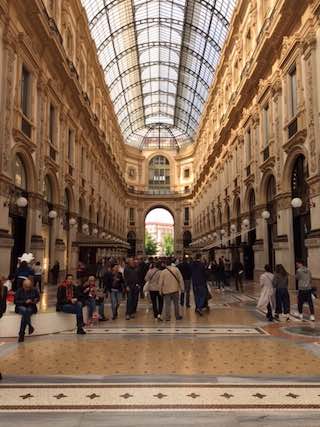 We had our first pizza and gelato in Savini, inside the beautiful Vittorio Emanuele II Galleria. Connecting Piazza del Duomo to Piazza della Scala, the walking mall, designed by Giuseppe Mengoni and completed in 1877, is covered by two glass-vaulted arcades which meet in an octagon.
Nicknamed “il salotto di Milano” because of its many restaurants and shops where strolling locals meet, the Milanese Galleria, which inspired the use of the term for our modern shopping malls, displays four mosaics in the octagon, representing the coat of arms of the three capitals of the Kingdom of Italy, Turin, Florence, and Rome, and the coat of arms of Milan.
The bull from the Turin coat of arms is a bit worn and damaged due to the superstition that if one spins around three times with the heel on the testicles of the bull, good fortune will follow.
The Milanese Galleria connects two other famous landmarks, the Duomo and Teatro alla Scala. At the end towards the famous La Scala theater, a most interesting museum, Leonardo, displays the famous machines that Leonardo’s fertile scientific mind had envisioned and drawn.
On our last trip, in addition to luxury retailers selling paintings, books, leather goods, haute couture, and jewelry, there was a McDonald’s appearing at odds with the famous restaurants, cafes, and bars such as Biffi Café, founded in 1867 by Paolo Biffi, the pastry chef to the monarch, the Savini restaurant, and the Camparino with its Art Nouveau style.
McDonald’s lost its lease in 2012 after 20 years of occupancy. A lawsuit followed in which McDonald’s was asking for €24 million in damages from the city of Milan, their landlord, €6 million per year in sales lost due to the non-renewal of the lease. A second Prada store occupied McDonald’s location. The suit was eventually dropped after McDonalds was offered the chance to open a restaurant in a nearby location. McDonalds offered free food and drinks during the last few hours of operation in the posh location.
Leonardo3 Museum is located at the entrance to the Milanese Galleria from Piazza della Scala. Touted as “one of the most important events of the year,” The World of Leonardo Exhibition (March 1, 2013-December 31, 2016) displays working models of Leonardo’s machines, his inventions and artistry brought to life, and the digitized restorations of his paintings.
Among more than 200 interactive 3D reconstructions, some of Leonardo’s machines are hanging from the ceiling such as the submarine, the time machine, the mechanical dragonfly, the rapid-fire crossbow, and the mechanical eagle. Additionally, there is a digital restoration of the Last Supper, of La Gioconda, and reconstructions of his musical instruments. Leonardo da Vinci’s codices are also displayed in virtual format.
On a rainy day, we walked not far from the Duomo, across the damp and slightly foggy Parco Sempione, one of the city’s largest parks, where the Sforza Castle (Castello Sforzesco) was visible in the background, its dark and foreboding brick and grey stone weathered by time. Built in 1360-1499 by Francesco Sforza, Duke of Milan, on the ruins of a 14th century fortification, the castle was in use until 1862. Renovated in the 16th and 17th centuries, it became one of the largest citadels in Europe. Sforza Castle was extensively restored by Luca Beltrami in 1891-1905 and it now houses several city museums and art collections fanned across the inner courtyard.
The castle has a square plan with 200 m-long sides, four towers in the corners and 7 meter-thick walls. The Visconti lords used it as city residence until they were ousted in 1447 and the castle was destroyed by the Golden Ambrosian Republic. Francesco Sforza defeated them and turned the Castello into his private residence three years later. Torre del Filarete (Filaret’s Tower) bears the name of the architect and sculptor Filarete who was hired to design and decorate it.
Ludovico Sforza hired artists to decorate the castle, among them Leonardo da Vinci, whose frescoes decorate several rooms. Bramante painted frescoes in the Sala del Tesoro and the Sala della Balla. Leonardo painted the ceiling of the Sala delle Asse with vegetable motifs.
The castle was damaged by assaults from various French, Italian, and German troops. In 1521 the Torre del Filarete exploded, following placements of mines around its foundation and having been used as a weapons depot.
Francesco II Sforza restored and enlarged the fortress when he returned briefly to power and adapted part of it as residence for his wife, Christina of Denmark.
The Spanish dominated the castle next and it became a citadel with a garrison of 1,000-3,000 men ran by a castellan. The external fortifications were 3 km long, covering an area of 25.9 hectares. When the Austrians of Lombardy replaced the Spanish rule, the castle remained a fort with trenches dug around the castle during Napoleon’s rule. Most of the outer fortifications were demolished during the Cisalpine Republic.
On the city side of the castle there is a semi-circular Piazza Castello with radial streets bound by the Foro Buonaparte. On the wooded side of the castle there is a parade ground known as Piazza d’Armi.
After Italy was unified in the 19th century, the castle became the property of the city of Milan. That is when the former parade grounds were transformed into Parco Sempione, the largest parks in the city.
Heavily damaged in 1943 by the allies’ bombardment of Milan, the castle was reconstructed after the war by the BBPR architects for the purpose of housing museums. Currently, the Sforza Castle has exhibits antique art, arms, sculptures and furniture, decorative arts, musical instruments, prehistoric and Egyptian archeology, the quarters of the Spanish hospital, and the Leonardo hall.
The Museum of ancient art houses 2,000 pieces of Late-Antiquity, Medieval and Renaissance sculpture in Lombardy. Containing Sforza and Spanish era decorations, the museum displays an armory, the funerary monument of Gaston the Foix, the funerary monument of Barnabo Visconti, and the famous Rondanini Pieta by Michelangelo, his last and unfinished work.
The picture gallery contains about 1,500 works by famous painters like the Venetian Canaletto, Giambattista Tiepolo, and Francesco Guardi. Among them are wooden bas-reliefs and sculptures in terracotta and marble. Canaletto’s famous “A view of the wharf of Venice” graces the halls of the Pinacoteca.
The Vinciana Collection holds 5,000 volumes, including manuscripts, and over 2,000 photographs on Leonardo da Vinci. It is the most important place for research on Leonardo.
The Art Library contains 91,000 volumes with some rare and antique editions. The library catalogue is available on-line.
The history of personal archives of famous archeologists and numismatists is found in the Archeological and Numismatic Library. Founded in 1808, it contains 33,000 modern volumes, 1,125 antique volumes, 700 titles of periodicals, audiovisual materials, and historical archives.
The Trivulziana Library and City Historical Archive is a historical preservation library that owns 180,000 volumes, including manuscripts dating back to the 8th century and the most famous Notebook by Leonardo da Vinci.
Works of engravers, ceramists, sculptors, gold and silver smiths, armourers, and tapestry weavers made from glass, brass, gold, silver, porcelain, and silk brocade are displayed in the Museum of Decorative Arts.
Walking a few blocks from the park, there is a famous but simple church, Chiesa di Santa Maria delle Grazie (Holy Mary of Grace) which houses in the refectory of the convent the mural of Leonardo da Vinci’s famous Last Supper. Its official name under UNESCO’s World Heritage Site is Church and Dominican Convent of Santa Maria delle Grazie with "The Last Supper" by Leonardo da Vinci.
Santa Maria delle Grazie is a Roman Catholic Church designed by architects Guiniforte Solari and possibly Donato Bramante. Bramante was in the service of the duchy at the time, but there is scant evidence of his connection to the project which was finished in 1497, fourteen years after the groundbreaking ceremony.
Francesco I Sforza, Duke of Milan, ordered its construction and the church became a burial site for the Sforza family. Ludovico Sforza’s wife, Beatrice, was buried there in 1497.
An altarpiece by Titian, with Christ receiving the crown of thorns, was installed in 1543 in the Chapel of Holy Crown. In 1797 French troops looted the painting which is now housed in the Louvre.
Most of the refectory was destroyed in the night of August 15, 1943 by an allied bombing raid which hit the church directly and the convent. The walls that hold the Last Supper survived because they were sandbagged. Appointments must be made months in advance in order to view the mural.
The Old Sacristy (Sacrestia Vecchia) designed and built by Donato Bramante, is the residence of the Dominican Cultural Center (Centro Culturale Alle Grazie). Conferences are organized and hosted by clerics on issues of spirituality, philosophy, art, literature, and sociology, concerts and exhibitions. Past themes of speeches held by professors include “The Church as a Reconciled World,” “Unity and the Trinity of God,” “The Mystery of Christ,” and “The Theological Faith and the Essence of Christianity.”
Bramante’s Sacristy is a rectangular room with a chapel space at one end even though the sacristy is where religious vestments are kept. The 15th century cabinets where such vestments were stored are no longer there. The vaulted ceiling was painted by Leonardo da Vinci in the same blue with golden stars as the wall of the refectory.
Parts of Leonardo da Vinci’s Codex Atlanticus with sketches and notes are kept in the sacristy and displayed since 2009.
A beautiful fountain, potted flowers along the walls, and small trees decorate the center of the cloister. The cloister connects the main church with the sacristy.
Because I did not make arrangements months in advance to view Leonardo’s Last Supper, I was not able to see it. I was so close! I traveled so many thousands of miles, walked slowly through Milan and in searing pain, like a penitent. I just leaned against the non-descript and simple outside wall, closed my eyes and imagined what it must have looked like on the other side. No amount of cajoling was going to earn me an entrance ticket or a peek on my pilgrimage quest. So, I cannot describe first-hand what it would have felt like and looked like to me. The Last Supper is still a mystery.
We had our first pizza and gelato in Savini, inside the beautiful Vittorio Emanuele II Galleria. Connecting Piazza del Duomo to Piazza della Scala, the walking mall, designed by Giuseppe Mengoni and completed in 1877, is covered by two glass-vaulted arcades which meet in an octagon.
Nicknamed “il salotto di Milano” because of its many restaurants and shops where strolling locals meet, the Milanese Galleria, which inspired the use of the term for our modern shopping malls, displays four mosaics in the octagon, representing the coat of arms of the three capitals of the Kingdom of Italy, Turin, Florence, and Rome, and the coat of arms of Milan.
The bull from the Turin coat of arms is a bit worn and damaged due to the superstition that if one spins around three times with the heel on the testicles of the bull, good fortune will follow.
The Milanese Galleria connects two other famous landmarks, the Duomo and Teatro alla Scala. At the end towards the famous La Scala theater, a most interesting museum, Leonardo, displays the famous machines that Leonardo’s fertile scientific mind had envisioned and drawn.
On our last trip, in addition to luxury retailers selling paintings, books, leather goods, haute couture, and jewelry, there was a McDonald’s appearing at odds with the famous restaurants, cafes, and bars such as Biffi Café, founded in 1867 by Paolo Biffi, the pastry chef to the monarch, the Savini restaurant, and the Camparino with its Art Nouveau style.
McDonald’s lost its lease in 2012 after 20 years of occupancy. A lawsuit followed in which McDonald’s was asking for €24 million in damages from the city of Milan, their landlord, €6 million per year in sales lost due to the non-renewal of the lease. A second Prada store occupied McDonald’s location. The suit was eventually dropped after McDonalds was offered the chance to open a restaurant in a nearby location. McDonalds offered free food and drinks during the last few hours of operation in the posh location.
Leonardo3 Museum is located at the entrance to the Milanese Galleria from Piazza della Scala. Touted as “one of the most important events of the year,” The World of Leonardo Exhibition (March 1, 2013-December 31, 2016) displays working models of Leonardo’s machines, his inventions and artistry brought to life, and the digitized restorations of his paintings.
Among more than 200 interactive 3D reconstructions, some of Leonardo’s machines are hanging from the ceiling such as the submarine, the time machine, the mechanical dragonfly, the rapid-fire crossbow, and the mechanical eagle. Additionally, there is a digital restoration of the Last Supper, of La Gioconda, and reconstructions of his musical instruments. Leonardo da Vinci’s codices are also displayed in virtual format.
On a rainy day, we walked not far from the Duomo, across the damp and slightly foggy Parco Sempione, one of the city’s largest parks, where the Sforza Castle (Castello Sforzesco) was visible in the background, its dark and foreboding brick and grey stone weathered by time. Built in 1360-1499 by Francesco Sforza, Duke of Milan, on the ruins of a 14th century fortification, the castle was in use until 1862. Renovated in the 16th and 17th centuries, it became one of the largest citadels in Europe. Sforza Castle was extensively restored by Luca Beltrami in 1891-1905 and it now houses several city museums and art collections fanned across the inner courtyard.
The castle has a square plan with 200 m-long sides, four towers in the corners and 7 meter-thick walls. The Visconti lords used it as city residence until they were ousted in 1447 and the castle was destroyed by the Golden Ambrosian Republic. Francesco Sforza defeated them and turned the Castello into his private residence three years later. Torre del Filarete (Filaret’s Tower) bears the name of the architect and sculptor Filarete who was hired to design and decorate it.
Ludovico Sforza hired artists to decorate the castle, among them Leonardo da Vinci, whose frescoes decorate several rooms. Bramante painted frescoes in the Sala del Tesoro and the Sala della Balla. Leonardo painted the ceiling of the Sala delle Asse with vegetable motifs.
The castle was damaged by assaults from various French, Italian, and German troops. In 1521 the Torre del Filarete exploded, following placements of mines around its foundation and having been used as a weapons depot.
Francesco II Sforza restored and enlarged the fortress when he returned briefly to power and adapted part of it as residence for his wife, Christina of Denmark.
The Spanish dominated the castle next and it became a citadel with a garrison of 1,000-3,000 men ran by a castellan. The external fortifications were 3 km long, covering an area of 25.9 hectares. When the Austrians of Lombardy replaced the Spanish rule, the castle remained a fort with trenches dug around the castle during Napoleon’s rule. Most of the outer fortifications were demolished during the Cisalpine Republic.
On the city side of the castle there is a semi-circular Piazza Castello with radial streets bound by the Foro Buonaparte. On the wooded side of the castle there is a parade ground known as Piazza d’Armi.
After Italy was unified in the 19th century, the castle became the property of the city of Milan. That is when the former parade grounds were transformed into Parco Sempione, the largest parks in the city.
Heavily damaged in 1943 by the allies’ bombardment of Milan, the castle was reconstructed after the war by the BBPR architects for the purpose of housing museums. Currently, the Sforza Castle has exhibits antique art, arms, sculptures and furniture, decorative arts, musical instruments, prehistoric and Egyptian archeology, the quarters of the Spanish hospital, and the Leonardo hall.
The Museum of ancient art houses 2,000 pieces of Late-Antiquity, Medieval and Renaissance sculpture in Lombardy. Containing Sforza and Spanish era decorations, the museum displays an armory, the funerary monument of Gaston the Foix, the funerary monument of Barnabo Visconti, and the famous Rondanini Pieta by Michelangelo, his last and unfinished work.
The picture gallery contains about 1,500 works by famous painters like the Venetian Canaletto, Giambattista Tiepolo, and Francesco Guardi. Among them are wooden bas-reliefs and sculptures in terracotta and marble. Canaletto’s famous “A view of the wharf of Venice” graces the halls of the Pinacoteca.
The Vinciana Collection holds 5,000 volumes, including manuscripts, and over 2,000 photographs on Leonardo da Vinci. It is the most important place for research on Leonardo.
The Art Library contains 91,000 volumes with some rare and antique editions. The library catalogue is available on-line.
The history of personal archives of famous archeologists and numismatists is found in the Archeological and Numismatic Library. Founded in 1808, it contains 33,000 modern volumes, 1,125 antique volumes, 700 titles of periodicals, audiovisual materials, and historical archives.
The Trivulziana Library and City Historical Archive is a historical preservation library that owns 180,000 volumes, including manuscripts dating back to the 8th century and the most famous Notebook by Leonardo da Vinci.
Works of engravers, ceramists, sculptors, gold and silver smiths, armourers, and tapestry weavers made from glass, brass, gold, silver, porcelain, and silk brocade are displayed in the Museum of Decorative Arts.
Walking a few blocks from the park, there is a famous but simple church, Chiesa di Santa Maria delle Grazie (Holy Mary of Grace) which houses in the refectory of the convent the mural of Leonardo da Vinci’s famous Last Supper. Its official name under UNESCO’s World Heritage Site is Church and Dominican Convent of Santa Maria delle Grazie with "The Last Supper" by Leonardo da Vinci.
Santa Maria delle Grazie is a Roman Catholic Church designed by architects Guiniforte Solari and possibly Donato Bramante. Bramante was in the service of the duchy at the time, but there is scant evidence of his connection to the project which was finished in 1497, fourteen years after the groundbreaking ceremony.
Francesco I Sforza, Duke of Milan, ordered its construction and the church became a burial site for the Sforza family. Ludovico Sforza’s wife, Beatrice, was buried there in 1497.
An altarpiece by Titian, with Christ receiving the crown of thorns, was installed in 1543 in the Chapel of Holy Crown. In 1797 French troops looted the painting which is now housed in the Louvre.
Most of the refectory was destroyed in the night of August 15, 1943 by an allied bombing raid which hit the church directly and the convent. The walls that hold the Last Supper survived because they were sandbagged. Appointments must be made months in advance in order to view the mural.
The Old Sacristy (Sacrestia Vecchia) designed and built by Donato Bramante, is the residence of the Dominican Cultural Center (Centro Culturale Alle Grazie). Conferences are organized and hosted by clerics on issues of spirituality, philosophy, art, literature, and sociology, concerts and exhibitions. Past themes of speeches held by professors include “The Church as a Reconciled World,” “Unity and the Trinity of God,” “The Mystery of Christ,” and “The Theological Faith and the Essence of Christianity.”
Bramante’s Sacristy is a rectangular room with a chapel space at one end even though the sacristy is where religious vestments are kept. The 15th century cabinets where such vestments were stored are no longer there. The vaulted ceiling was painted by Leonardo da Vinci in the same blue with golden stars as the wall of the refectory.
Parts of Leonardo da Vinci’s Codex Atlanticus with sketches and notes are kept in the sacristy and displayed since 2009.
A beautiful fountain, potted flowers along the walls, and small trees decorate the center of the cloister. The cloister connects the main church with the sacristy.
Because I did not make arrangements months in advance to view Leonardo’s Last Supper, I was not able to see it. I was so close! I traveled so many thousands of miles, walked slowly through Milan and in searing pain, like a penitent. I just leaned against the non-descript and simple outside wall, closed my eyes and imagined what it must have looked like on the other side. No amount of cajoling was going to earn me an entrance ticket or a peek on my pilgrimage quest. So, I cannot describe first-hand what it would have felt like and looked like to me. The Last Supper is still a mystery.
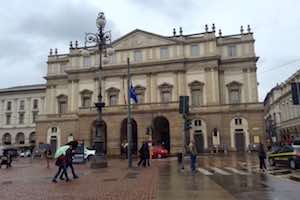 Teatro alla Scala (La Scala) is one of the most famous opera houses in the world. Inaugurated on August 3, 1778, the premiere performance was Antonio Salieri’s Europa riconosciuta (Europe recognized). In the past 200 years, the best operatic voices in the world have appeared on the stage of La Scala. I must admit that I’ve always imagined my beautiful daughter Mimi, with her inimitable mezzo-soprano voice, performing at La Scala.
The venerable building is home to La Scala Theater Chorus, La Scala Theater Ballet, and La Scala Theater Orchestra. An associate school, La Scala Theater Academy, professionally trains in music, dance, and stage management.
On Saint Ambrose Day, the feast of Milan’s patron saint, the season opens at La Scala on December 7. Tradition dictates that all performances must end before midnight, including long operas which start earlier in the evening.
A museum accessed through the theater’s foyer, exhibits collections of paintings, drafts, statues, costumes, and papers documenting La Scala’s history.
On February 25, 1776, after a carnival gala, Teatro Regio Ducale was destroyed by a fire. Wealthy Milanese who owned private boxes (palchi) in the theater petitioned Archduke Ferdinand of Austria-Este for a new theater. The first plan was rejected but the second plan was accepted by Empress Maria Theresa. Because it was built on the deconsecrated grounds of the demolished church Santa Maria alla Scala, the theater received its name from this church. The theater had about 3,000 seats and the stage was one of the largest in Italy.
To offset building expenses, private boxes (palchi) were offered for sale. Noble and wealthy Milanese used La Scala as a place to see their friends and relatives, be seen, and listen to music. The main floor (platea) had no chairs – spectators watched the shows standing up. There was no orchestra pit, the instrumentalists were in plain view.
Above boxes was the gallery (loggione) where the middle class could watch the performance. The gallery was always highly critical of opera stars. Tenor Roberto Alagna was booed off the stage in 2006 and his understudy had to replace him mid-scene, even out of costume.
La Scala also hosted a casino with gamblers sitting in the foyer.
The fear of fire was ever-present. The theater was illuminated by 84 oil lamps and a thousand throughout the theater. Several rooms had hundreds of water buckets to put out fires in an emergency. Oil lamps were replaced by gas lamps and then, in 1883, by electric lights.
La Scala underwent major renovations in 1907 and a controversial one in 2002-2004 that improved the sound system and allowed opera-goers to follow the libretto in the original language, in English, or in Italian. The 1907 renovation established the current 1,987 seats.
The 1943 bombing severely damaged La Scala, but it was rebuilt and reopened in 1946 with a concert conducted by Arturo Toscanini, composers Giuseppe Verdi and Giacomo Puccini, and soprano Renata Tebaldi.
Many famous operas had their first productions (prima) hosted at La Scala. Verdi did not allow his work to be played there for several years because, as he said, his work had been “corrupted” (modified) by the orchestra.
Teatro alla Scala (La Scala) is one of the most famous opera houses in the world. Inaugurated on August 3, 1778, the premiere performance was Antonio Salieri’s Europa riconosciuta (Europe recognized). In the past 200 years, the best operatic voices in the world have appeared on the stage of La Scala. I must admit that I’ve always imagined my beautiful daughter Mimi, with her inimitable mezzo-soprano voice, performing at La Scala.
The venerable building is home to La Scala Theater Chorus, La Scala Theater Ballet, and La Scala Theater Orchestra. An associate school, La Scala Theater Academy, professionally trains in music, dance, and stage management.
On Saint Ambrose Day, the feast of Milan’s patron saint, the season opens at La Scala on December 7. Tradition dictates that all performances must end before midnight, including long operas which start earlier in the evening.
A museum accessed through the theater’s foyer, exhibits collections of paintings, drafts, statues, costumes, and papers documenting La Scala’s history.
On February 25, 1776, after a carnival gala, Teatro Regio Ducale was destroyed by a fire. Wealthy Milanese who owned private boxes (palchi) in the theater petitioned Archduke Ferdinand of Austria-Este for a new theater. The first plan was rejected but the second plan was accepted by Empress Maria Theresa. Because it was built on the deconsecrated grounds of the demolished church Santa Maria alla Scala, the theater received its name from this church. The theater had about 3,000 seats and the stage was one of the largest in Italy.
To offset building expenses, private boxes (palchi) were offered for sale. Noble and wealthy Milanese used La Scala as a place to see their friends and relatives, be seen, and listen to music. The main floor (platea) had no chairs – spectators watched the shows standing up. There was no orchestra pit, the instrumentalists were in plain view.
Above boxes was the gallery (loggione) where the middle class could watch the performance. The gallery was always highly critical of opera stars. Tenor Roberto Alagna was booed off the stage in 2006 and his understudy had to replace him mid-scene, even out of costume.
La Scala also hosted a casino with gamblers sitting in the foyer.
The fear of fire was ever-present. The theater was illuminated by 84 oil lamps and a thousand throughout the theater. Several rooms had hundreds of water buckets to put out fires in an emergency. Oil lamps were replaced by gas lamps and then, in 1883, by electric lights.
La Scala underwent major renovations in 1907 and a controversial one in 2002-2004 that improved the sound system and allowed opera-goers to follow the libretto in the original language, in English, or in Italian. The 1907 renovation established the current 1,987 seats.
The 1943 bombing severely damaged La Scala, but it was rebuilt and reopened in 1946 with a concert conducted by Arturo Toscanini, composers Giuseppe Verdi and Giacomo Puccini, and soprano Renata Tebaldi.
Many famous operas had their first productions (prima) hosted at La Scala. Verdi did not allow his work to be played there for several years because, as he said, his work had been “corrupted” (modified) by the orchestra.View Comments
Dr. Ileana Johnson Paugh, Ileana Writes is a freelance writer, author, radio commentator, and speaker. Her books, “Echoes of Communism”, “Liberty on Life Support” and “U.N. Agenda 21: Environmental Piracy,” “Communism 2.0: 25 Years Later” are available at Amazon in paperback and Kindle.