

By Guest Column ——Bio and Archives--August 6, 2010
Global Warming-Energy-Environment | CFP Comments | Subscribe | Email Us
[Editor note: Harry de Gorter is Professor in the Department of Applied Economics and Management at Rutgers University; Jerry Taylor is a senior fellow at the Cato Institute specializing in energy and environmental policy.]

In the future, the scheduled rise in mandated volumes would require the production of biofuels in amounts that are probably beyond what the market would produce even if the effects of the tax credits were included.This means the tax credit will not increase ethanol consumption at all. Using CBO’s own (correct) formula of dividing taxpayer costs by the increase in ethanol consumption due to the tax credit, the cost of the tax credit in reducing gasoline consumption and greenhouse gas emissions is infinite, not $1.78 per gallon and $754 per ton, respectively.
the biofuel tax credits would no longer be increasing production, but they would still be reducing the costs borne by producers and consumers of biofuels.The CBO’s contention that a tax credit with a binding mandate converts into a decoupled subsidy to biofuel producers and consumers defies economic logic and completely ignores the burgeoning literature on how tax credits subsidize gasoline consumption described in the previous paragraph. In reality, ethanol producers will be unaffected but biofuel consumers benefit in the form of lower fuel (ethanol and gasoline) prices. Because the mandate determines the ethanol price, this means the consumer price of gasoline declines.
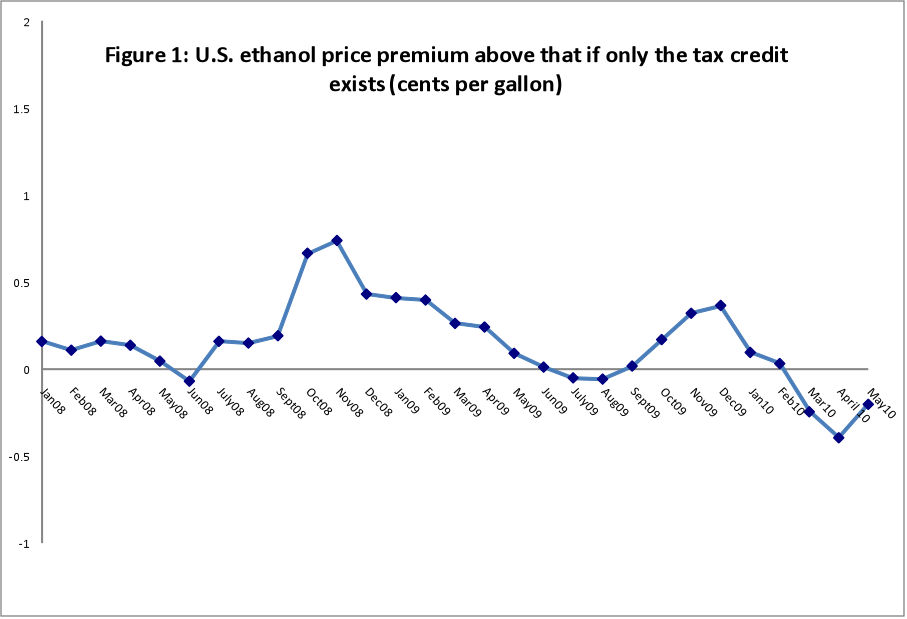 The negative values in Figure 1 arose because ethanol production increased so fast that in June of 2008, the infrastructure could not handle supplies while more recently, the “blend wall” is in effect where non-flex cars are subject to the current 10% blending limit.
The important implication is that if the tax credit determines ethanol market prices, then the mandate is dormant. Evidence in Figure 1 indicates that occurred in 4 months of the past 30 months. For 6 months, the blend wall seems to be the factor determining ethanol prices. In all the other 20 months, the mandate is determining the ethanol price.
But most importantly, if either the mandate or the blend wall is binding, then the tax credit is subsidizing gasoline or fuel (90% of which is gasoline) consumption.
View Comments
Items of notes and interest from the web.