

By Fraser Institute ——Bio and Archives--June 4, 2025
Canadian News, Opinion | CFP Comments | Subscribe | Email Us
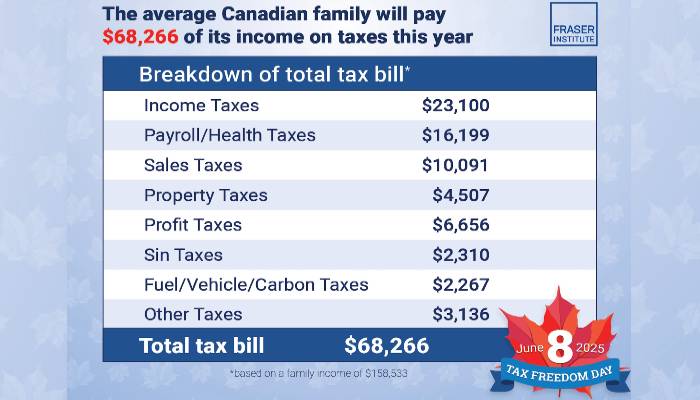
VANCOUVER— This Sunday, June 8, Canadians will celebrate Tax Freedom Day, the day in the year when they start working for themselves and not government, finds a new study published by the Fraser Institute, an independent, non-partisan Canadian public policy think-tank.
“If Canadians paid all their taxes up front, they would work the first 158 days of this year before bringing any money home for themselves and their families,” said Jake Fuss, director of fiscal studies at the Fraser Institute.

Tax Freedom Day measures the total annual tax burden imposed on Canadian families by federal, provincial, and municipal governments.
In 2025, the average Canadian family (with two or more people) will pay $68,266 in total taxes. That’s 43.1 per cent of its annual income ($158,533) going to income taxes, payroll taxes (including the Canada Pension Plan), health taxes, sales taxes (like the GST), property taxes, fuel taxes, “sin” taxes and more.
Represented as days on the calendar, the total tax burden comprises more than five months of income—from January 1 to June 7. On June 8th—Tax Freedom Day—Canadians finally start working for themselves, and not government.
But Canadians should also be worried about the nearly $90 billion in deficits the federal and provincial governments are forecasting this year, because they will have substantial tax implications in future years.
To better illustrate this point, the study also calculates a Balanced Budget Tax Freedom Day—the day of the year when the average Canadian finally would finally start working for themselves if governments paid for all of this year’s spending with taxes collected this year.
In 2025, the Balanced Budget Tax Freedom Day won’t arrive until June 21.
“Tax Freedom Day helps put the total tax burden in perspective, and helps Canadians understand just how much of their money they pay in taxes every year,” Fuss said.
“Canadians need to decide for themselves whether they are getting their money’s worth when it comes to how governments are spending their tax dollars.”
Tax Freedom Day for each province varies according to the extent of the provincially and locally levied tax burden.

Manitoba | May 17 |
Saskatchewan | May 31 |
British Columbia | May 31 |
Alberta Prince Edward Island | May 31 June 2 |
New Brunswick | June 4 |
Ontario | June 7 |
Nova Scotia | June 10 |
Newfoundland & Labrador | June 19 |
Quebec | June 21 |
CANADA | June 8 |
MEDIA CONTACT:
Jake Fuss, Director, Fiscal Studies, Fraser Institute
Grady Munro, Policy Analyst Fraser Institute
To arrange media interviews or for more information, please contact:
Bryn Weese, Fraser Institute
604-688-0221 ext. 589
bryn.weese@fraserinstitute.org
View Comments
The Fraser Institute is an independent Canadian public policy research and educational organization with offices in Vancouver, Calgary, Toronto, and Montreal and ties to a global network of 86 think-tanks. Its mission is to measure, study, and communicate the impact of competitive markets and government intervention on the welfare of individuals. To protect the Institute’s independence, it does not accept grants from governments or contracts for research. Visit fraserinstitute.org.
Follow the Fraser Institute on Twitter | Like us on Facebook