

By Dr. Ileana Johnson Paugh ——Bio and Archives--November 6, 2026
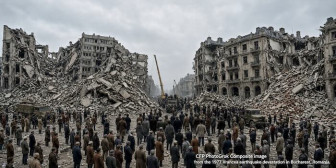
Americans have an interesting tradition; they ask where a person was at the moment of a disaster and people gladly share their memories from that date and that moment. Here is mine from 1977.
This traumatic event occurred on March 4, 1977. It was a chilly spring, Friday evening, and I was excited because we had hot water and I wanted to take a shower before the state turned the water off, a frequent occurrence in the poorly run communist economy.

At exactly 9:22 p.m. the walls started shaking badly, followed by an earthly whine unlike anything I had heard before. The bowels of the earth came to life like a giant monster. I dropped into the tub in a crouching position wondering when the walls were going to start falling apart. I watched the bathroom walls mesmerized as they swayed because I wanted to see how I would die. My dad was pounding on the door for me to get out and run down the stairs, but I could not speak and I was terrified in place like a statue.
We lived on the fifth floor, and I could not run fast enough to make it outside. Trying to run down the stairs would have been a mistake because a lot of people died when the stairs collapsed but the building did not. They could have survived if they had stayed put.
The 7.5 earthquake lasted 56 seconds, a long time for such a powerful and violent disaster. People were at home, had dinner with their families, and were getting ready to watch the Friday night movie that was allowed on the communist TV. Each Friday night, millions of people who could afford to buy a TV or had a neighbor with a TV watched the same movie allowed by the state’s censors.
The earthquake’s epicenter was deep in the bowels of the earth in the Vrancea Mountains, 85-100 km below the crust. Its violent shaking ended the lives of 1,578 people, injured 11,221 in Romania, 120 dead in Bulgaria, 165 injured, and two dead in Moldova. The capital city of Bucharest was affected the worst -1,424 people from the total humans killed resided in Bucharest.
After 56 long seconds, when the earthquake stopped, 32,900 buildings were left damaged and destroyed, and 35,000 families were without shelter. Economic losses were never accounted for by the communist government but a World Bank report from 1978 estimated the economic losses to be over $2 billion.

Most of the buildings lost or severely damaged were buildings from the pre-WWII era which were not built to withstand earthquakes, much less violent earthquakes like this one.
When the powerful tremor stopped, in the dark, people walked out of the building to assess the damage. The building stood but the walls were cracked. One slat in our bathroom window hung like a loose tooth of concrete, held dangling by reinforced iron. Nobody went back inside all night because there were other aftershocks which sent terrified people running away from the building.
Downtown Bucharest was not so lucky because thirty-three buildings collapsed. The high-rises built between the wars and shortly after WWII were damaged severely or collapsed into a high pile of rubble and white dust. They were beautiful Parisian apartments, and now they were gone, Wilson, Scala, Casata, Nestor, Dunarea, Continental, and Belvedere. Two new and modern apartments also collapsed because the concrete was bad. As the earthquake waves resonated with the waves of the high-rise buildings, some gave way and collapsed.
Nobody went back inside and we spent the chilly night outdoors because we were too scared to sleep in our own beds or to even retrieve a blanket. Tired or not, cold, or not, we stayed huddled and praying, thanking God that we survived and the apartment complex A6 did not collapse.
When dawn broke, we could really see the damage to the exterior of the complex, huge cracks running vertically. I was not so sure that I wanted to ever go back inside because nothing looked safe from the outside.
We took a bus to my grandma’s house and were relieved that her adobe house and the brick home were unharmed. We were also happy that we had a place to stay until the state gave us the green light to go back to our reinforced concrete apartments. This was the first time that we spent several nights in the brick house. We were guests by necessity.
When we eventually went back, the apartment complex was surrounded by large tree trunks supporting all the sides of the building until repairs could be made. Or so we thought.
With no guidance from authorities or national emergency aid, we relied on neighbors for help. Despite their fear, people in Bucharest came together. Strangers used their bare hands or buckets to dig survivors out before more debris buried them.
Eventually we had to go back to the university. I took the early morning train and when we arrived, we walked in horror from the train station past mountains of dirt and debris, what was left of former large buildings, a thick white dust, and a piece of metal sticking out here and there.
The smell of decomposition was overwhelming. On the eleventh day, when all hope of finding anyone still alive was lost, one young man who was buried in the basement bar of a hotel was brought out alive. His mother never left the area, waiting patiently to find her son. She knew that he was still alive. He survived against all odds.
Engineers rolled up their sleeves to consolidate the buildings that survived and were not going to be demolished. The costs kept climbing. On July 4, 1977, at a meeting of the Communist Party leadership, the dictator Ceausescu gave the order to stop the building consolidations and to proceed with just covering the cracks; everything broken in the interior had to stay as it was. But one engineer, Gheorghe Ursu, had the courage to stand up to the dictator and told him that it was wrong. He even offered to pay with his own money for reinforcement of the building he was working in. Frustrated, Ursu wrote a letter to Radio Free Europe, telling them what had happened. Gheorge Ursu was followed and harassed for years and years by the dreaded Securitate. He was finally arrested in 1985, beaten severely, and died during arrest. Such was the socialist society ruled by the Communist Party.
The order that Ceausescu gave remained secret until his death in 1989. At that time, his son, Andrei Ursu, found the order in the Securitate Archives and made it public.
View Comments