

By Guest Column ——Bio and Archives--February 26, 2010
American Politics, News | CFP Comments | Subscribe | Email Us
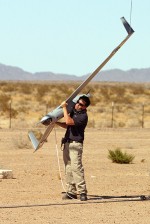
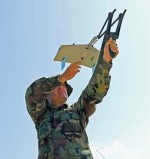 WASP is the smallest UAV in use today, weighing less than 300 grams.
The miniaturization is achieved by the use of multifunctional components, like the combined wing/battery.
WASP is nearly silent and, when flown at night, it's almost undetectable.
The Air Force has just ordered several hundred for reconnaissance and bomb-damage assessment.
WASP is the smallest UAV in use today, weighing less than 300 grams.
The miniaturization is achieved by the use of multifunctional components, like the combined wing/battery.
WASP is nearly silent and, when flown at night, it's almost undetectable.
The Air Force has just ordered several hundred for reconnaissance and bomb-damage assessment.

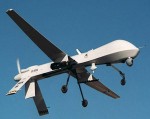 The MQ-1 Predator was an evolution of the earlier Gnat-750. Originally intended purely for reconnaissance, it was later armed with a single Hellfire missile. This combination appears to be extremely effective at precision strikes according to the Department of Defense, which claims a success rate of "nearly 100 percent." Predators are used by both the Air Force and the CIA.
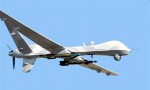 The MQ-9 Reaper is a scaled-up version of the Predator, larger, faster and more powerful. Reaper was designed from the outset as a hunter-killer. It can carry up to 14 Hellfire missiles or other weapons such as the 500-pound, laser-guided bombs shown. The 432nd Wing of the U.S. Air Force was activated to operate MQ-9 Reaper on May 1, 2007.
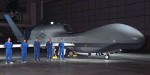 RQ-4A Global Hawk is the Air Force's endurance drone, able to cruise at around 400 mph for 35 hours. It has an operational ceiling of 65,000 feet, and from this altitude it can scan an area the size of Illinois (40,000 nautical square miles) in just 24 hours. It is equipped with radar and infrared, as well as optical sensors.
 The Joint Unmanned Combat Air System demonstration program, or J-UCAS-D, is intended to be the forerunner of the next generation of stealthy robot-strike aircraft. Its geometry and radar-absorbent materials make it difficult to impossible to spot on radar, as well as making it look badass.
Operating from aircraft carriers, the UCAS-D could fulfill the Navy's goal of an aircraft that can carry a payload (such as bombs) of up to 2,000 pounds, plus an extra 2,500 pounds externally when stealth is not required. A typical use would be to send unmanned drones in as a first wave to take out enemy air defenses and clear the way for manned aircraft.
The Joint Unmanned Combat Air System demonstration program, or J-UCAS-D, is intended to be the forerunner of the next generation of stealthy robot-strike aircraft. Its geometry and radar-absorbent materials make it difficult to impossible to spot on radar, as well as making it look badass.
Operating from aircraft carriers, the UCAS-D could fulfill the Navy's goal of an aircraft that can carry a payload (such as bombs) of up to 2,000 pounds, plus an extra 2,500 pounds externally when stealth is not required. A typical use would be to send unmanned drones in as a first wave to take out enemy air defenses and clear the way for manned aircraft.
 The CQ-10 Snow Goose is a parafoil-wing UAV for carrying medical equipment or other urgent supplies to Special Forces operating in unfriendly territory. The flexible wings are made of textile, like a parachute. The Snow Goose can be launched from the ground or from the loading ramp of a transport aircraft. Range and payload are inversely proportional; the CQ-10 can carry a 75-pound payload for 200 miles, or 500 pounds for a shorter distance depending on launch altitude and wind speed.
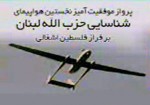 The MIRSAD-1 drone has been flown over Israel by the Lebanese militia group Hezbollah (mirsad means "ambush" in Arabic) It may be armed; Hezbollah has claimed that it can be loaded with a warhead of 40 to 50 kilos (90 to 110 pounds) of explosives, turning it into a flying suicide bomber able to reach anywhere. The Israeli Defense Force shot down two similar drones in 2006.
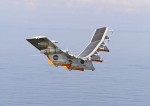 HELIOS was NASA's record-breaking solar-powered flight demonstrator. It achieved an altitude of more than 96,000 feet -- the highest for any aircraft not powered by a rocket. A combination of solar cells and fuel cells meant it could, in principle; stay aloft for days, weeks or even months at a time.
The vehicle broke up in 2003 during a flight near Hawaii when it hit turbulence, but the military is rumored to be continuing research into solar-powered UAVs with ultra-long endurance (vehicles capable of many hours in flight).
HELIOS was NASA's record-breaking solar-powered flight demonstrator. It achieved an altitude of more than 96,000 feet -- the highest for any aircraft not powered by a rocket. A combination of solar cells and fuel cells meant it could, in principle; stay aloft for days, weeks or even months at a time.
The vehicle broke up in 2003 during a flight near Hawaii when it hit turbulence, but the military is rumored to be continuing research into solar-powered UAVs with ultra-long endurance (vehicles capable of many hours in flight).
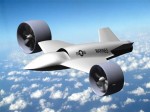 The Battlehog 150 is intended to meet the Marine Corps requirement for a vertical takeoff drone capable of operating from aircraft carriers. It can fly at over 300 mph with a payload of 500 pounds, with armaments likely to include Hellfire missiles, rocket pods and 7.62-mm mini-guns. The Battlehog series is designed to be as robust as possible, being able to withstand small-arms fire from close range. The drone is steered entirely by moving the two wingtip fans, so there are no vulnerable flight controls.
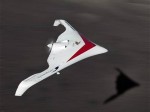 The Killer Bee is part UAV, part missile. It's intended to be deployed in 'constellations' of many vehicles working cooperatively. These swarms can be used for either reconnaissance or for attack with up to 30 pounds of weapons per drone. The Killer Bee is designed so several can be stacked together in the cargo bay of an aircraft or in a truck, maximizing the number that can be carried.
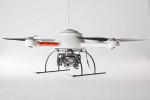 The German-made Microdrone is equipped with GPS, a camera and a loud-hailer to give instructions to those on the ground, and is currently being tested by police in the UK . This type of UAV is the one you're most likely to see hovering around your neighborhood.
Its quad-rotor design is intended to make it resilient -- Microdrone can return to base with just two rotors. Law-enforcement officials hope the Microdrone can carry out some of the tasks of police helicopters, but at a fraction of the cost.
The German-made Microdrone is equipped with GPS, a camera and a loud-hailer to give instructions to those on the ground, and is currently being tested by police in the UK . This type of UAV is the one you're most likely to see hovering around your neighborhood.
Its quad-rotor design is intended to make it resilient -- Microdrone can return to base with just two rotors. Law-enforcement officials hope the Microdrone can carry out some of the tasks of police helicopters, but at a fraction of the cost.
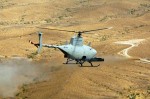 The MQ-8 Fire Scout made by Northrop Grumman is operated by the U.S. Navy and can make an automated landing on a moving aircraft carrier Typical missions include surveillance, locating targets and directing fire There have also been weapons tests with a Firescout armed with 2.75-inch rockets. The U.S. Army has now shown interest in having its own version.
Though nine MQ-8 vehicles are in the flight-test stage, the model is not yet operational. The Navy plans to eventually have a fleet of 168.
The MQ-8 Fire Scout made by Northrop Grumman is operated by the U.S. Navy and can make an automated landing on a moving aircraft carrier Typical missions include surveillance, locating targets and directing fire There have also been weapons tests with a Firescout armed with 2.75-inch rockets. The U.S. Army has now shown interest in having its own version.
Though nine MQ-8 vehicles are in the flight-test stage, the model is not yet operational. The Navy plans to eventually have a fleet of 168.
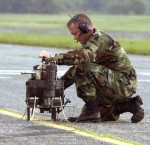 The Honeywell MAV, or micro air vehicle, will be an integral part of the U.S. Army's Future Combat System, giving reconnaissance capability to front-line troops. The small 'Class I' version seen here will be back-packable. It has a planned weight of 20 pounds, and is capable of a 50-minute mission spying on locations up to half a mile away. The vertical takeoff and hovering capability make it well-suitedto the urban canyons of the modern battlefield.
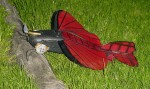 The morphing micro air/land vehicle, or MMALV, is a hybrid that can fly, then land, fold up its wings and crawl around buildings or other tight spaces. The MMALV project is lead by BioRobots, in collaboration with the Biologically Inspired Robotics Laboratory atCaseWestern Reserve University , the University of Florida and the NavalPostgraduateSchool
 Originally used for tracking schools of tuna, the Scan Eagle drone is used by the Marine Corps in Iraq , where various versions of the model have flown several thousand hours of missions. It has a stabilized, gimbaled camera turret that can be fitted with either daylight or infrared imagers. No runway is required; instead it is fired aloft by a pneumatic launcher and
View Comments
Items of notes and interest from the web.