

By Jim Bray, CFP Automotive Editor ——Bio and Archives--February 19, 2017
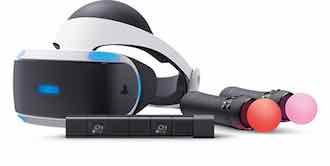 The term "virtual reality" has been around for years, and for about the same length of time we've been promised that it's the next big thing we'll have in our lives.
Like so many technological promises, however, it's been mostly vapourware when it comes to consumer products, with only a few baby steps taken on the journey to immersive virtual worlds for us to play in. But it appears to be coming, and if a couple of demonstrations I attended over the past couple of months are any indication, there should be some really cool stuff available over the next few years.
I can also see such technology being very handy when it comes to training (why read a dry textbook or suffer through an insufferable lecturer when you can "experience" something first hand?) and in other applications.
The term "virtual reality" has been around for years, and for about the same length of time we've been promised that it's the next big thing we'll have in our lives.
Like so many technological promises, however, it's been mostly vapourware when it comes to consumer products, with only a few baby steps taken on the journey to immersive virtual worlds for us to play in. But it appears to be coming, and if a couple of demonstrations I attended over the past couple of months are any indication, there should be some really cool stuff available over the next few years.
I can also see such technology being very handy when it comes to training (why read a dry textbook or suffer through an insufferable lecturer when you can "experience" something first hand?) and in other applications.


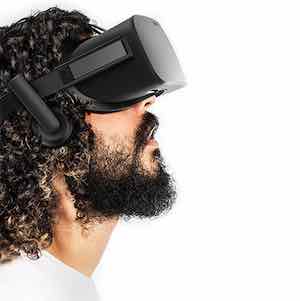 Oculus Rift had a roller coaster, though!
I got to experience it during a demo set up for me by the folks at Best Buy Canada, who had the system set up in one of their Calgary stores. I, having jabbered at length about how great the PS VR experience had been, dragged my son with me to prove once and for all that I wasn't completely nuts in my assessment of VR's potential. He was as blown away as I was, or nearly so.
For the Oculus Rift demo, we took turns wearing the headphone/visor combo right on the store's floor - and I wished they'd have set up a chair for us like Sony did for the PS4 demo. Oh, I didn't need it for most of the demo stuff, but the roller coaster sequence was unbelievable, and its hills and valleys - some of which were completely vertical drops - were so convincing that it was all I could do not to grab for something to hold. It wasn't as good as a real roller coaster, but it was a heckuva simulation!
Other demo stuff included a T Rex stalking through what appeared to be a museum, heading toward us and bellowing in our faces (I wished I'd had a virtual hanky for all the virtual snot!) before stepping over us and going on its way. There was also a sequence that put you right into the action of what looked like a first person shooter game - one of my favourite types of computer games. There were shots and explosions going off all around us as we were immersed in the alien robot attack unfolding in front of and around us.
A third demo, the weakest by far of these, came courtesy of LG and their new G5 phone. A VR headset is optional and while it's kind of cool, the virtual world looks as if it's rendered at a resolution of about three pixels (VHS would have looked better) and wasn't much of a demo at all. But as with the other demos, it points the way toward the VR future.
So I'm hooked.
Not surprisingly, the VR I saw isn't without its issues. While the VR world can be very convincing and enveloping - it's just like stepping inside the game, with your head orientation and moves tracked so well that, as you move your head, the virtual world's image moves along with it naturally in real-time - it quickly becomes obvious that you, yourself, aren't really there.
Well, duh, I can hear you say, but this is a flaw they need to fix before the experience becomes truly involving. For example, while I could look in any direction and see the virtual world properly, when I looked down I couldn't see my legs or feet - or any part of me. Despite this being perhaps a blessing in disguise (have you seen me recently?), it was a definite issue: I was a kind of disembodied virtual presence in a virtual world and since I could tell that I wasn't really there, it was easier to lose my suspension of disbelief (despite having reached for support when sliding down the huge virtual hills on the roller coaster).
Ditto for the first person shooter. While it was fantastic being there, I was a ghost character who had no real presence there, and therefore no interaction with the game or its characters. So while the action happened around me, very convincingly, I couldn't shoot back and nothing being lobbed or launched could affect me. There was one instance in which a piece of debris should have bounced off my virtual presence, or smashed in my virtual head, but since I wasn't really there it just passed through me harmlessly and I didn't suffer a scratch.
That brings up the need for "virtual motion." Your seat (or whatever you're in) needs to be set up like a flight simulator so when something happens you not only see it but you feel it as well. It's like the Star Tours ride we experienced at Disneyland back in the late 1980's: we didn't really go anywhere but the combination of virtual world and the movement of the simulation car made it more convincing in some ways - even though it was only two dimensional on a small screen at the front of the car - than the all-enveloping VR world was.
These issues can and will be addressed, I would think, and the lack of virtual presence and/or interaction with the game may have been fixed already, since my VR experience is limited to what I'm recounting here.
But I could see such VR presentations pushing 3D IMAX movies out of the viewing limelight, though it would cost a fortune to equip a whole movie theatre with VR headsets (and I'm not sure I want to wear a public VR headset that hasn't been hosed out - have you seen the 3D glasses they give you at theatres?).
It could also be a fantastic technology for learning, or virtual travel. Never been to Africa? Why not go on safari from the comfort of your home? Or how about visiting the moon or Mars? The potential is mind boggling!
As is usual in such things, though, it's going to take some generations of the technology to make it really worthwhile. And speaking of generations, it's been about that long in human years that we've been told that VR will be the next big thing. Yet here we are, in 2017, with it still in its infancy.
Still, VR can be a heckuva lot of fun and should become even more fun - and maybe even quite useful in the real world - over the next years.
Oculus Rift had a roller coaster, though!
I got to experience it during a demo set up for me by the folks at Best Buy Canada, who had the system set up in one of their Calgary stores. I, having jabbered at length about how great the PS VR experience had been, dragged my son with me to prove once and for all that I wasn't completely nuts in my assessment of VR's potential. He was as blown away as I was, or nearly so.
For the Oculus Rift demo, we took turns wearing the headphone/visor combo right on the store's floor - and I wished they'd have set up a chair for us like Sony did for the PS4 demo. Oh, I didn't need it for most of the demo stuff, but the roller coaster sequence was unbelievable, and its hills and valleys - some of which were completely vertical drops - were so convincing that it was all I could do not to grab for something to hold. It wasn't as good as a real roller coaster, but it was a heckuva simulation!
Other demo stuff included a T Rex stalking through what appeared to be a museum, heading toward us and bellowing in our faces (I wished I'd had a virtual hanky for all the virtual snot!) before stepping over us and going on its way. There was also a sequence that put you right into the action of what looked like a first person shooter game - one of my favourite types of computer games. There were shots and explosions going off all around us as we were immersed in the alien robot attack unfolding in front of and around us.
A third demo, the weakest by far of these, came courtesy of LG and their new G5 phone. A VR headset is optional and while it's kind of cool, the virtual world looks as if it's rendered at a resolution of about three pixels (VHS would have looked better) and wasn't much of a demo at all. But as with the other demos, it points the way toward the VR future.
So I'm hooked.
Not surprisingly, the VR I saw isn't without its issues. While the VR world can be very convincing and enveloping - it's just like stepping inside the game, with your head orientation and moves tracked so well that, as you move your head, the virtual world's image moves along with it naturally in real-time - it quickly becomes obvious that you, yourself, aren't really there.
Well, duh, I can hear you say, but this is a flaw they need to fix before the experience becomes truly involving. For example, while I could look in any direction and see the virtual world properly, when I looked down I couldn't see my legs or feet - or any part of me. Despite this being perhaps a blessing in disguise (have you seen me recently?), it was a definite issue: I was a kind of disembodied virtual presence in a virtual world and since I could tell that I wasn't really there, it was easier to lose my suspension of disbelief (despite having reached for support when sliding down the huge virtual hills on the roller coaster).
Ditto for the first person shooter. While it was fantastic being there, I was a ghost character who had no real presence there, and therefore no interaction with the game or its characters. So while the action happened around me, very convincingly, I couldn't shoot back and nothing being lobbed or launched could affect me. There was one instance in which a piece of debris should have bounced off my virtual presence, or smashed in my virtual head, but since I wasn't really there it just passed through me harmlessly and I didn't suffer a scratch.
That brings up the need for "virtual motion." Your seat (or whatever you're in) needs to be set up like a flight simulator so when something happens you not only see it but you feel it as well. It's like the Star Tours ride we experienced at Disneyland back in the late 1980's: we didn't really go anywhere but the combination of virtual world and the movement of the simulation car made it more convincing in some ways - even though it was only two dimensional on a small screen at the front of the car - than the all-enveloping VR world was.
These issues can and will be addressed, I would think, and the lack of virtual presence and/or interaction with the game may have been fixed already, since my VR experience is limited to what I'm recounting here.
But I could see such VR presentations pushing 3D IMAX movies out of the viewing limelight, though it would cost a fortune to equip a whole movie theatre with VR headsets (and I'm not sure I want to wear a public VR headset that hasn't been hosed out - have you seen the 3D glasses they give you at theatres?).
It could also be a fantastic technology for learning, or virtual travel. Never been to Africa? Why not go on safari from the comfort of your home? Or how about visiting the moon or Mars? The potential is mind boggling!
As is usual in such things, though, it's going to take some generations of the technology to make it really worthwhile. And speaking of generations, it's been about that long in human years that we've been told that VR will be the next big thing. Yet here we are, in 2017, with it still in its infancy.
Still, VR can be a heckuva lot of fun and should become even more fun - and maybe even quite useful in the real world - over the next years.
View Comments
Jim publishes TechnoFile Magazine. Jim is an affiliate with the Automobile Journalists Association of Canada and his careers have included journalist, technology retailer, video store pioneer, and syndicated columnist; he does a biweekly column on CBC Radio One’s The Business Network.
Jim can be reached at: bray@technofile.com