New Oil Discoveries are Needed
Global conventional oil discoveries fell to a record low in 2016 as companies cut spending. In 2016, only
2.4 billion barrels of new conventional oil were discovered worldwide—much lower than the average for the last 15 years, which was 9 billion barrels. The slowdown in the conventional oil sector was the result of reduced investment spending due to low oil prices. Another year of low conventional oil discoveries are expected for 2017 due to decreased exploration spending.
In contrast to the investment slump in the conventional oil sector, the U.S. shale industry has shown great resiliency, reducing production costs by 50 percent since 2014, and increasing investment and oil production. Despite the good news in the U.S. shale oil industry, oil demand is expected to grow by 1.2 million barrels per day a year over the next five years, and the International Energy Agency warns that an extended period of sharply lower conventional oil investment could lead to a tightening in supplies. That tightening could cause oil prices to climb unless the U.S. shale oil industry can pick up the slack.
In many cases, the U.S. shale oil industry is more competitive than conventional projects. For example, the average break-even price in the Permian Basin in Texas is $40 to $45 per barrel. At current prices, liquids production from U.S. shale plays is expected to expand by 2.3 million barrels per day by 2022. If prices increase, the expansion will be greater.
The offshore sector, which accounts for almost a third of global crude oil production, has been particularly hard hit by the industry’s slowdown. For example, in the North Sea, oil investments fell to less than $25 billion in 2016, about half the level of 2014.
The Trump Redirect Comes Not a Moment Too Soon
President Trump signed legislation to open the Arctic National Wildlife Refuge and his
proposed offshore lease plan for 2019 to 2024 will open over
90 percent of the Outer Continental Shelf acreage and over 98 percent of undiscovered, technically recoverable oil and gas resources in federal offshore areas for future exploration and development. The plan proposes 47 lease sales: seven new leases in the Pacific region, 12 leases for the Gulf of Mexico, 19 for coastal Alaska and nine for the Atlantic—the largest number of lease sales in U.S. history.



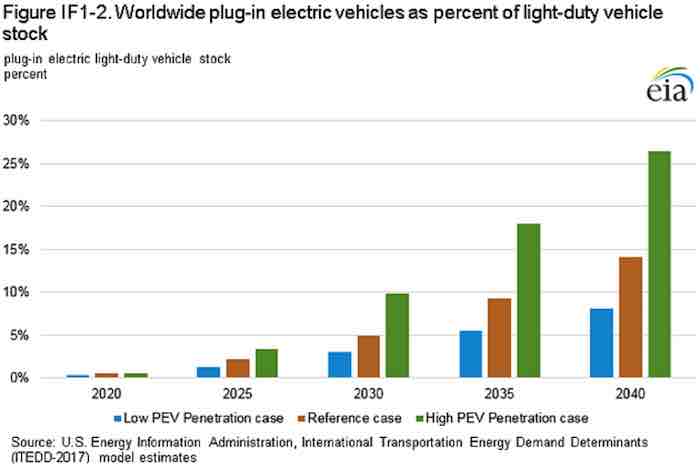
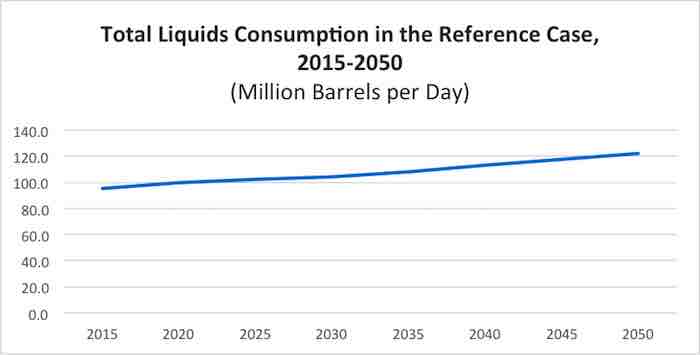
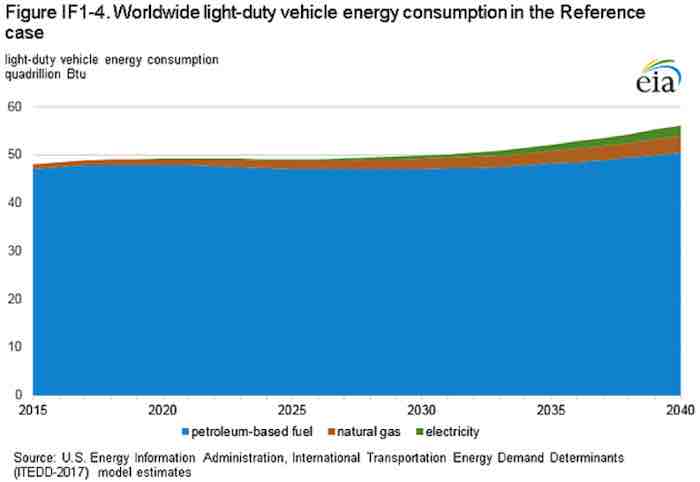
 The Energy Information Administration’s (EIA) International Energy Outlook 2017 evaluated the uncertainty associated with the long-term effects that electric vehicles may have on energy markets using three scenarios of electric vehicle penetration. The cases ranged from electric vehicles accounting for 8 percent of the world’s light duty vehicle stock in the low-penetration case, to 14 percent in the reference case to 26 percent in the high-penetration case in 2040. In the reference case, EIA forecasts liquids consumption in 2040 to be 112.9 million barrels per day—almost 20 percent higher than in 2015. The reduction in liquids consumption in 2040 is 1.38 million barrels per day in the high-penetration case (1.2 percent of reference case levels) and the increase in liquids consumption in the low-penetration case is 1.0 million barrels per day or just 0.9 percent of total liquids consumption in the reference case.
 Source: EIA
 Source:
 Source: