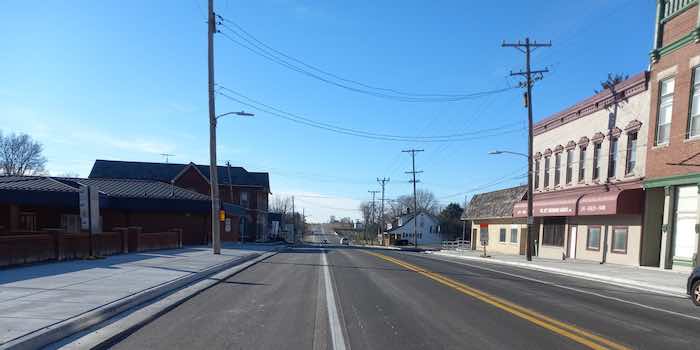
The other main route took us across the south side of Richmond across the river on the G Street bridge past the high school to the National Road, US 40, just after it crossed the river and made a jog to go past Earlham College and on to points west. From our house it was only 9 miles to the first town, Centerville. Old Federal style brick houses and store buildings crowded both sides of the National Road there. Jody’s Restaurant stood on a corner of the main intersection and everything about the town reeked of the really olden days. If I looked at the right time, I could see the brick Federal house that had been the home of Oliver P. Morton, the Civil War governor I would later come to revere. Even as a kid I could read the marker standing on the National Road and I knew there was something important about the place. The streets were tree lined, sugar maples and elms if I recall, and everything was neat and quaint and old-timey.
West of Centerville the landscape looked the way landscapes look when they’re perfectly arranged in my memory. Beautiful gently rolling farm land heavy with corn, soybeans, wheat, hogs, and cattle spread out before me as I gazed at it all through the windows of our ’58 Plymouth wagon. Well-kept farmhouses and barns dotted the view along with fenced patches of beech, maple, and white oak woods just often enough to comfort the eye. Creeks drained the glacial sandy loam soil at perfect intervals. Stock tanks and windmills were scattered here and there, reminding one of Currier and Ives or Grandma Moses. In my mind it was idyllic.
Beyond Centerville lay Pennville, then East Germantown. In the days I first remember it, this latter place was named Pershing. In the 1960s and 1970s, certain locals began to express their resentment over the town having the name of the commander of the American Expeditionary Force during the Great War. I thought it was a grand thing, because Pershing was the CO to my paternal grandfather who had served in France under him. I was fine with it. Duh. Lots better than East Germantown, especially after that problem in the 1930s and 1940s! In the haste to Americanize all things not already Americanized during World War I, the name had been changed to Pershing to avoid the odium of having been named after the largest ethnic group in the US, or the Kaiser! When feathers began to be smoothed and things began to be a bit calmer in the 1960s, the old timey Krauts got the name switched back to East Germantown. Eventually they took the Pershing name off the sign, too. Whatever.