Edison and Ford Estates in Fort Myers, Florida

Dr. Ileana Johnson Paugh , Bio and Archives--October 27, 2017
Lifestyles | Comments | Reader Friendly | Subscribe | Email Us
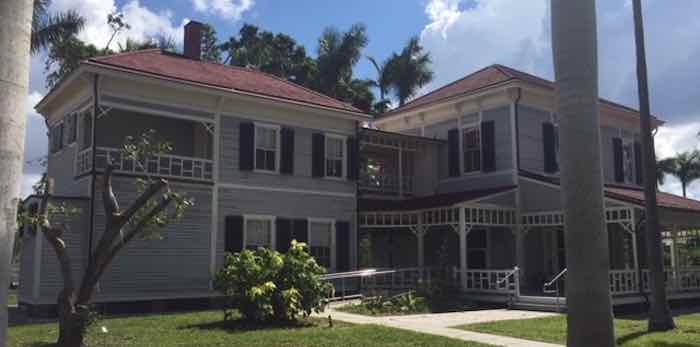 Hurricane Irma hit Florida with a vengeance six weeks ago, the island had to be evacuated, and the ocean receded from its bay. Siesta Key was spared severe devastation but its neighbors to the south, Naples, San Marco, and Fort Myers did not fare as well. Irma hit them as a strong category 3 hurricane. The evidence is painful to see in the mounds of chopped up uprooted trees and torn vegetation yet to be picked up in front of every home.
The Edison/Ford Estate lost 100 old trees, shrubs, and other tropical vegetation that used to shade almost 20 acres of property, now fully exposed to the sun. Vegetation grows fast in Florida but 100-year-old trees are hard to replace. The estate museum opened on October 14, 2017 for the first time since the severe winds devastated the once shady and lush green gardens, still beautiful but showing signs of distress.
Hurricane Irma hit Florida with a vengeance six weeks ago, the island had to be evacuated, and the ocean receded from its bay. Siesta Key was spared severe devastation but its neighbors to the south, Naples, San Marco, and Fort Myers did not fare as well. Irma hit them as a strong category 3 hurricane. The evidence is painful to see in the mounds of chopped up uprooted trees and torn vegetation yet to be picked up in front of every home.
The Edison/Ford Estate lost 100 old trees, shrubs, and other tropical vegetation that used to shade almost 20 acres of property, now fully exposed to the sun. Vegetation grows fast in Florida but 100-year-old trees are hard to replace. The estate museum opened on October 14, 2017 for the first time since the severe winds devastated the once shady and lush green gardens, still beautiful but showing signs of distress.Edison’s beloved 90-year-old Banyan tree survived the hurricane onslaught. This Banyan tree was among the more than 17,000 samples that Edison tested for his research effort to find a natural source of rubber. It is documented that the tree was planted in 1927 and is one of the largest in the continental U.S. The Banyan tree (Ficus benghalensis) produces a milky sap (latex) that can be used as rubber. The Edison and Ford estates have more than thirteen types of ficus trees. Fort Myers is known as the City of Palms; it is a tradition started by Edison – he planted 1.5 miles of royal palms along McGregor Boulevard in front of his winter home. Edison’s botanical research laboratory eventually found a source of rubber in the plant called goldenrod. He was worried that the source of rubber domestically would dry up in the case of a shortage in the foreign supply. The lab, which was built in 1928, remained operational until 1936, five years after Edison’s death.
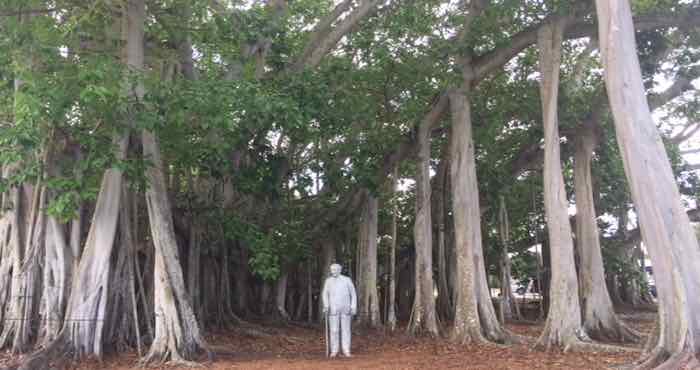 Edison’s beloved 90-year old banyan tree
Sanibel Island
Nearby Sanibel Island, lush with jungle-like vegetation seemed to have fared better. Off the fishing pier, the sugary-white quartz sand shell beach was sparkling in the noon sun. The ocean had a greenish-rusty brown hue. Wading in the surf to find more shells on the bottom was fun even in leather sandals. Sanibel Island’s lighthouse had an unusual iron skeleton appearance; it was first lit in 1884. The bay in Siesta Key was flooded by jelly fish and hundreds of bathers and swimmers were stung daily; nobody could resist the balmy 83 degree Fahrenheit waters with small and gentle waves. The life guards were flying the purple caution flag for dangerous marine life. People took a careless attitude to the jelly fish. How much can they possibly hurt? We are going in for a swim.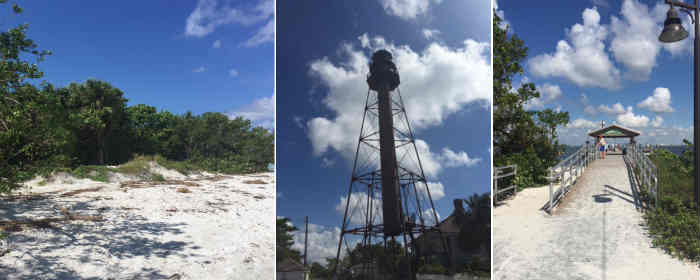 Sanibel Island, Lighthouse and Pier
Thomas Edison’s estate in Fort Myers, Florida
As clouds gathered for a rainy afternoon, it was a perfect time to visit Thomas Edison’s estate in Fort Myers, Florida. One of Edison’s famous inventions, the incandescent bulb, inexpensive and reliable, is now becoming extinct as the environmental scaremongers are blaming inexistent global warming on everything man-made despite evidence to the contrary. Thomas Alva Edison (1847-1931) was a prodigious inventor, newspaper printer/publisher, telegrapher, and businessman. Edison’s research lab in Florida focused on finding a domestic source of rubber. He was the only person who was awarded consecutive patents every year for 65 years, a total of 1,093. His favorite invention was the phonograph, but his work improved the telegraph, generators, motors, batteries, movie-making, and cement. Thomas Edison, Henry Ford, John Burroughs and families camped often in the Florida Everglades. His famous remark, “There is only one Fort Myers and soon 90 million Americans will discover it,” certainly rings true today. Edison found a 14-acre property along the Caloosahatchee River countryside, one mile south of the city of Fort Myers. The land was mostly scrub and wild vegetation with Giant Green Bamboo, a natural fiber with which Edison experimented as filament for his incandescent bulb. Among hundreds of exotic plants growing on the island, mango trees and orchids, there are many species of green bamboo. Edison and his family were trying to evade the cold winters of West Orange, New Jersey and found a mild paradise in Fort Myers.
Edison’s Seminole Lodge
The riverside buildings were built in 1886 and remodeled through the years. The large Seminole Lodge is composed of a family home, a connecting pergola, and a guest house. His little office, a pool, a teahouse, the Caretaker’s house, seawall recreation area, and Moonlight Garden were added later. In 1911, the pool constructed by W.R. Wallace and Company cost $1,000.
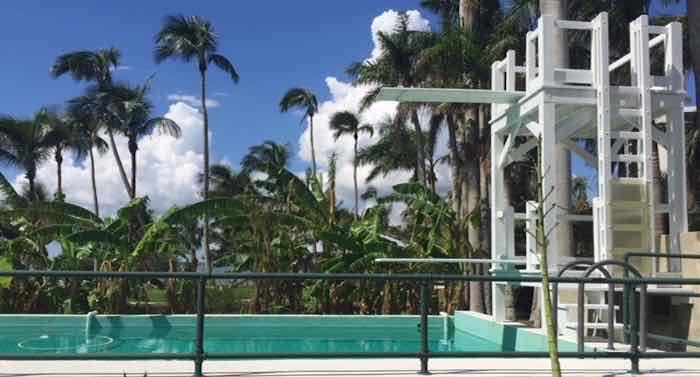 Edison's swimming Pool
The Guest House was built for Edison’s good friends Ezra and Lillian Gilliland as their winter retreat. They owned the home for three years and, in 1891 sold it to Ambrose McGregor, who lived with his family year-around in the house until 1902. In his honor, the boulevard that runs along the Guest House was named McGregor in 1914. Edison bought the home in 1906 and turned it into a guest house with a dining room, kitchen/pantry, and servants quarters.
“Visitors included Henry Ford and Harvey Firestone who stayed for days and Charles Lindbergh who came for dinner. They received reminders of a Florida visit when mangoes, grapefruit, guava, and orange marmalade would arrive at their northern homes.”
The Caretaker’s House is an example of early “Cracker” architecture and is one of the oldest standing buildings in Fort Myers. The lumber for all buildings on the property was pre-cut in Maine and transported by ship to the pier.
Edison's swimming Pool
The Guest House was built for Edison’s good friends Ezra and Lillian Gilliland as their winter retreat. They owned the home for three years and, in 1891 sold it to Ambrose McGregor, who lived with his family year-around in the house until 1902. In his honor, the boulevard that runs along the Guest House was named McGregor in 1914. Edison bought the home in 1906 and turned it into a guest house with a dining room, kitchen/pantry, and servants quarters.
“Visitors included Henry Ford and Harvey Firestone who stayed for days and Charles Lindbergh who came for dinner. They received reminders of a Florida visit when mangoes, grapefruit, guava, and orange marmalade would arrive at their northern homes.”
The Caretaker’s House is an example of early “Cracker” architecture and is one of the oldest standing buildings in Fort Myers. The lumber for all buildings on the property was pre-cut in Maine and transported by ship to the pier.
In 1947 Madeleine wrote to her mother, “We did enjoy the lazy days at Fort Myers – I couldn’t have borne it not to see the place again as it always was – and I’m glad it was warm enough for a farewell swim in the pool.” Until 1929 when city water was hooked to the riverside property, Edison provided water to its own property by ingenious ways such as a windmill which pumped water from a well, a 40,000 gallon cistern which captured rainwater, and two artesian wells. Today he might have been imprisoned by environmental agencies for capturing rainwater on his property. The pier which stretches 1,500 feet into the Caloosahatchee River was initially called the wharf and was used to load and unload boats of supplies for the family and for the lab. Later, it was used mostly for recreational activities such as boating and fishing.
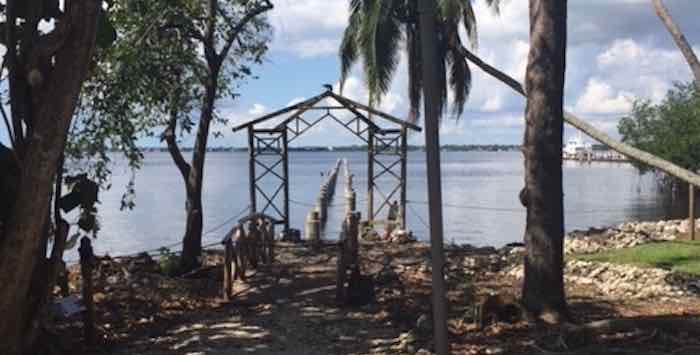 Edison's pier which stretches 1,500 feet into the Caloosahatchee River
Mina, Edison’s wife, wrote to the family in 1909, “Thomas caught a trout, snapper and I think a small tarpon which he did land, right off the pier… We may supper there this evening, I am not sure.”
At first Fort Myers was isolated from the rest of the state; the railroad connected to the city by 1904; then a wooden bridge was built in 1924; and the roadway now known as the Tamiami Trail, connecting Tampa to Miami, which allowed the Edisons to visit their friends, the Firestones, at their winter home in Miami Beach. The Tamiami Trail cost $8 million, took twelve years to complete, and 3 million sticks of dynamite. The Edison Bridge which spans the Caloosahatchee River was built in 1928 and dedicated on Edison’s last birthday, February 11, 1931. (Museum Archives)
Edison's pier which stretches 1,500 feet into the Caloosahatchee River
Mina, Edison’s wife, wrote to the family in 1909, “Thomas caught a trout, snapper and I think a small tarpon which he did land, right off the pier… We may supper there this evening, I am not sure.”
At first Fort Myers was isolated from the rest of the state; the railroad connected to the city by 1904; then a wooden bridge was built in 1924; and the roadway now known as the Tamiami Trail, connecting Tampa to Miami, which allowed the Edisons to visit their friends, the Firestones, at their winter home in Miami Beach. The Tamiami Trail cost $8 million, took twelve years to complete, and 3 million sticks of dynamite. The Edison Bridge which spans the Caloosahatchee River was built in 1928 and dedicated on Edison’s last birthday, February 11, 1931. (Museum Archives)
When completed, Edison’s bridge had no electric lights. A nationwide cartoon satirized the irony of the bridge for its lack of lights and, in 1937, the city added over fifty lampposts, work completed by the Florida Power & Light. In 1910 Edison had developed a commercial iron-nickel alkaline battery for use in electric cars, which he considered the future of mass transportation. Because of the internal combustion engine, Edison sold his battery for industrial use instead, thus becoming Edison’s most lucrative invention. His miner’s cap lamp battery (1930) saved thousands of miners from flammable gases igniting an explosion if a bulb broke. His secondary battery was encased in a steel case, an electric lamp connected with a flexible cable, and a safety measure preventing ignition. Another important invention was the carbonaire primary battery used for railroad applications (1950); it replaced prior primary batteries. Edison’s primary battery emerged during the 1880s, providing power to telephone systems, fire alarms, doorbells, sewing machines, electric fans, and phonographs.
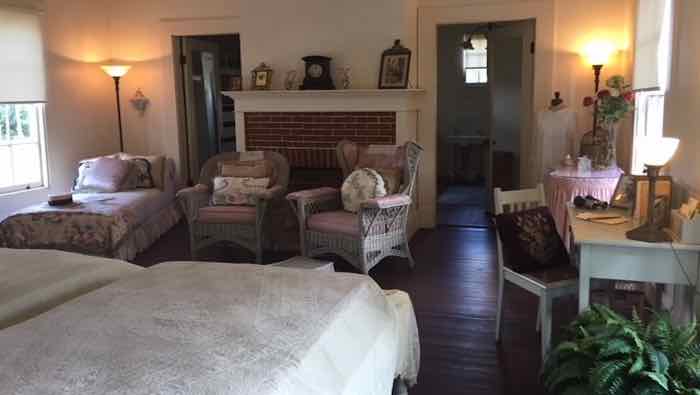 Edison's Bedroom
Edison’s research on secondary batteries (1899), which could be recharged, “was an alternative to existing lead-acid secondary batteries, which were heavy and difficult to recharge.” His portable unit from 1925, the 6-volt Edison Radio Filament battery, which could recharge radio batteries, was on display. So were the Edison-Lalande batteries from 1890, named to recognize the French scientist, Felix de Lalande, who had the first patent for the copper-oxide-zinc-caustic soda battery.
The first movie camera was called a kinetograph. Edison worked with George Eastman. Edison announced in 1888 that he would manufacture a machine called a kinetoscope that would “do for the eye what the phonograph does for the ear.” (kineto, Greek for “motion,” and scope for “view”) Edison modified Eastman’s flexible film and “adapted it for his own motion picture products.” (Museum Archives)
Edison’s system of lighting with Direct Current (DC) was first used on Pearl Street Station in New York. The area included Wall Street from which Edison attracted investors and several New York newspapers from which Edison gained publicity. The system was most efficient within a square mile of the station. The station burned in 1890 but the standard for an electrical utility was set.
Edison's Bedroom
Edison’s research on secondary batteries (1899), which could be recharged, “was an alternative to existing lead-acid secondary batteries, which were heavy and difficult to recharge.” His portable unit from 1925, the 6-volt Edison Radio Filament battery, which could recharge radio batteries, was on display. So were the Edison-Lalande batteries from 1890, named to recognize the French scientist, Felix de Lalande, who had the first patent for the copper-oxide-zinc-caustic soda battery.
The first movie camera was called a kinetograph. Edison worked with George Eastman. Edison announced in 1888 that he would manufacture a machine called a kinetoscope that would “do for the eye what the phonograph does for the ear.” (kineto, Greek for “motion,” and scope for “view”) Edison modified Eastman’s flexible film and “adapted it for his own motion picture products.” (Museum Archives)
Edison’s system of lighting with Direct Current (DC) was first used on Pearl Street Station in New York. The area included Wall Street from which Edison attracted investors and several New York newspapers from which Edison gained publicity. The system was most efficient within a square mile of the station. The station burned in 1890 but the standard for an electrical utility was set.
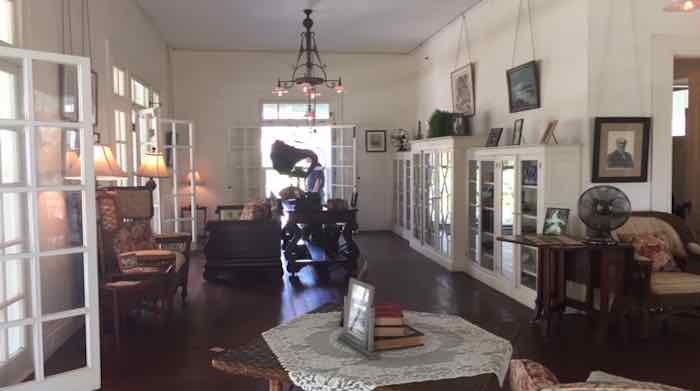 Edison's Living Room
But the alternating current (AC) proved more practical because it continually reverses direction, can be conducted at high voltage over long distances, and can be transformed to lower voltages to power many devices. The direct current (DC) runs in a single direction, is conducted at low voltage with a lower risk of injury, and can only be conducted a short distance. Direct current (DC) powers today cell phones and electric cars.
Nikola Tesla worked briefly for Edison in 1884 before he went to work for competitors. They were not really bitter rivals as the media portrayed them. The museum archives evidence the fact that years after the “war of the currents,” Edison appeared in public to hear Tesla address the American Institute of Electrical Engineers and Tesla graciously “asked the crowd to give Edison a standing ovation.”
By December 1878 Edison had designed numerous generators and an electric meter. The electric lighting was so much cheaper than gas yet he had not yet devised the incandescent light bulb.
Edison’s laboratory held equipment to perform chemical and mechanical experiments (1886). Edison had spent $12,000 to build and furnish each of his homes but he spent $16,000 on the lab. It had a dynamo powered by a coal-fired steam boiler which provided electricity for the entire estate in 1887, eleven years before the City of Fort Myers was electrified. The original lab was sold to Henry Ford who moved it to Dearborn, Michigan, where it became the base of operations of The Edison Institute, still open to visitors today.
The New York Times reported in February 1886 that “one of the ships carrying supplies for the lab was hit by lightning and sunk.” The insured cargo ($3,000) held “chemicals, machinery, and furniture.” (Museum Archives)
TO BE CONTINUED
Edison's Living Room
But the alternating current (AC) proved more practical because it continually reverses direction, can be conducted at high voltage over long distances, and can be transformed to lower voltages to power many devices. The direct current (DC) runs in a single direction, is conducted at low voltage with a lower risk of injury, and can only be conducted a short distance. Direct current (DC) powers today cell phones and electric cars.
Nikola Tesla worked briefly for Edison in 1884 before he went to work for competitors. They were not really bitter rivals as the media portrayed them. The museum archives evidence the fact that years after the “war of the currents,” Edison appeared in public to hear Tesla address the American Institute of Electrical Engineers and Tesla graciously “asked the crowd to give Edison a standing ovation.”
By December 1878 Edison had designed numerous generators and an electric meter. The electric lighting was so much cheaper than gas yet he had not yet devised the incandescent light bulb.
Edison’s laboratory held equipment to perform chemical and mechanical experiments (1886). Edison had spent $12,000 to build and furnish each of his homes but he spent $16,000 on the lab. It had a dynamo powered by a coal-fired steam boiler which provided electricity for the entire estate in 1887, eleven years before the City of Fort Myers was electrified. The original lab was sold to Henry Ford who moved it to Dearborn, Michigan, where it became the base of operations of The Edison Institute, still open to visitors today.
The New York Times reported in February 1886 that “one of the ships carrying supplies for the lab was hit by lightning and sunk.” The insured cargo ($3,000) held “chemicals, machinery, and furniture.” (Museum Archives)
TO BE CONTINUEDView Comments
Dr. Ileana Johnson Paugh——Bio and Archives
Dr. Ileana Johnson Paugh, Ileana Writes is a freelance writer, author, radio commentator, and speaker. Her books, “Echoes of Communism”, “Liberty on Life Support” and “U.N. Agenda 21: Environmental Piracy,” “Communism 2.0: 25 Years Later” are available at Amazon in paperback and Kindle.