China sees diplomatic benefits in hanging tough on climate change
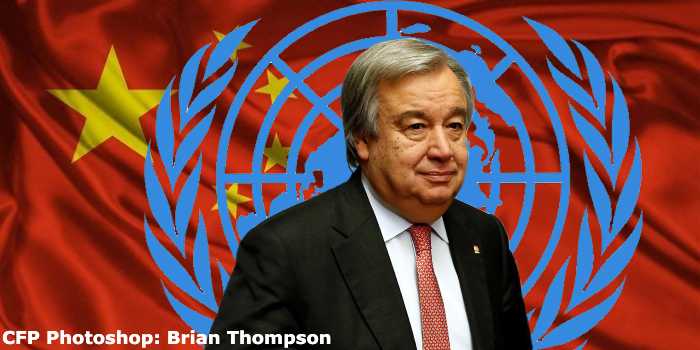
And what do we have as the only “world government,” but China, either directly or indirectly, through its various proxies is the main player. It seems the only Nation, holding its ground, is the U.S. with its support of the Ukraine and Israel and it not accepting the status quo brought forward by the United Nations. Why bring in the UN, you may ask? Unknown to many the most famous proxy for China is the United Nations.
Since 2007, the Under-Secretary-General for Economic and Social Affairs (DESA), who advises the UN Secretary General, has been from China.[8] These representatives of the People's Republic of China (PRC) advise the UN Secretary General on such things as all development-related issues, including climate change, internet governance, and financing for development. The issue with this is that these Under-Secretaries are, also, the brains behind of the United Nations Sustainable Development Goals (SDG). These SDGs are an affront to Western Democracies and undermine the very financial, theological and military strength of all member Nations, in the UN.
Most certainly some have stated that there are some good points in the SDGs, but when an Under-Secretary expresses, in their report, that to move forward with the SDGs, and, of course, climate change initiatives, nations “… could include shifting budget allocations away from military expenditures to social protection programmes.” Are we not just a little curious that someone, from China, would advise various countries to do this when they seem very militarily aggressive, themselves.[9]
Perhaps the most strategic move by China is its thoughtful move regarding sustainable development, financial gain, and climate change. In 2018 Prof. Jean-Paul Marechel[10] authored a report titled “What Role for China in the International Climate Regime”?[11] This report is succinct and brings forward an explanation as to why China got involved in “climate change.” According to Prof. Marechel’s report: “The United States’ withdrawal"
Times have changed. 2009 and the COP15 have become another world. Fifteen years ago, China thought – or pretended to think – that the issue of climate change was a weapon western countries wanted to use against its economic and political rise. Now, China sees diplomatic benefits in hanging tough on climate change, on being in favour of the Paris Agreement. It was already true three years ago but is even more true today, after Donald Trump’s election.
The agreement appears to have a sufficiently flexible structure and modest enough aims to withstand US withdrawal. Some experts feared that President Trump’s decision would jeopardize the future of the Paris Agreement. Of course, this decision will have a financial impact on at least two institutions: the UNFCC and the Green Climate Fund. The United States used to give 115 million dollars annually to the first (25% of the budget) and had promised to give 3 billion dollars to the second (to this day only 1 billion was given under President Obama). Washington’s decision can be also a bad example for some countries that are not absolutely convinced of the necessity to participate to the Agreement, but which did not want to be publicly opposed to it.
Peking appears to want to take advantage of this situation and might well succeed. In January 2017, just after Donald Trump’s victory, Xi Jinping insisted during the World Economic Forum in Davos on the fact that all signatories should stick to the Paris Agreement “instead of walking away from it”. The same month, Xie Zhenhua, China’s climate envoy, said that his country was “capable of taking a leadership role in combating global climate change”.
All these statements must be connected to the so-called “China solution”. This expression was publicly used for the first time in July 2017 on the 95th anniversary of the foundation of the Chinese Communist Party. During the speech he gave for that occasion, Xi Jinping asserted that the Chinese people were “fully confident that they can provide a China solution to humanity’s search for better social institutions”. Unlike the “China model”, or the “Peking Consensus” (designed to counterbalance the defunct Washington consensus), the “China solution” seems to be – or at least has been conceived to be – applicable everywhere, including in Western countries.