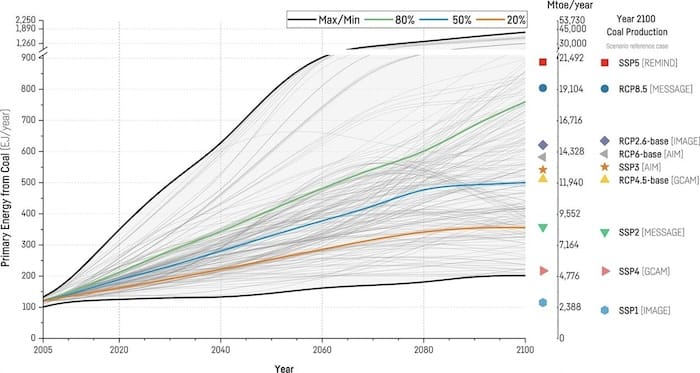
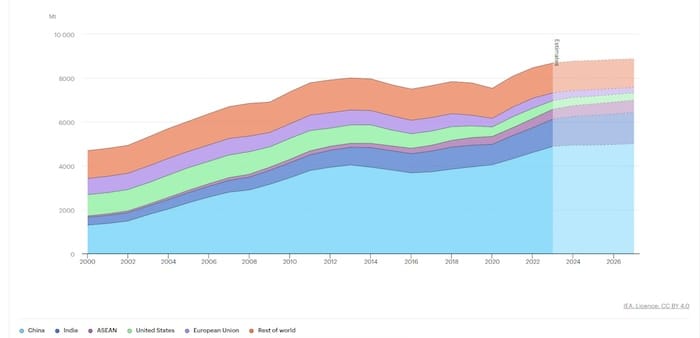
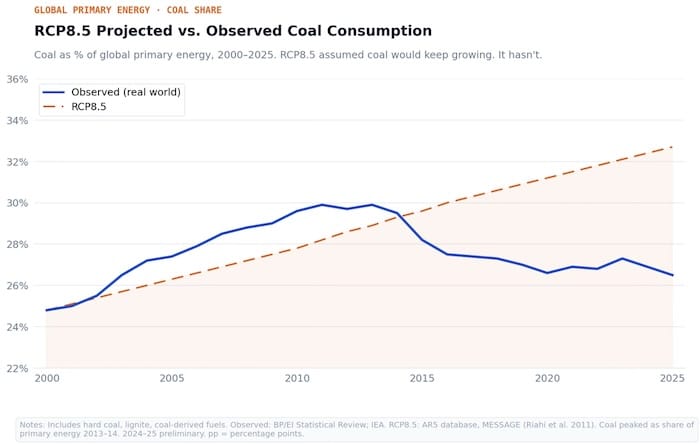
On The American Energy Institute’s webpage, They Knew, they detail how scientists have been flagging the implausibility of RCP8.5 since 2017. RCP8.5 projected a warming of approximately 4 – 5 °C, but it was built upon unrealistic assumptions. These scenarios have been continued to be used by governments, central banks, the world bank, courts, and throughout the education system. In a paper released this past April, researchers responsible for developing scenarios such as RCP8.5 for the Intergovernmental Panel on Climate Change (IPCC) have deemed it “implausible.” The authors write that its high emission levels “have become implausible, based on trends in the costs of renewables, the emergence of climate policy and recent emission trends.”
Yet well before this paper was published, the latest of the Climate Change Reconsidered (CCR) series of reports from the Nongovernmental International Panel on Climate Change (NIPCC) also called out RCP8.5. The CCR series cites thousands of peer-reviewed scientific references that detail the current state of climate science. The NIPCC has produced fourteen reports since 2009 from an international panel of experts who are, importantly, nongovernment scientists and scholars and so lack the inherent bias that those whose salaries are paid by the government obviously have. On their website, they explain,
“NIPCC seeks to objectively analyze and interpret data and facts without conforming to any specific agenda. This organizational structure and purpose stand in contrast to those of the United Nations’ Intergovernmental Panel on Climate Change (IPCC), which is government-sponsored, politically motivated, and predisposed to believing that climate change is a problem in need of a U.N. solution.”
The NIPCC reports show clearly that today’s climate is not unusual and that there is very weak evidence for future climate catastrophe, concluding that “There is no compelling scientific evidence of long-term trends in global mean temperatures or climate impacts that exceed the bounds of natural variability.”