Precious
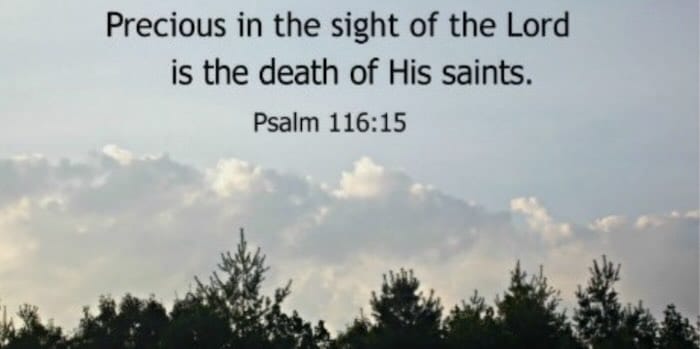
“Precious in the sight of the Lord is the death of his saints;”

Joseph J. Bucci , Bio and Archives--October 17, 2025
Lifestyles | Comments | Reader Friendly | Subscribe | Email Us
Our lives are unique and distinctive and flavorful. This is particularly true for those who follow Christ (Matthew 5:13). We have been fearfully and wonderfully made (Psalm 139:14). Those of us who have come into a saving relationship with Jesus Christ are called a chosen generation (1 Peter 2:9). We are the salt of the Earth and the light of the world (Matthew 5:13-14). Our lives have significance and meaning, not only to those closest to us, but in actuality to the entire world, because we are Image Bearers (Genesis 1:27) who are called to share the Good News of redemption to the entire world (Mark 16:15).
An individual life is not singular but works in harmony with other lives to grow to be nurtured as it reaches toward full maturity. Many faith experiences not connected with Christianity focus on finding maturity by developing a harmonious life here on Earth. This is a key tenet of humanism, and the search is generally inward (Buch-Hansen and Nesterova, 2024). In Christianity, we are encouraged to experience life with one another, serving others, and providing spiritual support through prayer and the sharing of what we have received (Acts 2:42-47). In fact there are 100 “one another” passes throughout the New Testament, found in 94 verses (Kranz, 2014). Our maturity is achieved by becoming more like Jesus, and this is something that continues each and every day of our lives (GotQuestions, n.d.).
We do have some say in how we spend each of our days. Moses not only wrote the first five books of the Bible, but was said to have also authored Psalm 90, which states in one place, “The years of our life are seventy, or even by reason of strength eighty; yet their span is but toil and trouble; they are soon gone, and we fly away” (Psalm 90:10). We can certainly choose to view our lives as drudgery and toil. But we also have the choice to view this life as an exquisite gift, the blessing of a caring Heavenly Father who assembled our parts together in our mother’s womb (Psalm 139:13) and made us as distinctive and unique as each snowflake (Psalm 139:14). Each choice that we make will have an impact on the quality of life, but not on the length. That is again up to God to determine (Psalm 139:16).
After we have fulfilled the times that God has set for us, there is then the drama of that transition from the world that we see to the world that we do not see (2 Corinthians 4:18). If we have chosen to allow Christ to be Lord of our lives and have sought to put every one of our activities under His Lordship, He then welcomes us into His blessed presence. Our Savior greets His precious saints with the words, “Well done, good and faithful servant (Matthew 25:21). There is preciousness, there is welcome, there is joy in His presence (Psalm 16:11).
This then helps to explain why the death of God’s saints, His called and chosen ones, is so precious to Him. He has lovingly directed their steps and orchestrated events throughout their entire lives – even knowing the intricate details of our sitting down and rising up (Psalm 139:2). From birth, to growth and maturity; from relationship building to opportunities for marriage and even the accumulation of wealth (Deuteronomy 8:18), it is God who establishes us and directs our steps (Psalm 37:23) and gives us a future and a hope (Jeremiah 29:11). That future and that hope are not found in establishing our own kingdom here on Earth. They are discovered in ushering in the kingdom of God as His instruments and His voice to an unbelieving and perverse generation (Luke 9:41).
This preciousness which is described here by the Psalmist in Psalm 116 is a word that means something rare or costly. It is something of value. God values His peculiar people (1 Peter 2:9). Their death is costly, because now there is one less voice proclaiming His truth that is removed from a world that desperately needs to hear the message of redemption which we are sent out to announce (Matthew 28:19). The work of spreading the “Good News” is so precious that the feet of these godly messengers are seen as beautiful (Isaiah 52:7). So when one of these precious saint’s voices is removed from the discourse, there is one less voice proclaiming God‘s glory, and one less faithful servant pointing to the narrow path on which we must trod in order to achieve true riches (Luke 16:11).
This is the dichotomy behind the tragic death of our brother Charlie Kirk. Kirk’s sudden and excruciating death has led to an incredible surge of interest in church, with people returning to the faith. There has also arisen a greater passion for spreading the gospel message to those who have not heard (Hallowell, 2025). We would do well to not simply remember the loss of our brother Charlie Kirk, but also the horrible genocide of precious Christian saints throughout the world, particularly in Nigeria (Annetta, 2025; Wright, 2025); in Syria (Sinjab, 2025); and in the Sudan (Persecution.org, 2025).
These are tender and rare saints (Psalm 116:15), whose lives had so much to contribute to their nation and their culture as they spread the message of sacrificial love and redemption among even those who hated them. Meanwhile, God welcomed these faithful servants into His presence with great joy and rejoicing by the angels (Luke 15:10).
Those of us who are children of God do not live with a kind of depressing acceptance or resignation of the fate that will befall us. We see a light at the end of the tunnel, past the finality of death to everlasting life (John 3:16). Your perspective on death depends on where you place your hope. And that is where Jesus began His earthly ministry.
Jesus began His teachings on the Kingdom of God by proclaiming “repentance” (Mark 1:15); and His first message challenged His hearers with the ultimate sovereignty of God, which causes us to sense our “poverty of spirit“(Matthew 5:3). Once we sense the futility of striving here on Earth and mourn over our condition (Matthew 5:4), God’s Spirit points us to the way out of such tragic, earth-bound thinking. The Spirit steers us past bitterness to search for truth that is authentic. We must learn about God’s perspective (Matthew 5:5); then hunger and thirst for the truth for righteousness (Matthew 5:6). There are end goals and means goals in this Beatitudes passage. The end goals are what comes as the fruit of us adapting to a change of perspective in in what we place our hope. The means of this change is a trust in our Sovereign God’s plans so confidently that we are able to become peacemakers, we are able to overcome attacks against us, which previously would have disabled us because of our bitter spirits (Matthew 5:7-11). This sums up well the life and message of God’s servant Charlie Kirk.
Charlie Kirk once said: “You can tell a lot about a person when someone dies” (Lemley, 2025). This “Beatitude perspective” is the means by which we can navigate this great and unexpected loss. These truths are blessings that accompany us down the path of grief, past bitterness and anger, with the offer of mercy towards our persecutors; and then on to our final victory. It is hard for us to navigate this now, but God has promised to give us His Spirit to guide us to all truth (John 16:13). One more truth is this: we know that when we believe in Christ, even though our bodies may die, we will truly will live again (John 11:25). And there will be a precious reception; we will be welcomed and ushered into a greater joy than we might ever imagine in His presence (Psalm 16:11). And so we will greet our precious friend and companion there on that distant but beautiful shore (Bennett, 1868).
Sources
- Annetta, S. (2025, October 7). The Silent Christian Genocide in Nigeria is Finally Being Exposed. Concerned Women for America: Legislative Action Committee
- Bennett, S.F. (1868). In The Sweet By and By. Hymnary.org
- Buch-Hansen, H. & Nesterova, I. (2024). Deepgrowth: Self-transformation towards harmonious being. Ecological Economics (224). ISSN 0921-8009.
- GotQuestions.org (n.d.). What is Spiritual Maturity? Got Questions Ministries.
- Hallowell, B. (2025, October 9). ‘Absolutely insane:’ Pastor reveals unexpected impact of Charlie Kirk’s murder. The Washington Times.
- Kranz, J. (2014, March 9). All the “one another” commands in the NT. OverviewBible.com.
- Lemley, C. (2025, September 18). Opinion: Reflections on the death of Charlie Kirk and our shared humanity. Amarillo Globe-News.
- Persecution.org (2025, February 11). Genocidal Militia Continues to Persecute Christians Across Sudan. Persecution.org.
- Sinjab, L. (2025, June 30). 'We're not safe here anymore' - Syria's Christians fear for future after devastating church attack. BBC News.
- Wright, K. (2025, August 26). Christian Genocide in Nigeria: 3 Million Believers Under Siege as Calls for US Intervention Mount. Christian Broadcast Network News.
View Comments
Joseph J. Bucci has served as a Pastor, Author, HR Director, Director of Training, Professor and Consultant. He teaches in the College of Arts and Sciences at Regent University in Virginia Beach. He has written two books and numerous articles on the theme of integrating faith with life and our work. You can contact Dr. Bucci at: Joseph J Bucci