Solar's Dirt and Toxic Issues
Nitrogen trifluoride (NF3) is a key chemical agent used to manufacture photovoltaic cells for solar panels
Jack Dini , Bio and Archives--December 19, 2017
Global Warming-Energy-Environment | Comments | Reader Friendly | Subscribe | Email Us
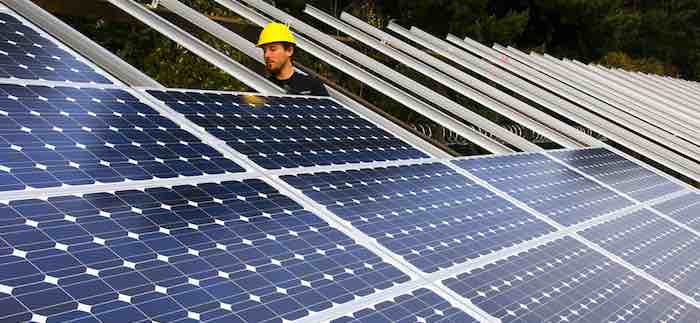 Global solar energy production is taking a major hit due to air pollution and dust. The first study of its kind showed airborne particles and their accumulation on solar cells is cutting energy output by more than 25 percent in certain parts of the world. The regions hardest hit are also those investing the most in solar energy installations—China, India and the Arabian Peninsula. Data showed a noticeable jump in efficiency each time the panels were cleaned after being left alone for several weeks.1
China is already looking at tens of billions of dollars being lost each year, with more than 80 percent of that coming from losses due to pollution. Lead researcher Mike Bergin said, “With the explosions of renewables taking place in China and their recent commitment to expanding their solar power capacity, that number is only going to go up.” 2
Joanne Nova observes, “Either way, real pollution and natural dust will slow the clean energy future in India and China until we get auto cleaning panels. Unfortunately, cleaning panels also risks damaging them, so the price of solar power really needs to include the cost of windscreen-wipers, electricity losses, damage to panels, and damage to panel cleaners too.” 3
Global solar energy production is taking a major hit due to air pollution and dust. The first study of its kind showed airborne particles and their accumulation on solar cells is cutting energy output by more than 25 percent in certain parts of the world. The regions hardest hit are also those investing the most in solar energy installations—China, India and the Arabian Peninsula. Data showed a noticeable jump in efficiency each time the panels were cleaned after being left alone for several weeks.1
China is already looking at tens of billions of dollars being lost each year, with more than 80 percent of that coming from losses due to pollution. Lead researcher Mike Bergin said, “With the explosions of renewables taking place in China and their recent commitment to expanding their solar power capacity, that number is only going to go up.” 2
Joanne Nova observes, “Either way, real pollution and natural dust will slow the clean energy future in India and China until we get auto cleaning panels. Unfortunately, cleaning panels also risks damaging them, so the price of solar power really needs to include the cost of windscreen-wipers, electricity losses, damage to panels, and damage to panel cleaners too.” 3
A Toxic Concern
Federal data show that a potent greenhouse gas, that's also a byproduct of solar panel construction, is on the rise. Nitrogen trifluoride (NF3) is a key chemical agent used to manufacture photovoltaic cells for solar panels, suggesting that government subsidies and tax credits for solar panels may be a driving factor behind the 1,057 percent increase in NF3 over the last 25 years. This increase in US annual emissions of NF3 from 1990 to 2015 compares to an increase of 5.6 percent in carbon dioxide emissions. 4 NF3 emissions have rapidly increased in Asia as well due to its rapidly growing solar market, and researchers say that many nations are under reporting their NF3 emissions by roughly a factor of 4.5. NF3 emissions are 17,200 times more potent than CO2 as a greenhouse gas over a 100 year time period. 4 Until recently, it was not possible to directly measure the atmospheric concentration of NF3, and scientists had assumed that only a small percentage of the NF3 used in industry escaped into the atmosphere. That has now changed. The GHP Protocol now requires NF3 to be included in the GHG inventories.5References
- “Air pollution casts shadow over solar energy production,” sciencedaily.com, June 26, 2017
- Mike H. Bergin et al., “Large reductions in solar energy production due to dust and particulate air pollution,” Environmental Science & Technology, June 15, 2017
- Joanne Nova, “India, China: clean dust , pollution off solar panels every two months,” joannenova.com, June 28, 2017
- Andrew Follett, “Solar panels increased emissions of a gas 17,200 times more potent than CO2,” dailycaller.com, March 1, 2017
- Stephen Russell, “Nitrogen trifluoride now required in GHG Protocol greenhouse gas emissions inventories,” wri.org/blog, May 22, 2013
View Comments
John William Dini, know to all as ‘Jack’, passed away at the age of 89 on June 17, 2026. He was born in Cleveland, Ohio on Nov. 14, 1936.
He published two books, a technical book on materials science and coatings and another on environmental issues. In retirement, he wrote extensively on various environmental issues for online publications.
He was a skilled leaded glass hobbyist, creating more than 20 lamps and many panels. He was a jogger for many years, competing in over 300 long distance races. He was a slow runner, not wanting to take the glory away from others. His secret was to start slow and taper. He and Anne traveled extensively, visiting over 70 countries.
He is survived by his wife, Anne, of 67 years, and sons Mike, Steve, and Paul. If you were to meet him somewhere, he would sum up his life as ‘peaches and cream’.