Take the Stairs!
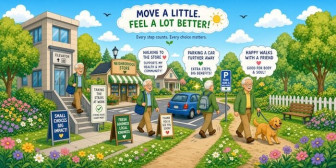
Take the stairs at work. Walk to the store. If you drive, park further away. Get a dog and walk it. Do these things with happiness. Don’t let modern conveniences lull you into poor health;

Diana Gifford Jones , Bio and Archives--October 3, 2026
Health and Medicine | Comments | Reader Friendly | Subscribe | Email Us
Most people are less physically active than they should be. So when you get the chance to take a flight of stairs, do it. Think of the escalator as your enemy and the stairs as your friend. A new analysis reinforces the message that climbing a few flights is well worth the effort.
Researchers combined the results of nine studies involving almost half a million people. The participants were followed for about 14 years. Those who regularly climbed stairs had a 39 per cent lower risk of cardiovascular death and a 24 per cent lower risk of death from any cause than those who did not regularly climb stairs. Those are impressive numbers. Climb the stairs!
But here’s a lesson in understanding these kinds of studies. They were observational, meaning there was no random assignment of half a million people to climb stairs and the other half to take elevators. Instead, researchers arrived at their conclusion by watching what people were already doing and then looking at what happened to them over many years.
This opens the door to a problem called reverse causation. Think about two people standing in the lobby of an office building. One walks toward the staircase. The other presses the elevator button. It is tempting to conclude that the person taking the stairs is healthier because stair climbing is making that person healthier.
But perhaps healthier people like to take the stairs as a matter of course. Maybe these people already have stronger legs, better balance, better lungs and healthier hearts. Maybe they are lighter, more active and less likely to have arthritis. Those waiting for the elevator may already have heart disease, shortness of breath, bad knees or some other condition that makes climbing stairs difficult.
In that case, the stairs are not necessarily the cause of the difference. They are instead a marker of the difference. This is what scientists mean by reverse causation. The apparent cause and effect can run in the opposite direction from what we assume. It is an important caution because headlines are very good at turning associations into prescriptions.
Benjamin Franklin would have understood the argument. In 1772, when he was 66, Franklin wrote to his son about the virtues of exercise and observed that walking a mile up and down stairs provided more exercise than walking five miles on level ground. He also pointed out the convenience: stair climbing could be done indoors when bad weather discouraged going outside or when a person was short of time. More than 250 years later, the inventor in Franklin would surely have admired the innovation of elevators, escalators and all sorts of other conveniences. But as an astute observer of the world, would he have recognized that in making life easier, we have also made ourselves less active?
Unlike walking on level ground, climbing requires lifting our body weight against gravity. The large muscles of the legs have more work to do. Heart rate and breathing rise quickly as they demand more oxygen and energy. Stair climbing can therefore deliver a vigorous cardiovascular workout in a short time.
Take the stairs at work. Walk to the store. If you drive, park further away. Get a dog and walk it. Do these things with happiness. Don’t let modern conveniences lull you into poor health.
But remember, stairs demand our respect, especially as we age. Balance, vision, muscle strength and reaction time change. Medications add to the risk of falling. A staircase is an excellent piece of exercise equipment when using it deliberately. But use the handrail! Mind your footwear. Remove any obstacles. Stay safe while being healthy.
***
This column offers opinions on health and wellness, not personal medical advice. Visit www.docgiff.com to learn more. For comments, diana@docgiff.com.
View Comments
Common Sense Health with Diana Gifford-Jones
Sign-up at DocGiff.com to receive my weekly e-newsletter. For comments, .(JavaScript must be enabled to view this email address). Follow on Instagram @diana_gifford_jones
Older archives of Dr. Gifford Jones