The Prisoner
A look at Community versus the Collective based in the television series "The Prisoner"

Dr. Lawrence Sasaki , Bio and Archives--September 15, 2026
American Politics, News | Comments | Reader Friendly | Subscribe | Email Us
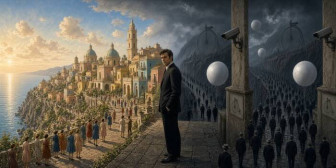
"The Prisoner"[1] is an ITV television series that came out in 1967, and I remember watching it when it first came out, but I had not thought of it until I saw an interview between Alex Jones and filmmaker Roger Avary[2]. During the conversation, he (Roger Avary) mentioned that he had spent some time in prison. Before he went in, he was advised by a former inmate that the only way he would survive prison was to “be your own man” and that lead to a discussion of the television series, “The Prisoner”.
The Prisoner Series:
- A look at Community versus the Collective based in the television series "The Prisoner"
- The Contrast between Community and the Collective
- The Return of the British Empire--Perfidious Albion
- The Red-Green Alliance
- The Elites War on America and Russia
- “In the beginning was the Word…” John 1:1
- The Most Effective Weapon Against the Plans of the Elites
- The Prison of the Mind--Will You Be Free or Slave?
“The Prisoner” was created by actor/producer Patrick McGoohan. He had just come off a highly successful secret agent series called “Danger Man”. “The Prisoner” follows what happens when a person, such as the secret agent, retires prematurely. People want to know why he is retiring in order to predict what he would do with all the secret information he possesses.
In the opening scene, he slams his retirement notice on the desk, rushes home and packs in order to escape. Before he had finished, he is gassed and collapses. He wakes up in his own room, but when he opens the blinds, he finds himself in a strange Mediterranean-like place called “the Village”. The famous line from the series is
- “I will not be pushed, filed, stamped, indexed, briefed, debriefed, or numbered. My life is my own.”
In the series, he is given the appellation, Number 6. In each episode, there is a new Number 2 whose task, it is, is to break Number 6 and get him to reveal why he resigned. It may seem a small thing, but it is part of who he is, it is private and none of their business. He responds:
- “I am not a number. I am a free man.”
- to which Number 2 responds with derisive laughter.
Throughout the series, Number 6 remained his own man, and the powers-that-be attempt to break him with various PSYOPs. It is interesting to watch, because the psychological manipulations used in the series are the same ones used by our own governments to manipulate us today. Although the forms are different, the techniques are the same. Currently. these include LGBTQ+ “pride”, the climate crisis, COVID-19 response, and so on.
Community and the Collective
The DVD set of “The Prisoner” includes an interview with Patrick McGoohan on TVOntario about the show. During the interview, he said that the series was about the struggle between the individual and a nebulous thing he called society. The series was produced during the turbulent times of the late ’60s and early ’70’s, so rebelling against “the establishment” was commonplace.
He did not qualify what he meant by “society”. I assume he meant that which was all around him at the time. However, there are two kinds of societies and it is important to understand the distinction between the two. There is an open and free society which I will call community, and a closed society with I will call the collective.
An open and free society can only exist in a Christian framework. In it, all are accountable to God, even government. So, in God’s economy, government exists to serve the people, providing the necessary infrastructure to facilitate the well being of the general population. In this context, the community comprises individuals, free to pursue the purpose for which they had been created. There is unity of purpose and little government interference. Such a society rewards diligence, hard work and creativity, in which all benefit from the bounty such creativity produces.
On the other hand, the collective exudes uniformity and conformity. If you stand out like Number 6, you are hammered back into shape. There is an episode called “Hammer Into Anvil”, where Number 2 sees himself as the hammer who will pound Number 6, who is he sees as the anvil, into submission. But Number 6 begins to do things that seem conspiratorial: leaving coded messages, whispered conversations, signalling to seemingly no one. Soon Number 2’s paranoia destroys him, and he is forced by Number 6 to report that he needs to be replaced.
In the series, the Village represents the collective, where there is uniformity, everyone pounded into interchangeable units, easily promoted and just as easily discarded. The Village comprises two types of inhabitants, prisoners and control. The prisoners are constantly watched and monitored by control. They live in a completely controlled environment and there is no escape.
The modern collective was born of the French Revolution of 1792
What Patrick McGoohan called society is what Britain had become, a society of conformity with a hive-like attitude. This, on the heels of a freedom loving people formed from the Welsh Revival of 1904 and the Hebridean Revival of 1949. This was also the timeframe of the Toronto Revival, led by evangelist Charles Templeton, from which the nick-name “Toronto the good” revived. It was not uncommon to find homes left unlocked as there was no fear of illegal entry. Over the years, the goodness diminished and people began locking their homes again. As for Charles Templeton, he unfortunately got caught up in the School of Higher Criticism and eventually left the faith, going into broadcast journalism.
The modern collective was born of the French Revolution of 1792, starting with the storming of Bastille Prison. It is ironic that our modern prison life began with the storming of a prison. The French Revolution was based on the writings of Voltaire and Jean-Jacques Rousseau, laying the foundation for an atheistic new society. Voltaire had just returned from exile in England where he had witnessed the balanced society which followed the Bloodless Revolution of 1688, where the role of King and country were precisely defined, and he wanted to replicate what he saw, but based on a secular, atheistic foundation. That was not to be, as evidenced by the blood bath that ensued.
The new French government quickly instituted a Revolutionary Tribunal which was created to speed the demise of the “Aristos”. Under emergency decrees, such as the Law of Suspects, you were presumed guilty until you could prove yourself innocent. A politician by the name of Georges Danton was one of the creators of the Revolutionary Tribunal. He was later found guilty by that same Tribunal and sentenced to the guillotine. In the television mini-series “The French Revolution”[3], he is depicted as laughing as goes to his slaughter, at the irony that this was his brain child. His last reported words were:
- “Show my head to the people. It is well worth seeing.”
This is the first of eight parts. In the series, I will explore the difference between community and the collective, how we got to where the collective is on the ascendance, and what we can do to fight back.
References
- The Prisoner, ITC Entertainment, 1967.
- Alex Jone: Top Hollywood Writer/Producer Roger Avary Exposes Hollywood’s Satanic Secrets!, July 10, 2026.
- The French Revolution, Nilaya Productions, 2020.
View Comments
Dr. Lawrence Sasaki has a PhD in Electrical Engineering in the field of electronic music. He is currently employed in the area of digital design verification and has worked on products spanning consumer to enterprise.