Electronics for high-altitude use can get smaller and sturdier with new nanomaterials
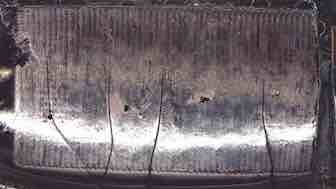
After being bombarded with ionizing radiation, this sample with copper-platinum nano-ink on its surface still conducts electricity

By American Chemical Society —— Bio and Archives--May 5, 2020
Science-Technology | Comments | Back To Full Article
 WASHINGTON — As demand for higher-efficiency and smaller electronics grows, so does demand for a new generation of materials that can be printed at ever smaller dimensions. Such materials are critical to national security applications and space exploration. But materials that work well on Earth don’t always hold up well at high altitudes and in space. Scientists are now creating new metal-based nanomaterials for circuit boards that could be resistant to the high-altitude radiation encountered by electronics in aerospace equipment, fighter jets and weapon systems.
The researchers are presenting their results through the American Chemical Society (ACS) SciMeetings online platform.
“This research grew out of the huge need at U.S. national laboratories for electronic materials that are stable when subjected to ionizing radiation,” says Timothy J. Boyle, Ph.D., the project’s principal investigator. “We started looking at nanometal materials because they can be printed at the required smaller dimension, but we had to overcome their tendency to be damaged by ionizing radiation.”
WASHINGTON — As demand for higher-efficiency and smaller electronics grows, so does demand for a new generation of materials that can be printed at ever smaller dimensions. Such materials are critical to national security applications and space exploration. But materials that work well on Earth don’t always hold up well at high altitudes and in space. Scientists are now creating new metal-based nanomaterials for circuit boards that could be resistant to the high-altitude radiation encountered by electronics in aerospace equipment, fighter jets and weapon systems.
The researchers are presenting their results through the American Chemical Society (ACS) SciMeetings online platform.
“This research grew out of the huge need at U.S. national laboratories for electronic materials that are stable when subjected to ionizing radiation,” says Timothy J. Boyle, Ph.D., the project’s principal investigator. “We started looking at nanometal materials because they can be printed at the required smaller dimension, but we had to overcome their tendency to be damaged by ionizing radiation.”Welcome to CFP’s Comment Section!
The Comment section of online publications is the new front in the ongoing Cancel Culture Battle.
Big Tech and Big Media are gunning for the Conservative Voice—through their Comment Sections.
Canada Free Press wishes to stay in the fight, and we want our fans, followers, commenters there with us.
We ask only that commenters keep it civil, keep it clean.
Thank You for your patience and for staying aboard the CFP ‘Mother Ship’.
READ OUR Commenting Policy