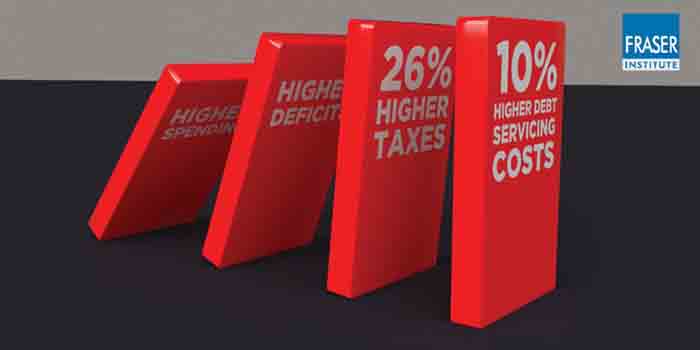
Higher deficit-financed spending by provincial governments leads to 26% higher taxes and 10% higher debt interest costs, historical analysis shows
“The evidence is clear—despite the rhetoric, even temporary deficit-financed government programs impose significant future costs on taxpayers,” said Bev Dahlby, Fraser Institute senior fellow and study co-author.

By Fraser Institute —— Bio and Archives--May 2, 2023
Canadian News, Opinion | Comments | Back To Full Article
CALGARY—Despite misperceptions that government deficits have no cost, higher deficit-financed spending by provincial governments over the past 50 years has led to higher taxes and higher debt-servicing costs, according to a new study released today by the Fraser Institute, an independent, non-partisan, Canadian public policy think-tank.
“Governments that run ongoing deficits ultimately have to face the fiscal music in the form of higher taxes and higher debt interest payments for future taxpayers,” said Ergete Ferede, a senior fellow at the Fraser Institute and co-author of How Provincial Governments Respond to Fiscal Shocks and Federal Transfers.
The study analyzes provincial government finances between 1966/67 and 2020/21 and finds that for every $1 increase in per-capita deficit-financed program spending, there was a corresponding increase in taxes of 26 cents and 10 cents in higher debt servicing costs in the future.
Welcome to CFP’s Comment Section!
The Comment section of online publications is the new front in the ongoing Cancel Culture Battle.
Big Tech and Big Media are gunning for the Conservative Voice—through their Comment Sections.
Canada Free Press wishes to stay in the fight, and we want our fans, followers, commenters there with us.
We ask only that commenters keep it civil, keep it clean.
Thank You for your patience and for staying aboard the CFP ‘Mother Ship’.
READ OUR Commenting Policy