False memory syndrome, mass hysteria, and rent seeking drive indigenous grievances
The only factual and moral grounds for supporting our fellow citizens is to demand evidence and accountability while embracing identical rights for all Canadians regardless of their ethnicity or life experiences;

Brian Talarico and Hymie Rubenstein
, Bio and Archives--September 21, 2025Canadian News, Opinion | Comments | Reader Friendly | Subscribe | Email Us
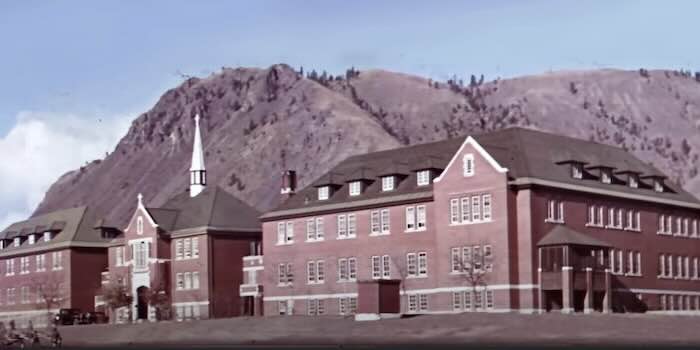
In August 2024, one of us — Dr. Brian Talarico — visited the former Indian Residential School on British Columbia’s Kamloops Indian Reserve. The long-shuttered institution was a day school for the band and a residential school for students from other reserves. Open to the public, it is the largest building on the Kamloops reserve. It houses a tax office and an indigenous women’s resource centre. But its central feature is a large meeting room with a stage at one end. The walls have annual photos of the band council and chief from 1994 to the present. The room is also used for formal council meetings.
With no other supporting evidence, this gruesome accusation immediately led to moral panic at home and sensational headlines around the world
Two young men were hanging about offering to show visitors around. They told factually unsupported stories about the school designed to elicit sympathy and money from visitors. They matter-of-factly told Talarico that the school’s Catholic priests pushed a child off the third-floor fire escape to the ground below, that the priests routinely impregnated aboriginal girls and then incinerated their babies in the school boiler or drowned them in the adjoining Thompson River. They also said that the children were kept in the school 365 days per year and that the only lessons were learning English because they didn’t want to teach the children any skills that would allow them to steal jobs from white people.
The former school is located across the river from downtown Kamloops and adjacent to the main highway running to northern BC. It employed local aboriginals as teachers and other staff. During the years of school operation there were no reports of missing or murdered children.
None of this prevented horrific stories of residential school murders from being shouted from the rooftops following the May 27, 2021 announcement from the Kamloops Indian Band that “the stark truth of the preliminary findings came to light—the confirmation of the remains of 215 children who were students of the Kamloops Indian Residential School…. We had a knowing in our community that we were able to verify. To our knowledge, these missing children are undocumented deaths. Some were as young as three years old.”
With no other supporting evidence, this gruesome accusation immediately led to moral panic at home and sensational headlines around the world, and across Canada, the meagre information available was more than sufficient for mournful vigils, solidarity speeches, emotional testimonials from former IRS students, self-flagellation by politicians, flags on government buildings lowered to half-mast for five months, statues of former Canadian heroes defaced, destroyed, toppled, or removed, demands for the renaming of streets and public schools, Roman Catholics questioning their faith in the Church that operated over 70 percent of the schools, and the destruction of Roman Catholic and Anglican Churches.
Absent from all this hysteria and inflammatory rhetoric was any recognition that aboriginal parents did not report the loss of any of their children at the time, at least as an incredible assertion as the band’s announcement. Moreover, over four years after the Kamloops press release and an outlay of $12 million from the federal government for searches, not a single body of a missing child has been recovered, not the least because the band chose to spend this rent-seeking money on unknown research and refining their communication strategies.
Last year, the band even replaced “remains” with “anomalies,” namely soil disturbances of unknown origin, proof enough that the May 2021 announcement was grossly exaggerated.
So, what was learned from this visit to the long-shuttered boarding school?
Cultural hysteria known as the Satanic Panic that began in BC in 1980, spreading around the world over the next 10 years
First and foremost, the band is unlikely to ever attempt to identify the alleged remains of students buried in reputed graves, most likely because it knows there are no interred children at the site in question. This decision would surely be rooted in the fact that there are no known missing IRS children for the entire history of this school. But to acknowledge that truth and others like it would risk having to apologize to the Canadian people, surrender the band’s victimhood, and perhaps even pay back money.
Second, this school building does not hold any traumatic history for the band. Instead, it is used as offices and as the council meeting room. These two young men are being ‘trained’ to earn money out of a false narrative of trauma. This is a tragedy that will likely prevent them from maturing, earning an honest living, or raising a family.
As for its overall financial implications, Frances Widdowson has rightly argued that “it is important to point out that these allegations [of murder and genocide] have resulted in the extraction of numerous forms of compensation from governments, incentivizing indigenous organizations to enthusiastically promote them.”
As sensational as the Kamloops “discovery” has been and as much as it has created a national moral panic, it is no gruesome outlier. Instead, it is a painful reminder of the cultural hysteria known as the Satanic Panic that began in BC in 1980, spreading around the world over the next 10 years.
Published in 1980, Michelle Remembers was written by Dr. Larry Pazder, a Victoria, BC psychiatrist, and his patient Michelle Smith, a local housewife who'd sought treatment after a miscarriage.
Under Pazder's care, Smith underwent "recovered-memory therapy”—a practice that's since been discredited—as the book recounts in detail. The result was a best-selling work of horror, a memoir with a compelling paperback tagline: "The shocking true story of the ultimate evil—a child's possession by the Devil!"
That child was Smith, and her nightmare allegedly began at the age of five. It was then, Smith claims, that her mother gave her away to a Satanic cult. For 14 months, she would be held captive and tortured, witnessing ritual murders and mutilations, many involving babies. The public gobbled it up like so many cannibalized corpses, and as book sales took off, its authors became regular fixtures on TV, appearing on everything from Oprah to CBC's Midday.
For the next 10 years, Satanic Panic resulted in over 12,000 reports of children being abused or even physically sacrificed. As a bestseller, it also left a wave of destruction and wrongful convictions in its wake.
The Myth of Repressed Memory: False Memories & Allegations of Sexual Abuse
Still, after exhaustive police investigations in Canada and America not a single report was ever proven so the panic gradually died away. Though the negative legacy of this cultural hysteria on the lives of families where a false memory was reported was immense, counselling and therapy are not regulated professions in Canada so trauma therapy “to help patients recover repressed and forgotten memories of their childhood abuse” remains in use to this day.
Two facts about these reports of Satanic abuse are important to remember. Most individuals did not recover memories in therapy: they recovered memories by interaction with others. Secondly, the contents of the reports were remarkably similar. Often, priests and the Catholic Church were the falsely reported abusers. Yet, because of the commonality in the reports, trauma advocates uncritically took this as proof that the reports were truthful.
Douglas Hintzman, is a distinguished psychologist with considerable expertise on memory. Author of the important 1978 book The Psychology of Learning and Memory, Hintzman has noted that “Psychologists, parapsychologists, physicists and popes— we are all human, and we are all subject to the same errors. Degree of conviction, particularly if it is based on memory, is a poor guide to the truth.”
This does not deny that when people report previous trauma, it is important that we believe the salience of their memory to them and that we remain open minded as we search for evidence. Still, there is considerable experimental evidence that people distort their memories, that human memory is often not faithful to objective facts, and that false memories can be implanted in people through suggestion, through recovered-memory therapy, and through wishful thinking and a desire to belong to a group. Thus, in many cases, the memories of childhood abuse are false memories.
The Myth of Repressed Memory: False Memories & Allegations of Sexual Abuse, a 1994 book by Elizabeth Loftus, then a psychologist at the University of Washington, convincingly show how false traumatic memories can be caused by interviews. Loftus has also demonstrated that that the potential for financial rewards could cause the human brain to create a false traumatic memory.
This and other research over the past five decades by skilled memory researchers has shown how human memory is inherently unreliable.
What does all this research about the fallibility of memory tell us about the current shared recollections held by former students at Canada’s Indian Residential Schools, including memories of students murdered at these schools, the cumulative result amounting to a genocide?
The first indication that false memory syndrome and undeserved moral panic lie behind the murder and genocide accusations is the carefully collected and compiled records of school attendance.
Funding from Ottawa for the indigenous boarding schools between 1883 and 1996 was tied to the attendance of children. Any deaths or chronic absence was carefully reported together with ordinary attendance records.
Second, many children did die, aboriginal and non-aboriginal alike, during the period these schools were functioning. TB, smallpox, and accidents killed many children in earlier eras. Though the Truth and Reconciliation Commission (TRC) charged with reporting on the history, operation, and legacy of the schools documented many deaths of indigenous children, it never compared the death rate on reserves to those in the schools. Without this comparison the numbers lack meaning and context.
Third, though the TRC interviewed thousands of people, it reported only a single murdered child.
Doris Young arrived at the Elkhorn Indian Residential School in 1944 when she was three years old, and was there until the school closed in 1949, when she was eight. In 2012 she told a TRC hearing that she and other students witnessed the murder of a nameless fellow student, saying “there was all these screams, and there was blood all over the walls.” As an adult, Doris Young, who would necessarily have had to witness this murder between three and eight years of age, asked the RCMP to investigate her claim. However, as she admitted to the TRC, the RCMP found no evidence of a murder having been committed. Nonetheless, the TRC published her account in its written report anyway.
Fourth, Sir John A. Macdonald, our first prime minister, has been harshly criticized for not doing more to rescue aboriginals living in the Prairies from the catastrophic effects of the disappearance of the buffalo herds because of overhunting by indigenous and non-indigenous people in the latter part of the 19th century.
This was near the birth of a new country with a tiny population and government spread over a huge land mass. A trans-Canada railway was not yet completed and the most important federal force in Western Canada was the Northwest Mounted Police, which numbered only 300 members. Even so, the Macdonald government delivered rations to 30,000 affected aboriginals. Indeed, the government spent more on support for aboriginals than it did on the Canadian military or almost any other function of government.
What can we learn from those examples that can be applied to Canada’s aboriginal population?
Fifth, historical trauma exists on a personal and a community level around the globe. Japan suffered the devastating effects of two atomic bombs and the loss of belief in the emperor as a direct descendant of God. Germany experienced the blanket firebombing of Dresden, the suicide of Hitler, and a resounding defeat by the allied forces. The country was then divided, with nearly one-third given to Russia. Meanwhile, Jewish families experienced the torture, starvation and murder of some six million of their relatives in the world’s largest and most carefully orchestrated genocide.
But Japan, Germany, and Israel have built strong, resilient, and democratic societies since that time.
What can we learn from those examples that can be applied to Canada’s aboriginal population? If we truly wish to help people give up victimhood and live fulfilled lives, we need to do things differently. We cannot continue to make victimhood the main avenue to financial gain. Rent seeking alone does not eradicate blame, anger, addiction, depression or anxiety, and the resulting dysfunctions.
Private property rights and the freedom to trade encouraged these societies and promoted individual achievement, upward mobility, and happiness. The tribal communal structure of Canadian aboriginal communities does not do this. On the contrary, it promotes elitism, autocratic dictatorship, and financial abuse.
If one remains a victim then one continues to live with blame, anger, depression and anxiety. The goal of life and therapy is to become an engaged participant, not to remain a victim. The key to this is forgiveness, both of others and oneself.
It is also immoral to continue to fund aboriginal groups based on a false history of trauma and to encourage a never-ending victim identity. It is immoral to fund aboriginal children to grow up on dysfunctional reserves. It is immoral to blame residential schools for all the problems on reserves when 70% of aboriginal children did not attend these schools.
Sixth, and most important of all, just as the remarkable commonality of false memories of Satanic abuse was not evidence of the truth of those remembrances, the unproven commonality of memories of residential school abuse is not evidence of actual abuse and murder, let alone genocide.
The only factual and moral grounds for supporting our fellow citizens is to demand evidence and accountability while embracing identical rights for all Canadians regardless of their ethnicity or life experiences.
Brian Talarico, MD, FRCPC, is a retired psychiatrist
Hymie Rubenstein, editor of REAL Indigenous Report, is a retired professor of anthropology at the University of Manitoba and a senior fellow at the Frontier Centre for Public Policy
View Comments
Items of notes and interest from the web.