The Ethanol Tax Credit—It’s Worse Than You Think
Tax credits, Subsidies, Ethanol market prices

- Harry de Gorter and Jerry Taylor
[Editor note: Harry de Gorter is Professor in the Department of Applied Economics and Management at Rutgers University; Jerry Taylor is a senior fellow at the Cato Institute specializing in energy and environmental policy.]
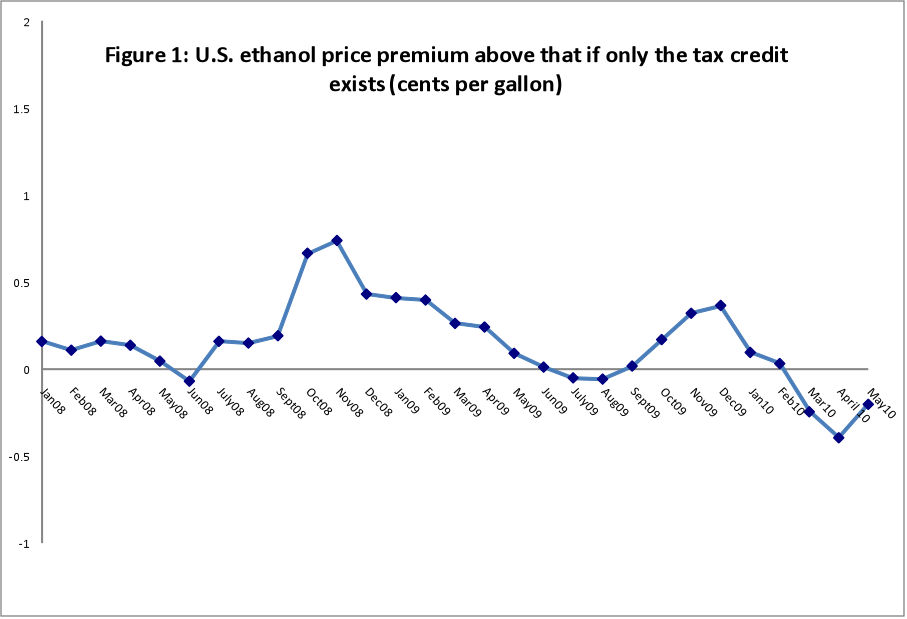
The nonpartisan Congressional Budget Office (CBO) recently issued a report on how the corn-ethanol tax credit costs $1.78 to reduce one gallon of gasoline consumption and $754 to reduce one ton of greenhouse gases. The Wall Street Journal immediately noted that “to put that [latter] number in perspective, the budget gnomes estimate that the price for a ton of carbon under the cap-and-tax program that the House passed last summer would be about $26 in 2019”. While this study is being used by critics of the tax credit - which will cost about $30 billion over the next five years and is up for reauthorization this year - the CBO nonetheless severely underestimates the true costs of the ethanol tax credit in their calculations because:
- It ignores the existence of the ethanol consumption mandate (the Renewable Fuel Standard);
- It assumes each (energy equivalent) gallon of ethanol produced due to the tax credit replaces a gallon of gasoline;
- It ignores the fact that with an ethanol consumption mandate, the ethanol tax credit subsidizes gasoline consumption instead, and
- It erroneously suggests that the ethanol consumption mandate has not been binding in the past.