The Stimulus Spending Black Hole: Your Money Wasted
When producers work, save and invest they create innovative solutions that lead to wealth creation, jobs and economic growth.

Guest Column Maureen Bader, Wyoming Liberty Group, Bio and Archives--March 13, 2012
American Politics, News | Comments | Reader Friendly | Subscribe | Email Us
Congress passed the American Reinvestment and Recovery Act, known as the Stimulus, in February 2009. Originally meant to hand out $787 billion tax dollars to stimulate the economy and create jobs, the amount rose to $840 billion for 2012. Although laden with utopian promises of milk and honey, the result of redirecting billions of dollars out of people's pockets is continued recession and high unemployment.
The theory that government could pick your pocket and create jobs is not a new. In the 20th century, governments used this belief to justify targeting money at unused resources and spending on what today is called 'shovel-ready' projects. However, just as government spending wasn't able to kick start the economy in the 1930s or the 1970s, it isn't now either. As the economist John Maynard Keynes said, "The ideas of economists and political philosophers, both when they are right and when they are wrong, are more powerful than is commonly understood. Indeed the world is ruled by little else. Practical men, who believe themselves to be quite exempt from any intellectual influence, are usually the slaves of some defunct economist." What has the theory of a defunct economist meant for jobs Wyoming? Between February 2009 and December 2011, the federal government poured more than $662 million in stimulus funding into Wyoming. According to Recovery.gov, the federal government website that tracks stimulus spending, other people's money created temporary jobs in Wyoming, but at the last count, at almost $1 million per job. This is a mind-blowing cost!
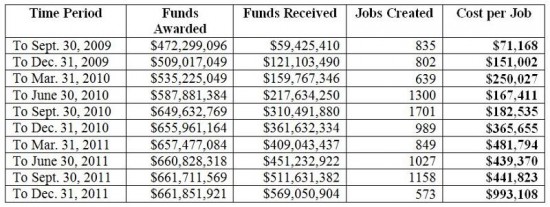 Source:
Where did Wyoming's cut of the money go? The Wyoming Department of Transportation shoveled up the biggest share of stimulus money, about $155 million. In one example, a project used just over $12 million to work on 9.9 miles of road and create 3.4 jobs. That's about $1.2 million dollars per mile and $3.5 million per job.
Imagine a private sector construction company paying more than a million dollars to create a paving job. At least it would quickly go out of business, unlike governments, which can waste money for much longer.
Consequently, it should come as no surprise that blowing all this cash on high-priced help has not reduced unemployment in Wyoming.
Between 2001 and 2008, the average unemployment rate in Wyoming was 3.7 per cent. In 2009 the unemployment rate sat at 6.4 per cent, in 2010, at 7 percent and in 2011, at 6 per cent. So much for recovery.
Taxpayers are figuring out that when the cost of an activity far outweighs its benefit, it wastes resources and makes them worse off. If we want real recovery, instead of creating gold-plated government jobs and pouring resources down a black hole, the federal government must leave money in the pockets of the people who made it. When producers work, save and invest they create innovative solutions that lead to wealth creation, jobs and economic growth.
Source:
Where did Wyoming's cut of the money go? The Wyoming Department of Transportation shoveled up the biggest share of stimulus money, about $155 million. In one example, a project used just over $12 million to work on 9.9 miles of road and create 3.4 jobs. That's about $1.2 million dollars per mile and $3.5 million per job.
Imagine a private sector construction company paying more than a million dollars to create a paving job. At least it would quickly go out of business, unlike governments, which can waste money for much longer.
Consequently, it should come as no surprise that blowing all this cash on high-priced help has not reduced unemployment in Wyoming.
Between 2001 and 2008, the average unemployment rate in Wyoming was 3.7 per cent. In 2009 the unemployment rate sat at 6.4 per cent, in 2010, at 7 percent and in 2011, at 6 per cent. So much for recovery.
Taxpayers are figuring out that when the cost of an activity far outweighs its benefit, it wastes resources and makes them worse off. If we want real recovery, instead of creating gold-plated government jobs and pouring resources down a black hole, the federal government must leave money in the pockets of the people who made it. When producers work, save and invest they create innovative solutions that lead to wealth creation, jobs and economic growth.View Comments
Guest Column——Bio and Archives
Items of notes and interest from the web.