Vizinada
Unknown Croatia

Guest Column Barry Napier, Bio and Archives--December 12, 2009
Lifestyles | Comments | Reader Friendly | Subscribe | Email Us
 Englishmen, they say, go out in the noonday sun. So do I.
It was hot and very sunny, and that added to the enjoyment, as my companions and I strolled down a narrow, dusty dirt track in the village of Vizinada, Istria, north-western Croatia. Only it wasn’t noon, but early morning.
Englishmen, they say, go out in the noonday sun. So do I.
It was hot and very sunny, and that added to the enjoyment, as my companions and I strolled down a narrow, dusty dirt track in the village of Vizinada, Istria, north-western Croatia. Only it wasn’t noon, but early morning.It is on the top of the hill facing the lush green valley, with its mountains; one with the amazing Motavun fortress-village perched on top. Every morning it appears out of the sea-mist like a fairytale castle. I got up before dawn each day, just to take photos and videos of the spectacle, each one different! Though we were staying in the large villa at the top of the village, none of us knew the ancient part existed – we had only seen the newer, 19th century section, on the main road from Pula to Slovenia. We saw the dirt track wending downwards and wondered where it led. We were glad we looked! The track first passed a very large mansion, owned by the famous German aristocrat, Count Bismark. His three litre Audi was housed under a rickety old cane shade at the side of the dirt path. A large old log with an axe embedded in it, lay nearby. Then, on left and right were houses with iron-fenced balconies, built around the 1600s.
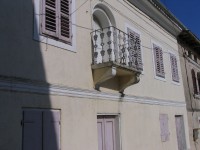 Every house had that Mediterranean look, with faded colours and crumbling plaster. To the left, still moving downwards into a large flat square, is what was once a fine merchant’s house. Behind it is a plain, huge 18th century church with a separate bell tower (the bell can be heard every morning at 6 am!).
Carrying on past the church we came to a grassy lane that faded-off into the slopes of a field. Then, an ancient roof above an open-air space supported by old columns, medieval, an L-shape room without windows or doors. Was this used for market days at one time? I could find no reference to its origin. Down the narrow road and another church is on the left, but shut. It is also very old, very small, probably medieval, and has been patched up many times. Its windows are typically Istrian – high-up and the shape of halved lemon slices. We move around in the heat, slowly kicking up dust and enjoying the silence. I touched the ancient door, with its raised, weathered grain, and hevy round handle.
As we look at the rustic, solid door, an old lady living opposite beckoned to us. When we walked towards her, she went into her house. Out she came again, smiling, with a large old iron key, and pointed to the church door, speaking briefly in her own tongue. We thanked her in ours, and unlocked the building. With a trust for strangers I have not witnessed for a long time, she wanted us to go in and enjoy the church! Her face showed a kindly pride in something she valued highly. This kind of trusting nature is everywhere in Istria, and it is very touching to those of us made cynical by those countrymen of our own who are out to do us harm.
Every house had that Mediterranean look, with faded colours and crumbling plaster. To the left, still moving downwards into a large flat square, is what was once a fine merchant’s house. Behind it is a plain, huge 18th century church with a separate bell tower (the bell can be heard every morning at 6 am!).
Carrying on past the church we came to a grassy lane that faded-off into the slopes of a field. Then, an ancient roof above an open-air space supported by old columns, medieval, an L-shape room without windows or doors. Was this used for market days at one time? I could find no reference to its origin. Down the narrow road and another church is on the left, but shut. It is also very old, very small, probably medieval, and has been patched up many times. Its windows are typically Istrian – high-up and the shape of halved lemon slices. We move around in the heat, slowly kicking up dust and enjoying the silence. I touched the ancient door, with its raised, weathered grain, and hevy round handle.
As we look at the rustic, solid door, an old lady living opposite beckoned to us. When we walked towards her, she went into her house. Out she came again, smiling, with a large old iron key, and pointed to the church door, speaking briefly in her own tongue. We thanked her in ours, and unlocked the building. With a trust for strangers I have not witnessed for a long time, she wanted us to go in and enjoy the church! Her face showed a kindly pride in something she valued highly. This kind of trusting nature is everywhere in Istria, and it is very touching to those of us made cynical by those countrymen of our own who are out to do us harm.
Forgotten Art
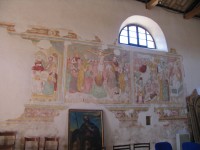
We opened the large door, and were unprepared for what we saw. The church was almost empty, except for a few stacked chairs. But, around the flaking walls, were the most amazing medieval frescoes illustrating scenes from the New Testament, the colours still vibrant after 400 years. Leaning loosely against the walls were framed oil paintings from about the same period. If they were in a city gallery they would be locked in a vault! We just couldn’t believe we had been handed the keys to these wonderful treasures in such a trusting and genuine way. We locked up again and handed the key back. The old lady smiled; she was visibly pleased we had enjoyed what we saw, and waved as we carried on down the road… the whole old village nestled into the side of the hill.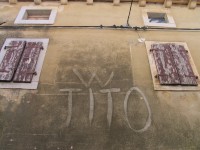 Either side were old buildings and on the right we found what now looked out of place in this gentle place: a zealot had scraped ‘ww’ on the wall of a house, with the name ‘Tito’ painted onto the now flaking wall beneath, reminding us of a far less gentle time not so long ago.
On down the hill and we came to a dead-end with a farmhouse. There were two very small new holiday homes there, and one under construction, but like many other Istrian developments they were made of recycled old materials. So, they fitted their environment well. Though small, the view they have over the Mirna Valley was worth a king’s ransom! Still early morning, the valley was filled with a mist that seemed to hold the opposite mountains and mountain villages magically in mid-air. I just stood quietly, drinking it all in, enjoying the heat of the sun, the silence, and the sense of seeing something usually hidden from view.
We walked back up again, this time on our left, passing a derelict building without a roof or floors. Thickish tree branches stuck out of each window. Curious, I took a closer look and could see that the branches were long enough to traverse the whole depth of the building, front to back. The branch-ends poked out from windows opposite each other. Shorter branches were tied to the ends, across the windows, and I could then see it was an ingenious way of tying the house together, to stop the walls falling down!
Either side were old buildings and on the right we found what now looked out of place in this gentle place: a zealot had scraped ‘ww’ on the wall of a house, with the name ‘Tito’ painted onto the now flaking wall beneath, reminding us of a far less gentle time not so long ago.
On down the hill and we came to a dead-end with a farmhouse. There were two very small new holiday homes there, and one under construction, but like many other Istrian developments they were made of recycled old materials. So, they fitted their environment well. Though small, the view they have over the Mirna Valley was worth a king’s ransom! Still early morning, the valley was filled with a mist that seemed to hold the opposite mountains and mountain villages magically in mid-air. I just stood quietly, drinking it all in, enjoying the heat of the sun, the silence, and the sense of seeing something usually hidden from view.
We walked back up again, this time on our left, passing a derelict building without a roof or floors. Thickish tree branches stuck out of each window. Curious, I took a closer look and could see that the branches were long enough to traverse the whole depth of the building, front to back. The branch-ends poked out from windows opposite each other. Shorter branches were tied to the ends, across the windows, and I could then see it was an ingenious way of tying the house together, to stop the walls falling down!
The Poets’ Square
Back to the square, and the space seems too big for the size of the buildings… maybe something had been demolished in the distant past. To our left is a raised plinth of stone. On it are two wells with ornate cast-iron works. Behind this is a house cobbled together with such a mix and size of stones, it is impossible to assess the real age. It looks like a combination of medieval and 18th century styles and leans this way and that. In the middle of the facing wall surrounded by a cluster of varied stones is a large stone plaque, with the figure of a lion, seen everywhere in Istria, evidence of previous Venetian rule. Below it are tablets of stone set into the wall, containing a legend from the 1700’s concerning a former Italian governor. The square is the venue for an annual Poets’ Battle, where poets come to read out their verse. They are judged at each round until only two are left. The grand final finishes when only one poet is left. And yet, none of this is listed in the tourist guides.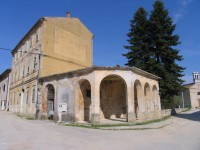 Carry on again to the left and the road starts to wind back up again, past more historical buildings, ancient alleyways, and arches with rickety wooden doors. Finally, on the left, a very large, white building stood impressively on the hillside, contrasted against the brilliant blue sky. Does it belong to the Scottish countess who owns a renovated Vizinada palace? Both a Count and a Countess in one small village! The road comes out in the newer part of the village at the top of the hill, by the shops. This bit was 18th century, looking rather like a painting by Cezanne, and the tranquility of the place made its mark on my senses. I loved it.
Remember to turn down the hill from the ‘modern’ part of the village and don’t just drive through. Go down that very narrow old road and take in the ancient atmosphere. Then go to the newer part and have a cool drink. You will find scant reference to Vizinada in the guide-books, so make a point of discovering it for yourself. Not even my Istrian tourism friends know about it! And there are many more similar hidden gems, not found in the usual guide books… just keep your eyes open and enjoy the real Istria!
Apart from the traditional festival of poetry, Versi na Stemi, when poets do verbal battle to win the annual poetry competition, there are also the folk-feasts of Krostulijada, St Mary and St Valentine. And, when you drive back out of Vizinada toward Pula wanting something to eat or drink, try Konoba Da Quinto run by the Ritoša family. They don’t speak English, but their welcome is so friendly, you won’t want to miss working out what’s for food… and whatever it is, it will be good! It’s on the main road when you leave Vizinada, on the left, painted yellow with seats outside. Ask for Klaudio.
Notes
Carry on again to the left and the road starts to wind back up again, past more historical buildings, ancient alleyways, and arches with rickety wooden doors. Finally, on the left, a very large, white building stood impressively on the hillside, contrasted against the brilliant blue sky. Does it belong to the Scottish countess who owns a renovated Vizinada palace? Both a Count and a Countess in one small village! The road comes out in the newer part of the village at the top of the hill, by the shops. This bit was 18th century, looking rather like a painting by Cezanne, and the tranquility of the place made its mark on my senses. I loved it.
Remember to turn down the hill from the ‘modern’ part of the village and don’t just drive through. Go down that very narrow old road and take in the ancient atmosphere. Then go to the newer part and have a cool drink. You will find scant reference to Vizinada in the guide-books, so make a point of discovering it for yourself. Not even my Istrian tourism friends know about it! And there are many more similar hidden gems, not found in the usual guide books… just keep your eyes open and enjoy the real Istria!
Apart from the traditional festival of poetry, Versi na Stemi, when poets do verbal battle to win the annual poetry competition, there are also the folk-feasts of Krostulijada, St Mary and St Valentine. And, when you drive back out of Vizinada toward Pula wanting something to eat or drink, try Konoba Da Quinto run by the Ritoša family. They don’t speak English, but their welcome is so friendly, you won’t want to miss working out what’s for food… and whatever it is, it will be good! It’s on the main road when you leave Vizinada, on the left, painted yellow with seats outside. Ask for Klaudio.
Notes
- Vizinada is in the mid northern part of Istria. Istria is the north western region of Croatia. To its north is a sliver of Slovenia that goes on to northern italy.
- To its east is the rest of Croatia. To its west is the mediterranean and Venice.
- To the south is main Istria.
- Istria is still mainly untouched, but is quickly becoming a tourist destination of charm.
- The only airport in Istria is at Pula in the south. It is provincial, so sometimes is not used. Other airports commonly used are Venice and Trieste in Italy.
- Not that easy to get to, but worth the trip.
View Comments
Guest Column——Bio and Archives
Items of notes and interest from the web.