
Slash and Burn
Slash and burn is a time-honored tradition of turning forested lands into agricultural fields. It is still very much prevalent in tropical and sub-tropical areas all around the world, in Asia, Africa, and South America.
Of course, it has its drawbacks and consequences. Apart from the smoke and air pollution initially produced, the most pertinent and lasting effects are the changes in the biota and water table of the area. Erosion and soil degradation often follow. Subsequent drainage of the groundwater in bogs exposes the peat to air and potential combustion.
In SE Asia, vast tracts of ancient jungle have been deforested in this manner and turned into oil palm plantations. In fact, production of palm oil in Indonesia has, since 1964, recorded a phenomenal increase from 157,000 tonnes to 41.5 million tonnes in 2018 and a total of 51 million tons will be needed in 2025 to sustain international and domestic demands. Palm oil accounts for 11% ( $16.5 bn) of Indonesia's export earnings (https:/www.dw.com/en/palm-oil-too-much-of-a-good-thing/a-44979802 ). Indonesia alone produces over half of the world production of palm oil.
Furthermore, roughly one third of the Indonesia’s palm oil (including palm kernel oil) production is used as “biodiesel” fuel, much of which is exported to India, China, Europe, the U.S. and other countries.
In short:
These “wildfires” on Borneo are accidentally or deliberately set by the people and not evidence of any “climate change.” If anything, this picture demonstrates the new “virtual reality” that increasingly pervades our factual reality in too many ways.



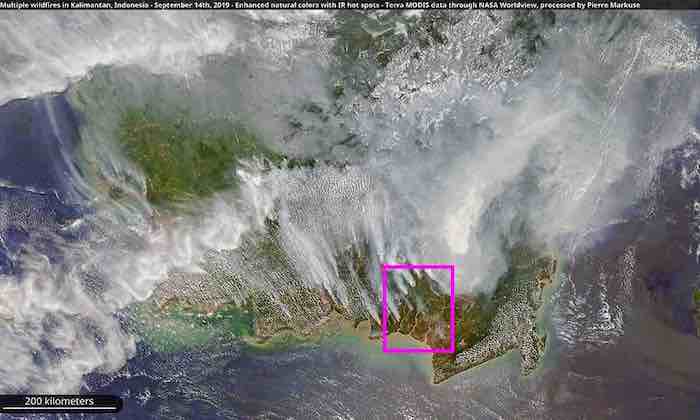 A recent news post at Gizmodo claims to show “The Satellite Images That Show a Decade of Climate Change”. Needless to say, it was widely mentioned in the mainstream media.
