

By Fraser Institute ——Bio and Archives--August 6, 2025
Canadian News, Opinion | CFP Comments | Subscribe | Email Us
TORONTO—The Ontario government now forecasts it will finally balance the province’s operating budget by 2027, but given the current government’s history of missing its own fiscal targets, it’s questionable whether this one will be achieved, finds a new study released today by the Fraser Institute, an independent, non-partisan Canadian public policy think-tank.

“The current Ontario government initially ran on a campaign to get the province’s finances back on track, but unfortunately, it has developed a pattern of running large deficits and blowing past its own deficit and borrowing targets, just like the previous government,” said Ben Eisen, senior fellow at the Fraser Institute and co-author of Hold the Celebration on Ontario’s Finances (Again!).
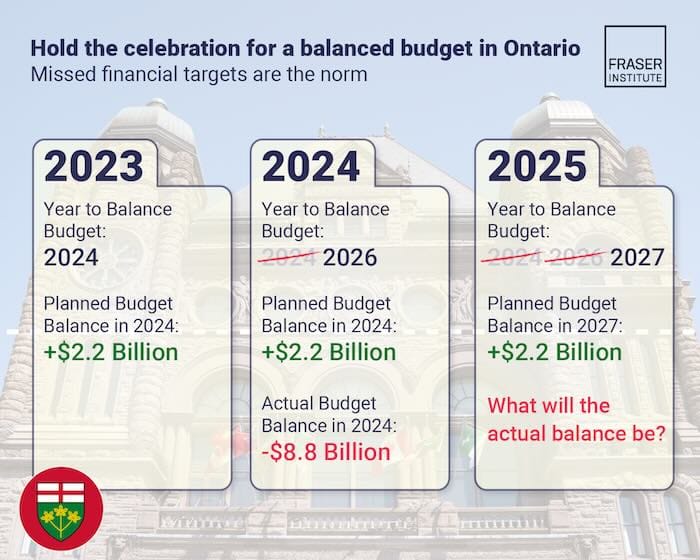
The study shows that the government of Ontario has repeatedly failed to meet its deficit and borrowing targets and has presented three different planned dates for eliminating its deficit in the last three budgets.
After having run deficits every year except one since 2007, the Ontario government now forecasts it will not balance its operating budget until 2027/28. However, the government has a history of missing its fiscal targets. For example:
“The Ontario government’s track record of missing its fiscal targets has resulted in a substantial run-up in provincial debt, which is now estimated to exceed half a trillion dollars in 2027/28,” Eisen said.
“Ontario’s finances have deteriorated significantly over the last few decades, and it will take prudent fiscal management—not missed targets and moving goal posts—to get them back on track.”
Media Contact:
Ben Eisen, Senior Fellow, Fraser Institute
To arrange media interviews or for more information, please contact:
Drue MacPherson, Fraser Institute
604-688-0221 ext. 721
drue.macpherson@fraserinstitute.org

View Comments
The Fraser Institute is an independent Canadian public policy research and educational organization with offices in Vancouver, Calgary, Toronto, and Montreal and ties to a global network of 86 think-tanks. Its mission is to measure, study, and communicate the impact of competitive markets and government intervention on the welfare of individuals. To protect the Institute’s independence, it does not accept grants from governments or contracts for research. Visit fraserinstitute.org.
Follow the Fraser Institute on Twitter | Like us on Facebook