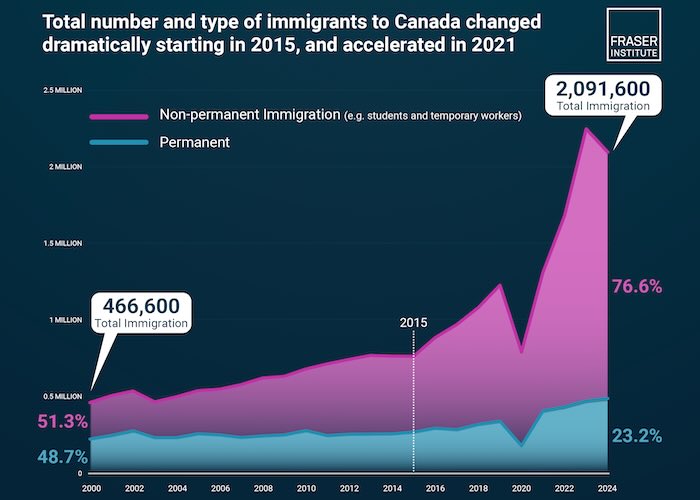
The sharp rise in recent years reflected both planned increases in permanent immigrant inflows as well as unprecedented and largely unplanned growth in the numbers of temporary foreign workers, international students, and asylum seekers. For example, in 2024 alone, 485.6 thousand permanent immigrants entered Canada, along with 518.2 thousand international students and 912.9 thousand temporary foreign workers.
However, due to concerns about the impact of unprecedented in-migration on housing affordability, employment opportunities (or lack thereof), access to health care and other issues, late last year the federal government unveiled plans to substantially reduce immigration levels over the 2025-27 period, affecting permanent immigrants, international students, and other temporary visa holders.
The composition of immigration also changed dramatically during this period. From 2000 to 2015, the average share of total immigrants in the permanent category was 42.1 per cent while non-permanent share (mainly international students and temporary workers) was 57.9 per cent. From 2016 to 2024 (excluding Covid 2020), permanent immigrants averaged 27.7 per cent of total in-migration versus 72.3 per cent for non-permanent.
“We’re in the midst of a housing crisis in Canada, and the unfortunate truth is we lack the necessary infrastructure to accommodate immigration at the 2022-24 rate,” said Steven Globerman, senior fellow at the Fraser Institute and study co-author.
“While the changes announced late last year have been confirmed by the new government, the levels of immigration over 2025-27 will still be well above historic benchmarks.”
This study is the first in a series of papers from the authors on immigration.
Media Contact:
Jock Finlayson, Senior Fellow, Fraser Institute
Steven Globerman, Senior Fellow, Fraser Institute
To arrange media interviews or for more information, please contact:
Drue MacPherson, Fraser Institute
604-688-0221 ext. 721
drue.macpherson@fraserinstitute.org