Paying an unfamiliar website: what Canadians should check first
If a payment goes bad, speed matters. Contact your card issuer or the processor first, because dispute windows are finite. Then report it to the Canadian Anti-Fraud Centre

News on the Net -- Joana Borges, Bio and Archives--September 8, 2026
Lifestyles | Comments | Reader Friendly | Subscribe | Email Us
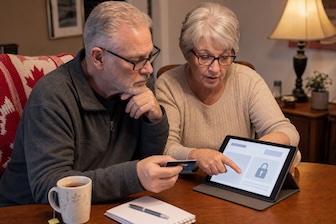
The About page is the least useful page on any website you are about to give money to. Anyone can write one. The pages that tell you something real are the ones the site owner did not write for you: the checkout, the terms, the refund policy, and the small print about who actually processes the payment. Most people read those last, if at all, and that order is exactly backwards.
Canadians are careful with their money in person and oddly casual with it online. The Canadian Anti-Fraud Centre's standing advice is blunt: verify that the organization you are dealing with is legitimate before you take any other action, and if it seems too good to be true, it is. That applies to a stranger on the phone and it applies to a website with a nice logo. Here is what verifying actually looks like at the point of payment.
Who is taking your money
Start with the checkout page, not the product. When you enter card details, are you handing them to the merchant directly, or to a processor you recognise sitting in between? The distinction matters. A merchant that holds your full card number can be breached, can rebill you, or can simply be a fraud. A processor you already use is a known quantity with a dispute process you can find.
PayPal is the common example. Its Canadian site states that transactions are encrypted and that it does not share your full financial information with merchants, with Purchase Protection on eligible purchases. Interac e-Transfer through your own bank is another. What you are looking for in both cases is a familiar name standing between you and someone you have never dealt with. If the only option is typing your card into a form on a site you found yesterday, the site is asking for a level of trust it has not earned.
Whether anyone is allowed to sell you this
Some purchases are regulated, and for those the licence matters more than the reviews. Financial products, insurance, prescription medication and gambling all fall into that category in Canada, and each has a provincial or federal body that keeps a public register. A five-star rating tells you the seller is good at collecting ratings. A register entry tells you someone with the power to shut them down has looked at them.
Take three purchases Canadians make online every week. Buying travel insurance: the seller should appear on your provincial insurance regulator's register, and if it does not, no testimonial changes that. Filling a prescription: the pharmacy should be licensed by the college of pharmacists in the province it ships from, which is a two-minute search. Playing at an online casino: it is a 19+ activity in most provinces, Ontario and Alberta now require operators to register provincially before serving their residents, and PayPal approves gambling merchants one at a time rather than as a category, which is why independent lists of PayPal-approved casinos in Canada usually note which regulator each site answers to alongside the payment details. In all three cases the homework is the same. Find out who is supposed to have vetted the seller, then confirm that they actually did.
The same applies to a mortgage broker or a used-car dealer with a slick website. Find the regulator, find the register, and look the company up before you look at its reviews.
Whether the price has a tail
The Competition Bureau's Little Black Book of Scams has a name for the most common way an honest-looking purchase turns expensive: the subscription trap. A free or low-cost trial asks for a card to cover shipping, a pre-checked box you did not notice agrees to a monthly plan, and cancelling turns out to be far harder than signing up. The Bureau's advice is to read the terms before you enter a card, research the company and read the negative reviews specifically, and treat a "limited time offer" as pressure rather than information.
None of this is exotic. It is the same discipline this outlet's readers were urged to apply to financing after a bankruptcy: understand what you are agreeing to before you sign, and be suspicious of anyone who does not want you to slow down.
Whether you can get it back
Buyer protection is not one thing. A credit card gives you a chargeback route through your bank. A processor like PayPal gives you its own dispute process on top of that, with its own eligibility rules. A debit payment or a bank transfer sent directly to a merchant generally gives you neither, because the money has already left. Before paying an unfamiliar site, it is worth knowing which of those three situations you are in, because the answer decides whether a bad experience costs you an afternoon or the full amount.
Read the refund policy for what it excludes rather than what it promises. "100% satisfaction" is marketing. "Returns accepted within 30 days, buyer pays shipping, restocking fee applies" is information, and it is the information you want.
What to do when it goes wrong
If a payment goes bad, speed matters. Contact your card issuer or the processor first, because dispute windows are finite. Then report it to the Canadian Anti-Fraud Centre, even if the amount is small, because their picture of what is circulating depends on people bothering to file.
The Gifford-Jones column argued in these pages that more information has not produced better judgement, and that was about health. It is just as true of money. Nobody needs to understand payment infrastructure to protect themselves online. They need to slow down at the one page on the site that was not written to persuade them, and read it the way they would read a contract from a stranger, because that is what it is.
Joana Borges covers topics ranging from lifestyles to gaming.
View Comments
News from around the world