The Supply/Production Chain Only as Strong as the Weakest Link Part II
Are Your Customers' Successes or Failures Yours?

Guest Column Abe WalkingBear Sanchez, Bio and Archives--September 1, 2011
American Politics, News | Comments | Reader Friendly | Subscribe | Email Us
If you could show a customer a better way to increase sales, improve cash flow and working capital, and implement new efficiencies that would drive down their costs and give them a competitive advantage would you do it, if for no other reason than by doing so they could/would buy more from you and be able to pay you in a more timely manner?
Should we be our business brother's keeper? This second article in a two part series deals with the past due A/R management function/leg in a business. During my training programs on B2B Credit Sales and A/R Management we often find that a number of customers are late in paying their bills not because they are trying to avoid payment, or because something went wrong somewhere, or because they are sitting on the money and practicing cash management...they can't pay because they are waiting on their own customers to pay them...A/R being the largest source of working capital.
What to do? Past Due A/R Management, not collections, is the second major part of the Credit and A/R Management Function, with Credit Approval being the first. Words are important because they convey values. Use the wrong word and the wrong value is communicated. Collections is the enforcement of payment and those who owe are debtors who are beholding to their creditors. "A creditor is worse than a master for a master owns only your person while a creditor owns your dignity and can belabor that." V. Hugo I think Victor got it wrong, a master can belabor both your person and dignity. Instead of "collections" think of past due A/R management as the "Completion of The Sale." The difference between the two being that in Completion of The Sale the goal is not "the enforcement of payment" and you are not dealing with "debtors." The goal of past due A/R management is to identify why a customer, the guy who puts the food on the table, hasn't paid and to resolve the issue so that the customer pays and just as, if not more important, buys again and again. Most often, as a rule, the most profitable sales are repeat sales and with the following repeat sale being more profitable than the last. In past due A/R Management, we have to remember that it is the seller who is beholding to the customer. Good vital signs, KPIs (key performance indicators), to monitor for past due A/R Management are: 1) During key times of the month the % of A/R current to 30 day past due If credit customers are paying, your cash flow will be good and your repeat sales will be good as well. A good tool in the pursuit of a high % of A/R current to 30 days past due is having the A/R aging printed out and worked by largest dollar amount. It's the 80/20 Rule, 20% of the A/R will make up 80% of the dollars and working the largest accounts first also leads to the largest repeat sales. 2) The A/R is very often the largest source of a company's working capital so a good thing to monitor is the payment % during key times of the month and the PDI (payment days index) at the end of the month. By tracking the payment percentage during the month we can determine if we need to exert greater efforts.
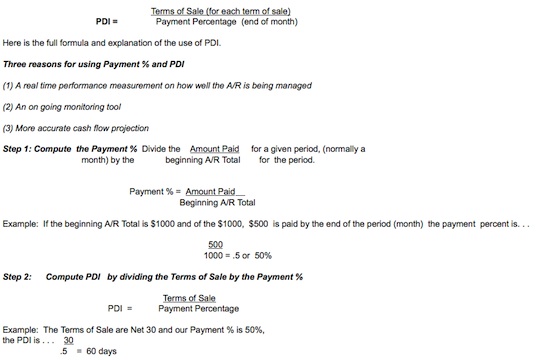 Varied Terms Of Sales: Compute PDI for each Term of Sale and then Average
3) The normally smallest % of past due credit customers who represent a potential for loss.
Having the Credit function report on credit customers who are experiencing serious financial problems or who are being uncooperative, lie or break arrangement... as they are identified ...is important for a number of reasons.
a) further credit sales can be cut off thus limiting the potential bad debt
b) additional resources can be brought to bear to either "enforce payment" in the case of those customers who are being uncooperative, lie or skip out or to work on the improvement of your position with those who are having a serious financial problem. In either case time is of the essence.
c) if there is a trend as to the type of business that customers representing a risk of failure fall into the Marketing leg/function and Sales leg/function need to know and sooner is better than later, so that they can reevaluate and adjust their own efforts.
4) The inefficiencies uncovered, situations where something has gone wrong somewhere. Knowing in a timely manner the source of errors, omissions and miscommunications allows for the timely correction and the driving down of the total cost of doing business for sellers and for their customers. Studies have found that on average 25% of the total cost of doing business is directly the result of inefficiencies.
In the course of approving lines of credit (90 % or more of B2B Sales involve credit terms) and then managing the resulting A/R, the Credit function interfaces with many other business functions, suppliers and customers and can identify areas of opportunity for improvement , inefficiencies.
Dr. Demming said that the true cost of errors is unknown and unknowable. Dr. Coase said that of all the frictions (cost) involved with business the greatest friction of all is the friction of failure of something going wrong somewhere.
A vital sign that should be monitored and given full management attention and energy is the number of "systems problems" (something went wrong somewhere) and the dollars involved. Systems problem are friction and drive up everyone's cost of doing business ...seller and buyer alike and lead to a competitive disadvantage.
The proper management of A/R (accounts receivable) results in good cash flow, sustained repeat sales, controlled bad debt and new efficiencies.
Before you can monitor the KPIs for Credit Sales and A/R you have to know what it is that you are dealing with and then you can establish the best possible outcome and goals.
1) 90 % or more of all B2B Sales involve payment at a later date...credit terms are extended
2) A/R, short term money due from the sale of products or services based on payment at a later date is often one of the largest assets many companies have. On average the A/R is 40% or more of the total assets, (less with manufacturers more with service companies and some distribution companies)
3) Next to cash on hand the A/R is among the most the most liquid of assets, being but one step removed from money in the bank and is the largest source of working capital.
4) In the course of approving Credit Sales and then managing the resulting A/R, the Credit and A/R function interfaces with customers, sales, marketing, accounting, operations, the warehouse, service, vendors/suppliers, attorneys, transportation and many others involved with the supply chain.
Based on their understanding of a business function, Management Team members need to establish clear and best goals for the different functions and then be able to monitor the progress or lack of progress being made toward those goals. They need to hire the right people capable of carrying out the tasks and then measure their work. Managers need reliable information on which to develop strategies and then monitor the execution of plans.
© Copyright 2011 A/R Management Group, Inc. [url=http://www.armg-usa.com]http://www.armg-usa.com[/url] All Rights Reserved. Feel free to use this article in your publication, to forward to anyone on your email list or to copy and distribute
Varied Terms Of Sales: Compute PDI for each Term of Sale and then Average
3) The normally smallest % of past due credit customers who represent a potential for loss.
Having the Credit function report on credit customers who are experiencing serious financial problems or who are being uncooperative, lie or break arrangement... as they are identified ...is important for a number of reasons.
a) further credit sales can be cut off thus limiting the potential bad debt
b) additional resources can be brought to bear to either "enforce payment" in the case of those customers who are being uncooperative, lie or skip out or to work on the improvement of your position with those who are having a serious financial problem. In either case time is of the essence.
c) if there is a trend as to the type of business that customers representing a risk of failure fall into the Marketing leg/function and Sales leg/function need to know and sooner is better than later, so that they can reevaluate and adjust their own efforts.
4) The inefficiencies uncovered, situations where something has gone wrong somewhere. Knowing in a timely manner the source of errors, omissions and miscommunications allows for the timely correction and the driving down of the total cost of doing business for sellers and for their customers. Studies have found that on average 25% of the total cost of doing business is directly the result of inefficiencies.
In the course of approving lines of credit (90 % or more of B2B Sales involve credit terms) and then managing the resulting A/R, the Credit function interfaces with many other business functions, suppliers and customers and can identify areas of opportunity for improvement , inefficiencies.
Dr. Demming said that the true cost of errors is unknown and unknowable. Dr. Coase said that of all the frictions (cost) involved with business the greatest friction of all is the friction of failure of something going wrong somewhere.
A vital sign that should be monitored and given full management attention and energy is the number of "systems problems" (something went wrong somewhere) and the dollars involved. Systems problem are friction and drive up everyone's cost of doing business ...seller and buyer alike and lead to a competitive disadvantage.
The proper management of A/R (accounts receivable) results in good cash flow, sustained repeat sales, controlled bad debt and new efficiencies.
Before you can monitor the KPIs for Credit Sales and A/R you have to know what it is that you are dealing with and then you can establish the best possible outcome and goals.
1) 90 % or more of all B2B Sales involve payment at a later date...credit terms are extended
2) A/R, short term money due from the sale of products or services based on payment at a later date is often one of the largest assets many companies have. On average the A/R is 40% or more of the total assets, (less with manufacturers more with service companies and some distribution companies)
3) Next to cash on hand the A/R is among the most the most liquid of assets, being but one step removed from money in the bank and is the largest source of working capital.
4) In the course of approving Credit Sales and then managing the resulting A/R, the Credit and A/R function interfaces with customers, sales, marketing, accounting, operations, the warehouse, service, vendors/suppliers, attorneys, transportation and many others involved with the supply chain.
Based on their understanding of a business function, Management Team members need to establish clear and best goals for the different functions and then be able to monitor the progress or lack of progress being made toward those goals. They need to hire the right people capable of carrying out the tasks and then measure their work. Managers need reliable information on which to develop strategies and then monitor the execution of plans.
© Copyright 2011 A/R Management Group, Inc. [url=http://www.armg-usa.com]http://www.armg-usa.com[/url] All Rights Reserved. Feel free to use this article in your publication, to forward to anyone on your email list or to copy and distributeView Comments
Guest Column——Bio and Archives
Items of notes and interest from the web.