Far Better Than DrudgeUnfiltered News • Daily Headlines

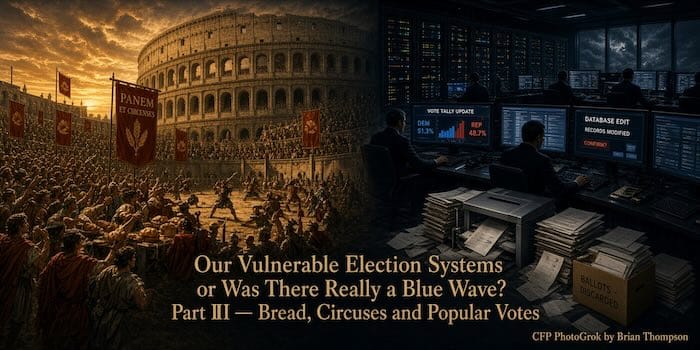
Part III--Bread, circuses and popular votes

Our Vulnerable Election Systems or Was There Really a Blue Wave?


The previous two parts of this report (here and here) focused on the centralization of election records and the replacement of hard copy based systems and records with easily altered machine systems and records. These were, however, not the only changes made to our elections. In this part, we will look at other changes that work together with centralization and electronic records to make our elections easier to manipulate and harder to fix.


The Covid pandemic was used as an excuse to implement universal vote by mail

In 2005, the Carter-Baker Commission Report on Federal Election Reform was issued. Produced by former President Jimmy Carter and former Secretary of State James Baker, it identified numerous weaknesses in our election systems, and issued 87 recommendations on how to improve our elections. That report has served almost as a blueprint for how to corrupt elections. Nearly every weakness identified in the report has been magnified in our current election systems.

One of the major findings was that vote by mail, known at the time as absentee voting, was one of the most significant weaknesses for election integrity, and that it should be reduced and even eliminated. Since then, every state has greatly increased vote by mail, and some even now use it exclusively. Other recommendations included requiring proper identification to vote, maintenance of a nationwide voter registration system, making elections easier to audit, among many others.

The Covid pandemic was used as an excuse to implement universal vote by mail, with the politician's promise that normal voting practices would be restored afterwards. So what is wrong with it? It's convenient, our officials assure us it is safe and secure, and it increases voter turnout so that more people participate in our democratic process. How can that be bad?

Where to begin? First, there is no assurance that a ballot returned by mail came from the voter to whom it was mailed. We already discussed ballot theft and ballot trafficking. Add ballot redirection to the list. A ballot mailing address can be changed through most of the state online voter registration systems, or a change request can be mailed in. Ballots that would be sent to legitimate voters are redirected to addresses where they can be collected, filled out, and returned as though they came from a legitimate voter.


Ballots can be collected and voted without the real voter's knowledge

In a recent case, a local official was convicted of election fraud where he had used online systems to change the mailing addresses of voters in his area to ones he could control, so it is not a theoretical problem. He was caught almost by accident. How many other instances are not caught?

In similar vein, investigators have found significant numbers of people who have moved away, yet their registrations are never cancelled, or they are re-registered, often at the address they moved from years earlier. These registrations are fairly easily identified, and again, the mailing addresses can be changed so that the ballots sent to them can be collected, completed, and returned, often without the original person ever knowing their prior registration was being used to commit fraud. If discovered, too many officials will just dismiss it as someone just trying to vote twice. We have found that as many as 5% of the voter rolls are likely to be such entries, and many of them have votes recorded against them.

There are also the so called "low propensity voters" who are registered but who haven't voted for years, if ever. These are easy to identify in the rolls, and form a large population of useful registrations. Even in states that don't have universal vote by mail, absentee ballots can be requested for them and directed to useful addresses. Just like the moved voters, these ballots can be collected and voted without the real voter's knowledge.

Signature checking is presented as a measure to prevent such ballot misuse, but many states no longer check signatures on return ballots, and even those that do, the check is often superficial. Most jurisdictions in California merely check to see if there is a mark in the signature line, and some don't even go that far.


Many people who entered the country illegally have reported that they have been given paperwork to complete that has included voter registration forms

Coupled with the ability to change and use existing voter registrations, there is a laxity in checking registration applications that allows many registrations to be accepted without proper checks for citizenship, for a legal address, for criminal status, or even for existence. Many people who entered the country illegally have reported that they have been given paperwork to complete that has included voter registration forms. They were told they needed to complete them in order to receive medical, housing, food, and employment assistance. The organizations assisting these illegals later assign addresses and submit the forms by mail or in registration drives. California, among other states, prohibit checking of citizenship when processing the forms, and end up registering millions of non-citizens to vote.

The organizations that collect and submit these forms know the names, birthdates, addresses, and other essential information that can be used to direct vote by mail or absentee ballots to locations where they can be collected, filled out, and returned. Since a registration exists in the voter rolls, those ballots will be accepted and counted just as if they had come from legal voters. Investigations have shown that every state has significant percentages of non-citizen registrations in their rolls, often as much as 20% or more.

Very few of the people whose names are being used are aware of that use. In the recent midterms, in many states, over half the ballots received were absentee or mail-in. How many of those came from legal voters? We don't know and it is almost impossible to tell without major investigations.

Another recent innovation in our elections is late and same-day registration. Prospective voters are allowed to complete a registration application and a ballot at the same time. The ballot is generally accepted and added to the counts before the registration is processed. Underage, non-citizens, non-residents, false names, and many other non-qualifying registrations are accepted, especially where registrants are not required to show any sort of ID. Even if is later shown that the registration is invalid, the vote they cast has already been counted and cannot be identified and removed afterwards. If a false name was used, most of the people who submitted false registrations will never be identified or prosecuted.



If we allow things to stand as they are, we may never have another chance to keep our Republic

Most locations report that huge numbers of same day registrations were received, often amounting to several percent of the in-person voter counts. Even if officials want to do a good job of vetting prospective voters, same-day registration laws can nullify that desire. Motor-voter laws act in similar fashion where an applicant for a driving license can be registered to vote simply by omitting to check a box on the license application form.

Drop boxes and ballot harvesting are two other recent additions from the Carter-Baker list of election vulnerabilities to avoid. By allowing ballots to be returned anonymously, it further reduces the risks of discovery for those who would commit fraud. Many investigations have provided evidence of massive numbers of ballots collected and deposited in drop boxes by paid workers--workers who are difficult to identify and who act as cutouts for the people and groups who are producing fraudulent ballots. While these methods may be used legitimately, they are very attractive for misuse and are widespread across many states. They are an excellent way to introduce fraudulent ballots into the system to be counted.

The result of all these changes and more is that we have election systems that make it easy to cheat, easy to manipulate at state and national levels, difficult to identify the manipulators, and difficult to correct through audits or other legal means. One thing we know for certain is that when you make fraud easy and low risk, many people will participate. In fact, many will consider anyone who doesn't cheat to be stupid--it's raining soup--the smart ones bring buckets.

As long as this series has been, I have only had space to touch on a few of the vulnerabilities and mention a few bits of evidence. The final part IV will summarize key points and provide a course of action from here. Election integrity is truly a bipartisan issue. If we allow things to stand as they are, we may never have another chance to keep our Republic.


Read next: School District Votes Today On Whether To Suspend-Expel Students For Not Using Pronouns

Email Us | Reader Friendly | Comments

David Robb—— David Robb is a practicing scientist and CTO of a small firm developing new security technologies for detection of drugs and other contraband. Dave has published extensively in TheBlueStateConservative, and occasionally in American Thinker.