Cold Weather Kills 20 Times as Many People as Hot Weather
Most of the temperature-related mortality burden was attributable to the contribution of cold

Allan MacRae & Joseph D’Aleo, Bio and Archives--September 14, 2015
Global Warming-Energy-Environment | Comments | Reader Friendly | Subscribe | Email Us
 Cold weather kills. Throughout history and in modern times, many more people succumb to cold exposure than to hot weather, as evidenced in a wide range of cold and warm climates.
Evidence is provided from a study of 74 million deaths in thirteen cold and warm countries including Thailand and Brazil, and studies of the United Kingdom, Europe, the USA, Australia and Canada.
Cold weather kills. Throughout history and in modern times, many more people succumb to cold exposure than to hot weather, as evidenced in a wide range of cold and warm climates.
Evidence is provided from a study of 74 million deaths in thirteen cold and warm countries including Thailand and Brazil, and studies of the United Kingdom, Europe, the USA, Australia and Canada.Contrary to popular belief, Earth is colder-than-optimum for human survival. A warmer world, such as was experienced during the Roman Warm Period and the Medieval Warm Period, is expected to lower winter deaths and a colder world like the Little Ice Age will increase winter mortality, absent adaptive measures. These conclusions have been known for many decades, based on national mortality statistics.
WORLD
Cold weather kills 20 times as many people as hot weather, according to an international study analyzing over 74 million deaths in 384 locations across 13 countries, published in The Lancet.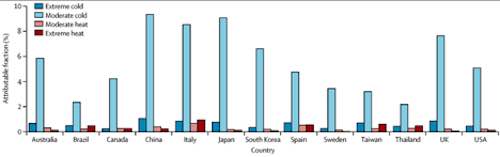
“We collected data for 384 locations in Australia, Brazil, Canada, China, Italy, Japan, South Korea, Spain, Sweden, Taiwan, Thailand, UK, and USA. … We analysed 74,225,200 deaths in various periods between 1985 and 2012. In total, 7.71% (95% empirical CI 7.43–7.91) of mortality was attributable to non-optimum temperature in the selected countries within the study period, with substantial differences between countries, ranging from 3.37% (3.06 to 3.63) in Thailand to 11.00% (9.29 to 12.47) in China. The temperature percentile of minimum mortality varied from roughly the 60th percentile in tropical areas to about the 80–90th percentile in temperate regions. More temperature-attributable deaths were caused by cold (7.29%, 7.02–7.49) than by heat (0.42%, 0.39–0.44). Extreme cold and hot temperatures were responsible for 0.86% (0.84–0.87) of total mortality. … Most of the temperature-related mortality burden was attributable to the contribution of cold. The effect of days of extreme temperature was substantially less than that attributable to milder but non-optimum weather. This evidence has important implications for the planning of public-health interventions to minimize the health consequences of adverse temperatures, and for predictions of future effect in climate-change scenarios.”
UNITED KINGDOM AND EUROPE
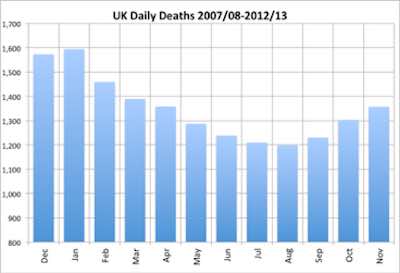
The Guardian examined Excess Winter Mortality after the 2012/13 hard winter. A total of about 50,000 Excess Winter Deaths occurred that winter in the UK:“Each year since 1950, the UK Office for National Statistics has looked at excess winter mortality… Excess winter mortality was 31,100 in England and Wales in 2012/13 – up 29% from the previous year. Figures for Scotland were also released recently showing a much smaller increase in winter deaths, up 4.1% to 19,908. In Northern Ireland meanwhile, the raw numbers were low but the increase was large – a rise of 12.7% to 559 deaths. The methodology behind the maths is surprisingly simple; the ONS take an average of deaths in winter (those in December to March) and subtract the average of non-winter deaths (April to July of the current year and August to November of the previous year). The result is considered 'excess'. “
UNITED STATES
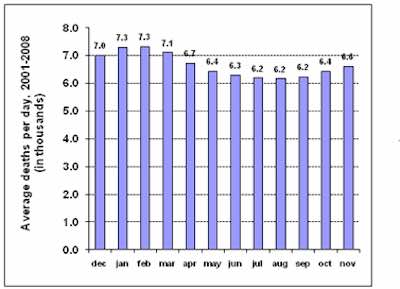
Similarly, the USA death rate in January and February is more than 1000 deaths per day greater than in July and August. Dr. Indur M. Goklany wrote in 2010:“Data from the US National Center for Health Statistics for 2001-2008 shows that on average 7,200 Americans died each day during the months of December, January, February and March, compared to the average 6,400 who died daily during the rest of the year. In 2008, there were 108,500 'excess' deaths during the 122 days in the cold months (December to March). “
MORE RECORD LOWS THAN HIGHS IN USA
Despite claims that extreme heat is increasing and cold is decreasing, the un-adjusted statewide extreme temperature data shows the opposite. A total of 23 of the state all-time record high temperatures occurred in the 1930s and 38 record highs occurred before 1960. There have been more record lows since the 1940s than record highs. In the USA, the 1930’s was the warmest decade.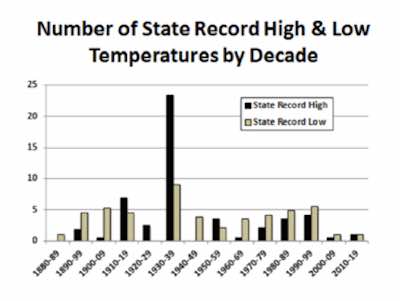
AUSTRALIA
Even in warmer climates such as Australia, Thailand and Brazil a similar pattern exists. Australians are up to 30% more likely to die during winters than summers, as determined in a study by the Queensland University of Technology (QUT).“Across the country severe winters that are colder and drier than normal are a far bigger risk to health than sweltering summers that are hotter than average. QUT Associate Professor Adrian Barnett, a statistician with the Institute of Health and Biomedical Innovation and the lead researcher of the study, said death rates in Australian cities were up to 30 per cent higher in winter than summer. The researchers analyzed temperature, humidity and mortality data from 1988 to 2009 for Adelaide Brisbane, Melbourne, Perth and Sydney.”
CANADA
Statistics Canada also reports deaths by month. The graph below shows that the Canadian death rate in January was more than 100 deaths/day greater than in August for the years 2001 to 2006. In 2006, there were 5,640 excess deaths during the winter months in Canada.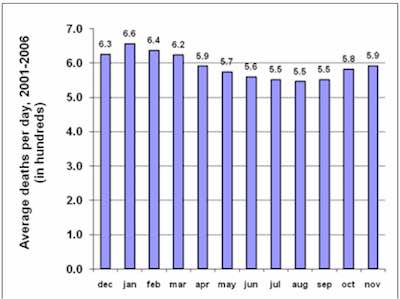
View Comments
Allan MacRae——Bio and Archives
<em>Allan MacRae is an Alberta Professional Engineer with engineering degrees from Queen’s and the University of Alberta. He is an energy expert with a track record of significant accomplishment on six continents. <em>