Philippines’ typhoon tragic, but not our fault
Climate finance should focus on adaptation
Tom Harris , Bio and Archives--November 13, 2013
Global Warming-Energy-Environment | Comments | Reader Friendly | Subscribe | Email Us
In the wake of Typhoon Haiyan, opinion leaders across the world are arguing that we will see more frequent and more severe extreme weather due to man-made global warming. This makes no sense. If increasing greenhouse gas emissions were to cause the world to warm significantly, an unlikely scenario, temperatures at high latitudes are forecast to rise the most, reducing the difference between arctic and tropical temperatures. Since this differential drives weather, we should see less extreme weather in a warmer world, not more.
The lack of extreme weather increase with global warming is one of the few areas of agreement between the United Nations Intergovernmental Panel on Climate Change (IPCC—see ipcc.ch) and the Nongovernmental International Panel on Climate Change. In 2012 the IPCC asserted that a relationship between global warming and wildfires, rainfall, storms, hurricanes, and other extreme weather events has not been demonstrated. In their latest assessment report released on September 27, 2013, IPCC scientists concluded that they had only “Low confidence” that “damaging increases will occur in either drought or tropical cyclone activity” as a result of global warming. The NIPCC report released on September 17, 2013 concluded the same, asserting that “In no case has a convincing relationship been established between warming over the past 100 years and increases in any of these extreme events.” While Typhoon Haiyan was certainly a tragic event, it is important to recognize that the number of tropical cyclones making landfall in the Philippines has not changed significantly over the past century. For the North Atlantic, forecasters predicted that the 2013 hurricane season would be more active than usual. But it has been one of the weakest hurricane seasons since record-keeping began about 50 years ago. No major hurricane made landfall, something that has not happened in 45 years. 2013 also saw the fewest number of North Atlantic hurricanes since 1982.
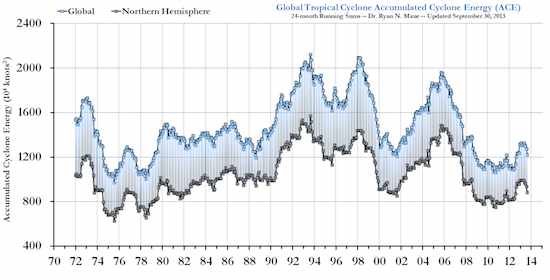
Globally, there has been no increase either. In fact, the worldwide Accumulated Cyclone Energy is now near a thirty year low.
 Regardless, devastating events such as Haiyan will always happen from time to time. So, instead of wasting vast sums of money vainly trying to stop such events from happening, we need to prepare for and adapt to them as best we can. This would include doing such things as burying electrical cables underground and reinforcing buildings and other infrastructure. Had the evacuation shelters in the Philippines been of more study construction, far fewer people would have died. We also need to support reliable energy sources such as coal, oil, natural gas, nuclear and hydro-power, to ensure that we have plenty of energy to heat and cool our dwellings as needed. Weak and intermittent renewable sources such as wind and solar are simply not up to the task at hand.
The real tragedy in all this is that most climate funding is devoted to supposedly preventing climate change that may happen in the future, not to helping people impacted by natural climate variability today in places like the Sahel in Africa and Northern Canada. According to the San Francisco-based Climate Policy Initiative (CPI) report (October 2013), of the approximately $357 billion US (almost $1 billion per day) that was spent on climate finance across the world in 2012, only 6% of it went to helping people in today’s world prepare for and adapt to climate change. CPI’s 2011 report demonstrated that, even within developing countries, only 5% of climate finance went into adaptation, a mistake that cost many lives this week in The Philippines. The rest of the money all went to trying to stop climate change that might happen decades in the future. This is essentially giving more value to the lives of people yet to be born than those suffering today due to the impacts of climate change, however caused.
People from across the political spectrum should speak out about this immoral approach, starting at the UN climate change conference currently underway in Poland. Developing countries must demand that adaptation negotiations be totally separated from the pointless, and usually fruitless, mitigation discussions. This will this greatly simplify adaptation negotiations and increase the likelihood of significant climate adaptation agreements. In contrast to mitigation where China and the United States continue to argue over who should go first and the very foundation of the issue is under dispute among scientists, no one doubts that climate change has dangerous impacts on the world’s poor.
Moving adaptation negotiations to conferences entirely separate from the UN mitigation-focused extravaganzas is crucially needed to give the topic a fresh start. Then, assisting countries in need due to natural climate variability will become an issue of foreign aid, one that should be debated as a humanitarian concern, not an environmental one.
Regardless, devastating events such as Haiyan will always happen from time to time. So, instead of wasting vast sums of money vainly trying to stop such events from happening, we need to prepare for and adapt to them as best we can. This would include doing such things as burying electrical cables underground and reinforcing buildings and other infrastructure. Had the evacuation shelters in the Philippines been of more study construction, far fewer people would have died. We also need to support reliable energy sources such as coal, oil, natural gas, nuclear and hydro-power, to ensure that we have plenty of energy to heat and cool our dwellings as needed. Weak and intermittent renewable sources such as wind and solar are simply not up to the task at hand.
The real tragedy in all this is that most climate funding is devoted to supposedly preventing climate change that may happen in the future, not to helping people impacted by natural climate variability today in places like the Sahel in Africa and Northern Canada. According to the San Francisco-based Climate Policy Initiative (CPI) report (October 2013), of the approximately $357 billion US (almost $1 billion per day) that was spent on climate finance across the world in 2012, only 6% of it went to helping people in today’s world prepare for and adapt to climate change. CPI’s 2011 report demonstrated that, even within developing countries, only 5% of climate finance went into adaptation, a mistake that cost many lives this week in The Philippines. The rest of the money all went to trying to stop climate change that might happen decades in the future. This is essentially giving more value to the lives of people yet to be born than those suffering today due to the impacts of climate change, however caused.
People from across the political spectrum should speak out about this immoral approach, starting at the UN climate change conference currently underway in Poland. Developing countries must demand that adaptation negotiations be totally separated from the pointless, and usually fruitless, mitigation discussions. This will this greatly simplify adaptation negotiations and increase the likelihood of significant climate adaptation agreements. In contrast to mitigation where China and the United States continue to argue over who should go first and the very foundation of the issue is under dispute among scientists, no one doubts that climate change has dangerous impacts on the world’s poor.
Moving adaptation negotiations to conferences entirely separate from the UN mitigation-focused extravaganzas is crucially needed to give the topic a fresh start. Then, assisting countries in need due to natural climate variability will become an issue of foreign aid, one that should be debated as a humanitarian concern, not an environmental one.View Comments
Tom Harris——Bio and Archives
Tom Harris is Executive Director of the Ottawa, Canada-based International Climate Science Coalition at http://www.icsc-climate.com.